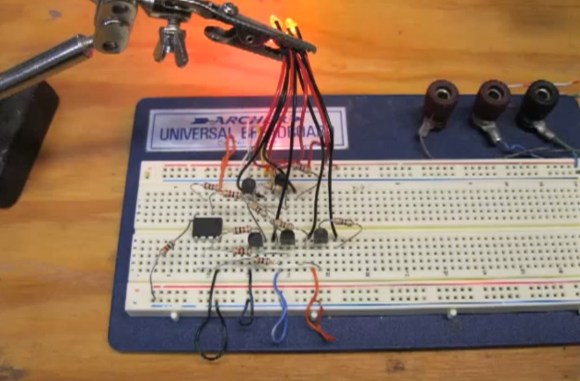
Time-lapse Synthesizer Build Will Blow Your Mind

[themonkeybars] recently uploaded a time-lapse video of his DIY synthesizer build. First off the video itself is a pretty neat hack. An iPhone time-lapse app was used to capture one frame every 5 seconds. By the time the build was complete, approximately 46,000 frames had been snapped. This boiled down to over 43 minutes of youtube footage. [themonkeybars] didn’t work full time on the project, so the video covers about a year’s worth of work which we think makes it even cooler. The synth is also featured in much of the video’s soundtrack.

The synthesizer itself would be classified as an analog modular synth, a type we’ve seen before. Modular synthesizers are one of the earlier forms of electronic music. The synthesizer is composed of discrete modules such as oscillators, modulators, and filters. The modules may be housed in the same box, but they are not internally connected. All connections are made via front panel patch cables. This is where the term “Patch” came from. Continue reading “Time-lapse Synthesizer Build Will Blow Your Mind”

An Oscilloscope On Your Wrist

osc-watch2

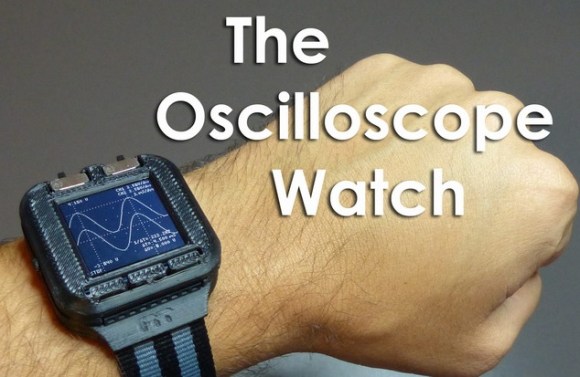
Calculator watches were the Geek cred of the 80’s. Today everyone is getting smart watches. How can the hip Geek stay ahead? [Gabriel Anzziani] to the rescue with his Oscilloscope Watch! [Gabriel] has made a cottage industry with his micro test tools. We’ve featured his Xprotolab and Xminilab on here on Hack a Day more than once. The Oscilloscope Watch basically takes all the features of the Xprotolab and squeezes them down into a wrist watch.

The Oscilloscope Watch includes an oscilloscope, a logic analyzer, an arbitrary waveform generator, and of course it tells time.  The Oscilloscope Watch’s processor is the AVR XMega128.  [Gabriel] has even included a link to the schematics (PDF) on his Kickstarter page. We really like that 3D printed case, and hope [Gabriel] opens up his CAD designs for us to work with.

Like its predecessors, the Oscilloscope watch won’t be replacing your Tektronix scope, or even your Rigol. Much like a Swiss army knife or Leatherman tool, the Oscilloscope Watch packs a bunch of tools into a small package. None of them are as good as a full-sized tool, but in a pinch they will get the job done. If you are wondering where the probes connect. [Gabriel] states on the Kickstarter page that he will design a custom 9 pin .100 connector to BNC adapter to allow the use of standard probes.

The screen is the same series of Sharp Memory LCD’s used in the Pebble watch. [Gabriel] chose to go with the FPC version of the Sharp LCD rather than the zebra connector.  We’ve learned the hard way that those flex circuits snap at the LCD glass after only a few flexes. Hopefully this won’t impact the hackability of the watch.

Turn A Decommissioned Robot Into A CNC Machine

adeptRobot

Some of us may have been accused of living in Mom’s basement – [Benjamin] kicks it up a notch by keeping an industrial robot in his parent’s attic shed loft.
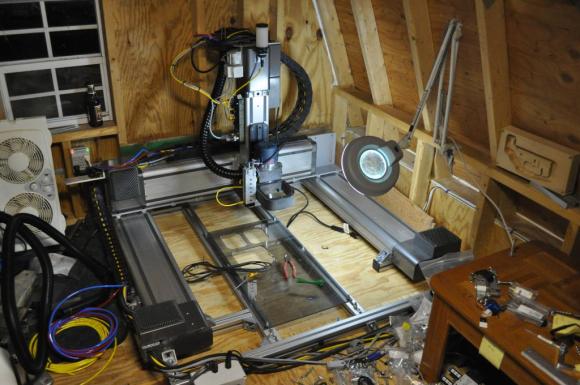
[Benjamin] was tasked with stripping down some retired equipment at work. It turns out the “retired equipment” was three Cartesian robots from Adept Robotics. These are large industrial XYZ platforms capable of high speed movements (3000 IPM rapids!).

Getting from a decommissioned machine to a working CNC is never a simple path. In this case [Ben] was able to make the transition relatively easily. Each axis of the robot has a 400 Watt Yaskawa servo with a 65k encoder and brake. The original Adept servo amps and control system was still working, so he kept it. The controllers were new enough that they communicate over a daisy chained IEEE1394 (Firewire) link. That is relatively modern compared to some of the conversions we’ve seen in the past.  The final piece of the puzzle was G-code creation Translating common G-code to a format his machine could recognize. Ben chose MeshCAM for the task.

One problem [Ben] ran into was stuttering on the X-axis. The original machines only had a single sided drive system on the X-axis. Single side is fine for an assembly machine that doesn’t see any tool load. However for a CNC machine that will see spindle loads, a single side drive creates a twisting force which threatens to rack the entire frame. He used one of the drive systems from his spare robot to convert his main machine to a double-sided drive, eliminating the issue.

Continue reading “Turn A Decommissioned Robot Into A CNC Machine”

Safety Warning: Arduino GSM Shield May Cause Fires

Be careful with those Arduino GSM cards. As [James] reports, they may turn into fire starters. One person has reported a small explosion and fire already on the Arduino forums.
Now before we go any further – You may be asking yourself who the heck [James] is, and what gives him the ability to second guess the Arduino team. Well, here is [James’] blog disclaimer:  “James is a Senior Technical Expert for Technology and Applications at KEMET Electronics, a capacitor manufacturer. The content of this post are his and in no way reflects opinions of his employer.”

Senior Technical Expert?  That’s a good enough reason for us to believe him.

[James] states the problem is a tantalum capacitor used to decouple the GSM radio power supply from the main Arduino supply.
Tantalum capacitors are great for their low ESR properties. However, they have a well known downside of getting very hot, or even exploding when stressed. It’s not the Tantalum Anode that is burning. The Manganese Dioxide used as a cathode in some Tantalum capacitors is the culprit. Continue reading “Safety Warning: Arduino GSM Shield May Cause Fires”

LIB3 Plans To Bring Contract Manufacturing To The Masses

LIB3's paste system
LIB3’s paste system

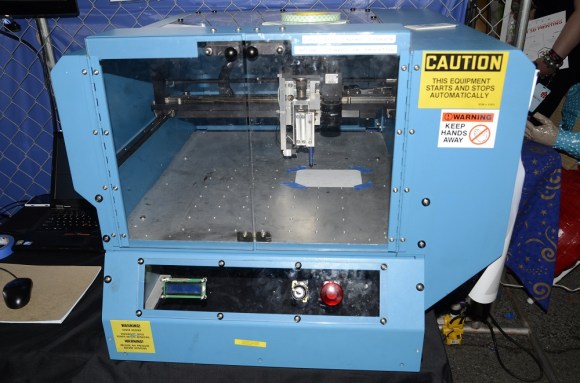
LIB3 is an open source hardware start-up from upstate New York. Thus far, the team has made some interesting products such as the piLED kit. However, they have big dreams for the future. LIB3 plans to become a contract assembly house specifically targeting low volume makers. To do this they have to build their own tools. LIB3’s latest project is a solder paste dispenser for surface mount components. Traditionally solder paste is applied with stencils made of stainless steel. In more recent years laser cut kapton has become a favorite for low volume production.

Both of these systems require a stencil to be made up. LIB3 took a different approach, and modified an old CNC glue dispenser for paste. The team got their hands on an 1991 vintage X/Y glue dispensing system. X/Y systems in this era were big, heavy affairs with powerful motors. LIB3 removed all the control electronics and built their own system from scratch. New features include direct computer control, and a vision system.

Continue reading “LIB3 Plans To Bring Contract Manufacturing To The Masses”

CastAR Comes To Maker Faire NY 2013

castAR-2

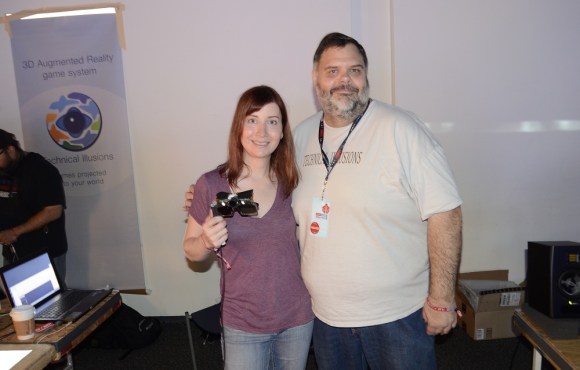
If there was one sentence heard over and over at Maker Faire NY, it was “Did you see castAR yet?” The Technical Illusions team was at Maker Faire in full force. [Jeri Ellsworth], [Rick Johnson,] and team brought two demos:  the tried and true Jenga simulator, and a newer overhead shooter based on the Unity 3D engine. We didn’t see any earth shattering changes from the previous demos of castAR, as [Jeri] has moved into optimization of the Hardware, and [Rick] toward even more immersive demos of the software. Optimization and preparing for market are considered the “hard yards” of any product design. This is the place where a huge amount of work goes in, but the changes are subtle to the layperson.

In addition to her development of castAR’s ASIC, [Jeri] has been hard at work on the optics. The “old” glasses used a solid plastic optical path. The newer glasses use a hollow path for the twin 720p projectors. This makes them even lighter than the previous generation. Weight on the castAR glasses can’t be overstated. They feel incredibly light. There was no perceptible pressure on the nose or ears when wearing them. Also missing was the motion sickness people often experience with VR. This is because castAR doesn’t replace the user’s vision field, it only augments the vision. Peripheral motion cues are still there, which makes for a much more comfortable experience. Continue reading “CastAR Comes To Maker Faire NY 2013”

OneTesla Electrifies Maker Faire NY 2013

onetesla

Throughout the maker pavilion, the siren song of a musical Tesla coil could be heard. Those who followed their ears found themselves at the oneTesla booth. OneTesla is a hobby Tesla coil, with the added twist of polyphonic MIDI input.

Started by three MIT students, oneTesla had a successful Kickstarter campaign last year. Like many kickstarters, they are a bit behind in the shipping department. They are shipping out their third run of kits to backers now. The group had a small number of oneTesla coils for sale at the show, which appeared to have sold out by midday Sunday.

The actual process of generating sound with a Tesla coil is fascinating. All Tesla coils are resonant at high frequency. In oneTesla’s case, this is 220kHz. Human hearing ends around 20kHz, so this is well beyond the range of perception. Since the coil is locked in at this frequency, the power to the coil is modulated at the desired sound frequency. Playing an A note for example, would mean modulating the coil at 440Hz.

Continue reading “OneTesla Electrifies Maker Faire NY 2013”