SEC Allows Crowdfunding

Kickstarter is not an investment, and no matter how many times this is repeated, you’ll find the phrase ‘my investment’ in the comments section of nearly every failed Kickstarter, Indiegogo, or other crowdfunding campaign. These campaigns are more closely related to group buys, and you’ll never find a Kickstarter offering equity or any sort of return beyond the latest electronic bauble, indie game, or graphic novel. Sure, you may bootstrap a business with that pledge, but don’t expect dividends from Ouya or Pebble.

Now, this may finally change. The US Securities and Exchange Commission approved new rules for crowdfunding, allowing startups to raise money from Jane and Joe Internet.

Previously, angel investments, venture capital, and hedge funds were not for the common man; these were high-risk investments, and only accredited investors could participate in these funding rounds. Accredited investors, at least in the US, are individuals with a net worth of at least $1 Million, or an income greater than $200,000 in each of the previous two years. The reason for only allowing accredited investors – depending on your interpretation – is to protect consumers or to maintain a perverse oligarchy by installing a glass ceiling over the middle class. Either way, normal people couldn’t invest in high-risk investments until now.

Congress has seen fit to create a new class of investor, and pursuant to Title III of the JOBS Act, the SEC recently released the complete rules for crowdfunded investment. In a massive, 600-page tome, all the regulations are laid bare, ready for the next serial entrepreneur who seeks at most $1 Million in investment for their next startup.

Investors and Startups

The rules issued by the SEC immediately place some limitations on what can be done under the new regulations. For startups, a maximum of $1 Million can be raised over a 12-month period.

For investors with an annual income or a net worth of less than $100,000, a maximum of $2,000 or 5% of annual income can be invested, whichever is greater. For investors with an annual income or net worth greater than $100,000, 10% of their income or net worth can be invested, whichever is smaller.

Brokers and Funding Portals

Investors and entrepreneurs are not allowed to keep their transactions to themselves; this is the SEC after all. Transactions will go through registered broker-dealers or something called a ‘funding portal’. These funding portals are forbidden from offering advice, making recommendations, advertising, paying employees a commission, holding securities themselves, and the regulation bars directors, officers, and partners of the funding portal from holding investments using that funding portal’s services.

It’s The Complete Opposite of Kickstarter

Kickstarter was never known for its transparency. While the basic premise of crowdfunding the manufacturing of a few baubles or 3D printers is sound – it’s cheaper per unit to build a hundred of something than to build just one – the reality of actually building something meant Kickstarters failed – it’s exponentially harder to build ten thousand of something than it is to build a hundred. Add to this Kickstarter’s investments in campaigns featured on their website, and you have the recipe for practices that aren’t illegal but certainly don’t pass the sniff test.

The regulations put forth by the SEC turn the most common trope of the Internet economy on their head; companies responsible for bringing startups and investors together are not financially dependant on these startups. Companies can not raise more money than they could handle, and hopefully individual investors won’t take to crowdfunded companies like online poker and day trading.

Traditional crowdfunding has started a lot of great companies so far; the Form1 printer began as a crowdfunding campaign, and Reading Rainbow still lives thanks to a successful Kickstarter. With these new regulations come new possibilities for the latest startups, and more paths to success than a traditional angel investor or VC tycoon.


Digging HDMI Out Of UDP Packets

[Danman] was looking for a way to get the HDMI output from a camera to a PC so it could be streamed over the Internet. This is a task usually done with HDMI capture cards, either PCI or even more expensive USB 3.0 HDMI capture boxes. In his searches, [danman] sumbled across an HDMI extender that transmitted HDMI signals over standard Ethernet. Surely there must be a way to capture this data and turn it back.

The extender boxes [danman] found at everyone’s favorite chinese reseller were simple – just an Ethernet port, HDMI jack, and a power connector – and cheap – just $70 USD. After connecting the two boxes to his network and setting up his camera, [danman] listened in to the packets being set with Wireshark. The basic protocol was easy enough to grok, but thanks to the Chinese engineers and an IP header that was the wrong length, [danman] had to listen to the raw socket.

Once everything was figured out, [danman] was able to recover raw frames from the HDMI extenders, recover the audio, and stream everything to his PC with VLC. All the code is available, and if you’re looking for a way to stream HDMI to multiple locations on a network, you won’t find a better solution that’s this cheap.

Cutest Possible Atari Disk Drive

[rossumur]’s first computer was an Atari 400, and after riding a wave of nostalgia and forgetting the horrible keyboard found in the Atari 400, he decided it was time to miniaturize the venerable Atari 810 disk drive by putting an entire library of Atari games on a single microSD card.

SD cards have been slowly but surely replacing disk drives for just about every old computer system out there. You no longer need 400k disks for your old mac, and your Commodore 64 can run directly off an SD card. The Atari 8-bits have been somewhat forgotten in this movement towards modern solid state storage, and although a solution does exist, this implementation is a pretty pricey piece of hardware.

[rossumur]’s hardware for giving the Atari 8-bit computers an SD card slot is just one chip – an LPC1114 ARM Cortex M0. This, along with an SD card slot, 3.3V regulator, a LED and some caps allows the Atari to talk to SD card and hold the entire 8-bit Atari library on a piece of plastic the size of a fingernail.

Designing a circuit board doesn’t have the street cred it once did, and to give his project a little more pizzazz he chose to emulate the look of the very popular miniaturized Commodore 1541 disk drive with a tiny replica of the Atari 810 disk drive. This enclosure was printed at Shapeways, and with some enamel hobby paint, [rossumur] had a tiny, tiny 810 drive.

While this build does require the sacrifice of a somewhat rare and certainly old Atari SIO cable, it is by far the best solution yet seen for bringing a massive game library to the oft-forgotten Atari 8-bit home computers.

Thanks [lucas] for the tip.

Building Memristors For Neural Nets

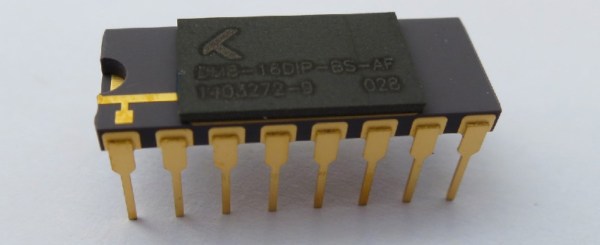
Most electronic components available today are just improved versions of what was available a few years ago. Microcontrollers get faster, memories get larger, and sensors get smaller,  but we haven’t seen a truly novel component for years or even decades. There is no electronic component more interesting with more novel applications than the memristor, and now they’re available commercially from Knowm, a company that is on the bleeding edge of putting machine learning directly onto silicon.

The entire point of digital circuits is to store information as a series of ones and zeros. Memristors as well store information, but do so in a completely analog way. Each memristor changes its own resistance in response to the current going through it; ‘writing’ a positive voltage lowers the resistance, and ‘writing’ a negative voltage puts the device back into a high resistance state.

Cross section of the metal chalcogenide memristor. Source: Knowm.org

This new memristor is based on research done by [Dr. Kris Campbell] of Boise State University – the same researcher responsible for silver chalcogenide memristors we saw earlier this year. Like these earlier devices, the Knowm memristror is built using silver chalcogenide molecules. To lower the resistance of the memristor, a positive voltage ‘pulls’ silver ions into the metal chalcogenide layer. The silver ions stay in this chalcogenide layer until they are ‘pushed’ back with the application of a negative voltage. This gives the memristor it’s core functionality – being able to remember how much current has gone through it.

This technology is different from the first memristors made by HP in 2008, and has allowed Knowm to create functional memristors on silicon with a relatively high yield. Knowm is currently selling a ‘tier 3’ memristor part that only has two out of eight devices failing QC testing. A ‘tier 1’ part, with all eight memristors working, is available for $220 USD.

As for applications for this memristor, Knowm is using this technology in something they call Thermodynamic RAM, or kT-RAM. This is a small coprocessor that allows for faster machine learning than would be possible with a computer with a much more traditional architecture. This kT-RAM uses a binary tree layout with memristors serving as the links between nodes.

While it’s much too soon to say if a kT-RAM processor will be better or more efficient at performing machine learning tasks in real life, a machine learning coprocessor does have a faint echo of the machine learning silicon developed during the 80s AI renaissance. Thirty years ago, neural nets on a chip were created by a few companies around Boston, until someone realized these neural nets could be simulated on a desktop PC much more efficiently. The kT-RAM is somewhat novel and highly parallel, though, and with a new electronic component it could be just what is needed to push machine learning directly into silicon.

Continue reading “Building Memristors For Neural Nets”

Applications For The Bitcoin Blockchain

Bitcoin, the libertarian’s dream currency, is far past the heady days of late 2013. When one Bitcoin was worth $1000 USD, there was no end to what could be done; new, gigantic mining rigs were being created, every online store jumped onto the bandwagon, and the price of Bitcoin inevitably crashed. Right now, the exchange rate sits at about $280 USD per coin, valuing all the Bitcoins ever mined somewhere around $4 Billion USD. That’s a lot of coins out there, and a lot of miners constantly verifying the integrity of the greatest thing to come from the Bitcoin community: the blockchain.

The bitcoin is just a record, or the ledger, of every transaction that has ever occurred on the Bitcoin network. It’s distributed, and the act of mining coins creates new blocks, or another set of data committed to the blockchain for eternity. While magical Internet money™ is by far the most visible product of the blockchain, developers, investors, and other people in the know are gushing about the possibilities of what can be done with a distributed record that can’t practically be altered and can’t be deleted.

[Jon Matonis], a figurehead for the entire cryptocurrency movement, recently said Bitcoin has become the strongest computer in the world, and stronger than all of the top 500 supercomputers combined. All of this computational power is effectively funneled in to verifying the integrity of the blockchain.

Bitcoin and other cryptocurrencies are not just a completely anonymous payment system; that’s only a side effect of the blockchain. The blockchain is the only inherently valuable part of a bitcoin; each transaction is logged in the blockchain, providing incredible security over how every coin is spent. No currency in the history of mankind has ever had a record of how every dollar or denarius is spent, and at the very least makes for very interesting economics research. Now, thousands of researchers across the globe are wondering what else the blockchain can do; tapping the power of the most powerful computer on the planet must have some interesting applications, and in the last few months, a few ideas have popped up.

Continue reading “Applications For The Bitcoin Blockchain”

You’re Never Too Young To Be A Rocket Scientist

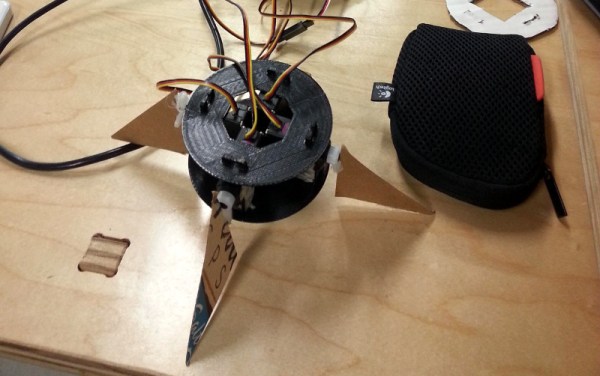
We’ve been keeping tabs on the progress SpaceX has made toward landing a rocket so that it can be reused for future orbital launches. As you would imagine, this is incredibly difficult despite having some of the world’s greatest minds working on the task. To become one of those minds you have to start somewhere. It turns out, high school students can also build guided rockets, as [ArsenioDev] demonstrates in his project on hackaday.io.

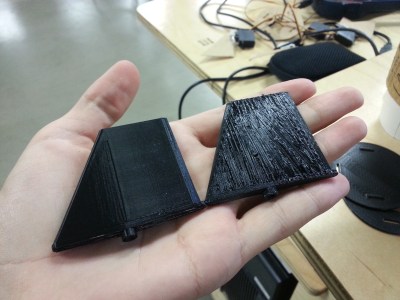
arseniodev-3d-printed-fin[Arsenio]’s design targets amateur rockets with a fuselage diameter of four inches or so. The main control module is just a cylinder with four servos mounted along the perimeter and some fancy 3D printed fins bolted onto the servo. These are controlled by an Arduino and a 6DOF IMU that’s able to keep the rocket pointing straight up. Staaaay on target.
We saw this project back at the Hackaday DC meetup a month ago, and [Arsenio] was kind enough to give a short lightning talk to the hundred or so people who turned up. You can catch a video of that below, along with one of the videos of his build.

Continue reading “You’re Never Too Young To Be A Rocket Scientist”

Better, Smaller WiFi Throwies

Because the world doesn’t have enough electronic junk floating around, [Victor] has improved the WiFi Throwie.

A decade ago, when strong, cheap magnets, bright LEDs, and small coin cell batteries were materials fresh to hacking, someone had a great idea: tape all these items up and throw them on bridges and overpasses. The LED throwie was born, and while we’re sure the biggest installation of LED throwies looked cool, it’s really just a small-scale environmental disaster.

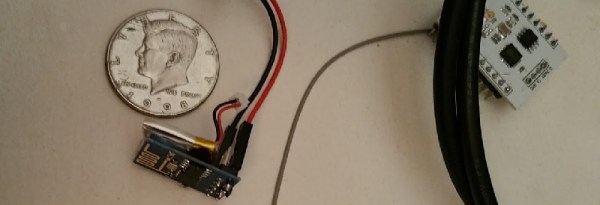
Since then, the ESP8266 was created, and the world now has a tiny WiFi-enabled computer that’s the size of a postage stamp. Yes, WiFi throwies already exist, but coin cells don’t work with the ESP. This means the compact and tiny ESPs are laden down with heavy lithium cells. [Victor] had a better solution: tiny lithium batteries for quadcopters exist, so why not use those?

[Victor] ended up using a small 100mAh 3.7V Lipo battery from a tiny quadcopter for this build. 100mAh isn’t a lot, but in sleep mode, the ESP only uses about 15mAh, or about 6 hours of run time. Sending a picture takes 30 seconds at 120ma, or about 120mAh, so even with a tiny battery no bigger than the ESP itself, this diminutive web server can handle 100 connections before the battery dies.

While not recommended unless you intend to retrieve your throwable web server, it is an interesting example of the latest and cheapest technology that made a throwable webserver possible; 10 years ago, both the ESP and a battery this small would have been unthinkable.