Here’s some good news for all the fools who thought 3D TV was going to be the next big thing back in 2013. Researchers at MIT have developed a system that converts 2D video into 3D. The resulting 2D video can be played on an Oculus Rift, a Google Cardboard, or even that 3D TV sitting in the living room.
Right now, the system only works on 2D broadcasts of football, but this is merely a product of how the researchers solved this problem. The problem was first approached by looking at screencaps of the game FIFA 13. Using an analysis tool called PIX, the researchers both stored the display data and extracted the corresponding 3D map of the pitch, players, ball, and stadium. To generate 3D video of a 2D football broadcast, the system then looks at every frame of the 2D broadcast and searches for a 3D dataset that corresponds to the action on the field. This depth information is then added to the video feed, producing a 3D broadcast using only traditional 2D cameras.
Grab your red and blue filter shades and check out the product of their research below.
[Samuel] is working on one of the most important electronics projects of our generation. He’s building a device for the Game Boy that will allow Pokemon trades between generation II and III. Yes, This means bringing your Charmander from Pokemon Red to your team in Pokemon Ruby, Sapphire, or Emerald. and finally completing the National Dex you’ve been working on for 20 years. Before he gets to designing this system, he first needs to listen in on the Game Boy Link Cable, and that means creating a breakout board.
The Game Boy Link Cable – sometimes inaccurately referred to as the Zelda cable – is a special proprietary connector. The design is well documented, but unlike the Wii Nunchuck controller, there’s no readily available breakout board available for this piece of obsolete technology.
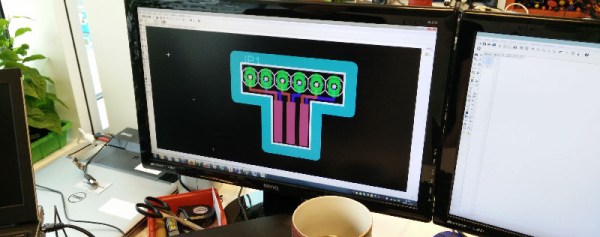
Together with a his friend [David], [Samuel] loaded up a copy of Eagle and designed a board that will fit on a small piece of copper clad FR4. This design was then sent over to a small CNC mill, The traces were machined away, and a sextet of pins were soldered into the holes.
With a breakout board for the Game Boy Link Cable, [Samuel] now has a great platform for peering into the strange and magical world of Pokemon. He’ll be using a Teensy microcontroller for his trading device, and with several similar projects already completed by others around the Internet, the potential for a Gen II to Gen III Pokemon trader is palpable.
Kickstarter, Indiegogo, and every other crowdfunding site out there frequently have projects that should never be products. The latest promises to protect you from security breaches and identity theft by blowing up your computer. It’s the USB Killer, and for only $99 USD, you too can destroy the USB port in your computer and everything else attached to it.
The USB Killer is a device that plugs into the USB port on any computer, charges up several caps, and dumps all that voltage back into the computer. The process repeats until something breaks. We’ve seen it used on a poor Thinkpad X60, and from the video evidence it does exactly what it’s designed to do: kill a computer.
The Indiegogo campaign for the USB killer comes with a web page for the campaign that goes over the function of the device in much more detail. Inside the USB killer is a DC/DC converter that charges a few capacitors to -110V. When the caps are charged, that voltage is dumped back into the USB port where something will happen. Somewhat surprisingly, the folks behind the USB Killer have a video of a computer not dying when the USB Killer is plugged in. Only killing the USB port in a computer is not a guaranteed functionality, as the Indiegogo campaign has the following disclaimer: “Please be aware: USB Killer may cause damage to the motherboard, depending on your computer. By making a pre-order you acknowledge that you are aware of this fact.”
While the gold standard for colorful blinky projects are individually controllable RGB LEDs, the usual offerings aren’t really that impressive. Yes, a few hundred Neopixels, WS2812, or other RGB LEDs will sear your retinas, but what if you wanted blinky glowy stuff that is so over the top as to be an affront to whatever creator you believe in?
This is it. [Ytai Ben-Tsvi] created an individually addressable RGB LED called the Pixie that is perfect for all the times when you need something bright, colorful, and want to blind a few people in the process.
WS2812s and Neopixels are basically RGB LEDs with a small microcontroller tucked tucked away inside, and so far there is no design house or fab plant in China that is crazy enough to add one of these tiny dies to an already overpowered LED. To build the Pixie, [Ytai] took a bare RGB LED module and added a microcontroller – a PIC12FF157X in this case. It’s not exactly a powerful microcontroller, but it can handle the shift register-like function of an individually addressable RGB, and adds gamma correction, over heating protection (something necessary when you’re dumping this much power into a tiny board, and other safeguards for each individual LED.
[Ytai] is working with Adafruit to produce these Pixies, and although they’re rather expensive at $15 per LED, you won’t need very many to blind yourself.
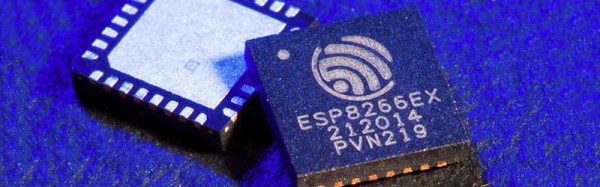
A little more than a year ago, a new product was released onto the vast, vast marketplace of cheap electronics. It was the ESP8266, and this tiny and cheap WiFi module has since taken over the space of hobbyist electronics and become the de facto standard for connecting tiny microcontrollers to the Internet.
Now there’s an upgrade on the horizon. [John Lee], the public face of Espressif, the makers of the ESP8266, has announced the next product they’re working on. It’s called the ESP32, and if the specs given are correct, it looks to be the next great thing for the Internet of Things.
The ESP32 will now contain two Tensilica processors running at 160MHz, compared to the ‘8266’s one processor running at 80 MHz. The amount of RAM has been increased to 400 kB, Bluetooth LE has been added, WiFi is faster, and there are even more peripherals tucked away in this tiny piece of silicon.
Right now, Espressif is beta testing the ESP32, with about 200 boards manufactured so far. If you’re one of the few lucky people who have one of these boards on your workbench, we’d love to see your take on it.
From time to time, we at Hackaday like to publish a few engineering war stories – the tales of bravery and intrigue in getting a product to market, getting a product cancelled, and why one technology won out over another. Today’s war story is from the most brutal and savage conflicts of our time, the console wars.
The thing most people don’t realize about the console wars is that it was never really about the consoles at all. While the war was divided along the Genesis / Mega Drive and the Super Nintendo fronts, the battles were between games. Mortal Kombat was a bloody battle, but in the end, Sega won that one. The 3D graphics campaign was hard, and the Starfox offensive would be compared to the Desert Fox’s success at the Kasserine Pass. In either case, only Sega’s 32X and the British 7th Armoured Division entering Tunis would bring hostilities to an end.
In any event, these pitched battles are consigned to be interpreted and reinterpreted by historians evermore. I can only offer my war story of the console wars, and that means a deconstruction of the hardware.
In just a few short days, Fallout 4 will be released and a substantial portion of the Hackaday staff will be taking the day off. As you would expect, a lot of people with 3D printers, soldering irons, and far too much time on their hands are getting pumped for the Fallout release. Here’s a few Fallout builds we’ve found over the past few weeks:
Pip-Boys
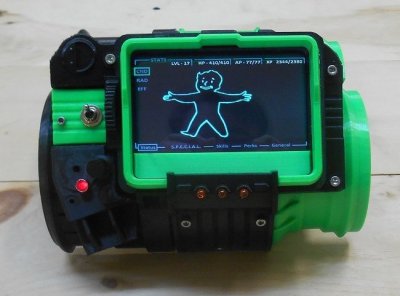
The most iconic thing you’ll find in a Fallout game is the Pip-Boy, the UI for the player and a neat wrist-mounted computer (that somehow has a CRT in it, I guess) for the player’s character. Hackaday’s own [Will Sweatman] built his own Pip-Boy 3000 that’s completely functional. The build uses a 4.3 inch touch display, a 10 position rotary switch, and a bunch of 3D printed parts.
Elsewhere on Hackaday.io, [Karl] is working on a functional Pip-Boy controller for Fallout, and [cody] built one with a Raspberry Pi. Of course, if you’re super special and have two thousand dollars to blow, Bethesda released a limited-edition Pip-Boy edition of Fallout 4 that’s compatible with most cell phones.
The Not Pip-Boys
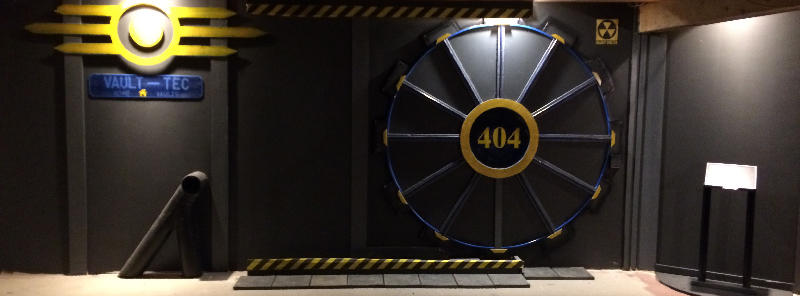
There’s more to Fallout than just wrist-mounted computers, and for the true aficionados, there are gigantic gear-shaped doors. [TreyHill] has a partially finished basement with a gaming room tucked behind his very own vault door. The door itself is built out of plywood and rolls along a gear rack mounted to the floor. Will it hold up to a nuclear blast? Probably not. Is it up to code? It looks cool, at least.
Fallout 4 will be available for the PS4, Xbox One, and PC, leaving out a large contingent of retro gamers. Fear not, lovers of the 6502: there’s’ a version for the Apple II:
This tribute to both the Apple II and Fallout was made with the Outlaw Editor, an SDK for pseudo-3D game development on exceedingly old hardware. There’s actual ray casting happening in this tribute, and it works just the same as Wolfenstein 3D or the like.






 The most iconic thing you’ll find in a Fallout game is the Pip-Boy, the UI for the player and a neat wrist-mounted computer (that somehow has a CRT in it, I guess) for the player’s character. Hackaday’s own [Will Sweatman]