Improving The Parallax Propeller In An FPGA

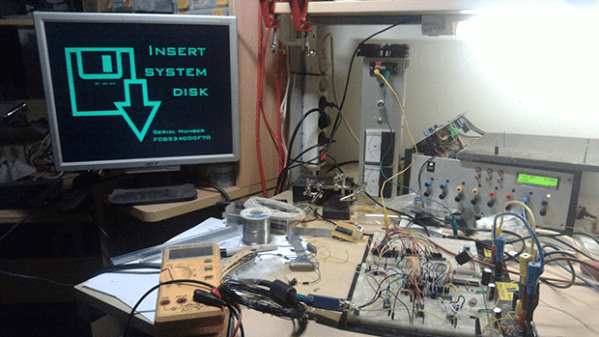
The Parallax Propeller is an interesting chip that doesn’t get a lot of love, but since the entire chip was released as open source, that might be about to change: people are putting this chip inside FPGA and modifying the binaries to give the chip functions that never existed in the original.

Last August, Parallax released the source for the P8X32A, giving anyone with an FPGA board the ability to try out the Prop for their own designs. Since then, a few people have put some time in, cleaning up the files, unscrambling ROM images, fixing bugs, and all the general maintenance that an open source microcontroller core requires.

[Sylwester] has grabbed some of the experimental changes found on the Parallax forum and included them as a branch of the Propeller source. There is support for a second 32-bit port, giving the new chip 64 I/O pins, multiply instructions, video generators, hard-coded SD card libraries, and a variant called a microProp that has four cores instead of eight.

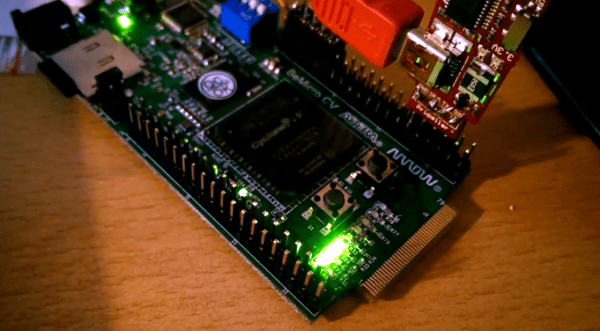
You can grab all the updated sources right here and load them up on a DE0 Nano FPGA board. If you’re exceptionally lucky and have the Altera DE2-115 dev board, you’ll also be able to run the upcoming Propeller 2.

Piezo Vacuum Pump For Lightweight Pick And Place

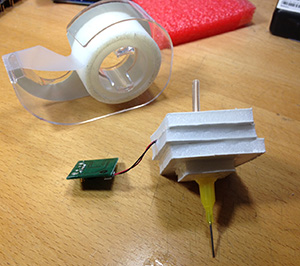
If you’re building a pick and place machine, or even just a vacuum pen, you’ll need some way to pick up tiny part. This means something that sucks, aquarium tubing, and everything that goes with that. A few months ago, [Wayne] found an interesting device called a Micro Blower that will blow small amounts of air from a small, lightweight device. A few modifications later, and he had a piezoelectric vacuum pump for picking up tiny parts.

The Micro Blower [Wayne] found is available on Mouser for about $45, but this device blows. To turn it into something that sucks, he would need to find a way to block up the input side of the pump so it could draw a vacuum. Eventually settling on mounting the blower inside a stack of foam board, [Wanye] glued on a 20 gauge needle and was able to suck up 0603 SMD parts.

The new piezoelectric sucker is extremely light, and the power draw is very reasonable: 18V and 20mA. This would be a great device to mount to a certain pick and place machine without having to run vacuum lines through the mechanics of a motion platform. Video below.

Continue reading “Piezo Vacuum Pump For Lightweight Pick And Place”

Reverse Engineering A Blu-ray Drive For Laser Graffiti

There’s a whole lot of interesting mechanics, optics, and electronics inside a Blu-ray drive, and [scanlime] a.k.a. [Micah Scott] thinks those bits can be reused for some interesting project. [Micah] is reverse engineering one of these drives, with the goal of turning it into a source of cheap, open source holograms and laser installations – something these devices were never meant to do. This means reverse engineering the 3 CPUs inside an external Blu-ray drive, making sense of the firmware, and making this drive do whatever [Micah] wants.

When the idea of reverse engineering a Blu-ray drive struck [Micah], she hopped on Amazon and found the most popular drive out there. It turns out, this is an excellent drive to reverse engineer – there are multiple firmware updates for this drive, an excellent source for the raw data that would be required to reverse engineer it.

[Micah]’s first effort to reverse engineer the drive seems a little bit odd; she turned the firmware image into a black and white graphic. Figuring out exactly what’s happening in the firmware with that is a fool’s errand, but by looking at the pure black and pure white parts of the graphic, [Micah] was able guess where the bootloader was, and how the firmware image is segmented. In other parts of the code, [Micah] saw thing vertical lines she recognized as ARM code. In another section, thin horizontal black bands revealed code for an 8051. These lines are only a product of how each architecture accesses code, and really only something [Micah] recognizes from doing this a few times before.

The current state of the project is a backdoor that is able to upload new firmware to the drive. It’s in no way a complete project; only the memory for the ARM processor is running new code, and [Micah] still has no idea what’s going on inside some of the other chips. Still, it’s a start, and the beginning of an open source firmware for a Blu-ray drive.

While [Micah] want’s to use these Blu-ray drives for laser graffiti, there are a number of other slightly more useful reasons for the build. With a DVD drive, you can hold a red blood cell in suspension, or use the laser inside to make graphene. Video below.

Continue reading “Reverse Engineering A Blu-ray Drive For Laser Graffiti”

A Graphics Card For A Homebrew Computer

One of [aepharta]’s ‘before I die’ projects is a homebrew computer. Not just any computer, mind you, but a fabulous Z80 machine, complete with video out. HDMI and DisplayPort would require far too much of this tiny, 80s-era computer, and it’s getting hard to buy a composite monitor. This meant it was time to build a VGA video card from some parts salvaged from old equipment.

When it comes to ancient computers, VGA has fairly demanding requirements; the slowest standard pixel clock is 25.175 MHz, an order of magnitude faster than the CPU clock in early 80s computers. Memory is also an issue, with a 640×480, 4-color image requiring 153600 bytes, or about a quarter of the 640k ‘that should be enough for anybody.’

To cut down on the memory requirements and make everything a nice round in base-2 numbers, [aepharta] decided on a resolution of 512×384. This means about 100k of memory would be required when using 16 colors, and only about 24 kB for monochrome.

The circuit was built from some old programmable logic ICs pulled from a Cisco router. The circuit could have been built from discrete logic chips, but this was much, much simpler. Wiring everything up, [aepharta] got the timing right and was eventually able to put an image on a screen.

After a few minutes, though, the image started wobbling. [aepharta] put his finger on one of the GALs and noticed it was exceptionally hot. A heatsink stopped the wobbling for a few minutes, and a fan stopped it completely. Yes, it’s a 1980s-era graphics card that requires a fan. The card draws about 3W, or about two percent of a modern, high-end graphics card.

Espruino Pico, Javascript On A USB Stick

There are probably very few official numbers for this, but web developers at least seem to outnumber the amount of people who regularly poke pins and registers with C. For them, the embedded world must be a scary and foreboding domain, full of bitwise operations and dynamic types. [Gordon] figured there was another way and built a Javascript interpreter for a microcontroller. The latest board built around this interpreter is up on Kickstarter, and its even smaller and more capable than his earlier version.

This isn’t [Gordon]’s first rodeo; last year he launched the (full-sized) Espruino, featuring an ARM Cortex M3 and his very own Javascript interpreter. The large-scale Espruino was a rousing success, and now he’s moving on to a smaller thumb drive-sized footprint for the Pico. The hardware is a bit better, relying on the ARM Cortex M4 STM32F4 with a bit more RAM, and this time the board is slightly cheaper. It still runs the same Javascript interpreter, though, so all the code is exactly what you’d expect.

We haven’t seen many projects using this tiny Javascript of Things, but the new layout does make it fantastically useful. Depending on how the crowd funding campaign turns out, [Gordon] might be adding socket, and USB HID support, along with inline C functions.

The Hackaday Prize: Interview With A ChipWhisperer

chipwhisperer

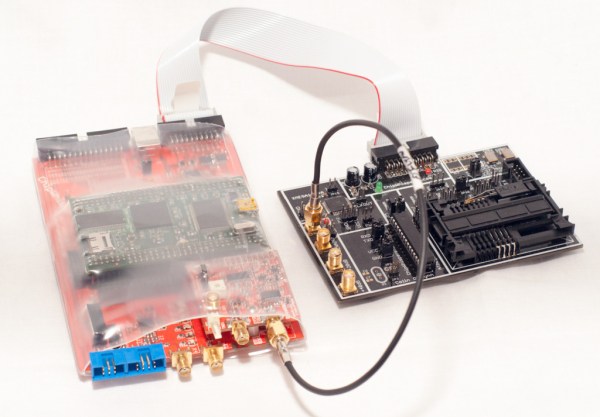
Every finalist for The Hackaday Prize has some aspect of it that hasn’t been done before; finding the chemical composition of everything with some 3D printed parts is novel, as is building a global network of satellite ground stations with off the shelf components. [Colin]’s ChipWhisperer, though, has some scary and interesting implications. By looking inside a microcontroller as its running, the ChipWhisperer is able to verify – or break – security on these chips. It’s also extremely interesting and somewhat magical being able to figure out what data a chip is processing simply by looking at its power consumption.

We have no idea who the winner of The Hackaday Prize is yet, and I’m hoping to remain ignorant of that fact until the party two weeks from now. Until then, you can read the short interview with [Colin O’Flynn], or check out his five-minute video for the ChipWhisperer below:

Continue reading “The Hackaday Prize: Interview With A ChipWhisperer”

Nikes With Power Laces, Just In Time For Next Year

With the world’s first hoverboard being shown a few days ago, we’re on the verge of the fabulous world of tomorrow from Back to the Future. Hoverboards are cool, but there’s a wealth of other cool technology from the far-off year of 2015: Mr. Fusions, inflatable pizza, Dustbusters, and of course, Nikes with power laces. [Hunter] just built them, and with the right shoes, to boot.

[Hunter] is using the BttF-inspired Nike Air Mag shoes for this build, along with a few bits of electronics – an Arduino pro mini, a force sensing resistor, and a motor. The build began by carving out a notch in the back of the shoe for the electronics. A small bit of fishing line goes around the shoe, providing the power behind the power laces.

A force sensitive resistor under the heel of the insole tells the microcontroller when a foot is inside the shoe, and a rotary encoder on the motor shaft makes sure all the power lace cycles are the same. It’s not quite the same as the shoe seen on screen – the lower laces can’t be replicated and it’s certainly not as fast as the BttF shoes, but it does work, and as far as shoelaces are concerned, they work well.

Videos below.

Continue reading “Nikes With Power Laces, Just In Time For Next Year”