A Proof Of Concept Flash Cart For The WonderSwan

Unless you’ve been to Japan or are fairly deep into the retro game collecting, you’ve probably never heard of the WonderSwan. It’s a handheld console, released after the Game Boy Color was beginning to show its age, and a bit before the introduction of the Game Boy Advance. It sold rather well in the only country it was released in, the game library is somewhat impressive, and there are quite a few homebrew games. Actually running these homebrew games is a challenge, though: each WonderSwan has a memory controller that maps the game ROM into the CPU’s memory. Without knowing how this controller chip works, the only way to run a homebrew cartridge is to turn on the machine with a real cart, go to the system menu, and swap the carts out. It turns out there’s a better solution, that includes programming CPLDs and looking at the output of a logic analyzer.

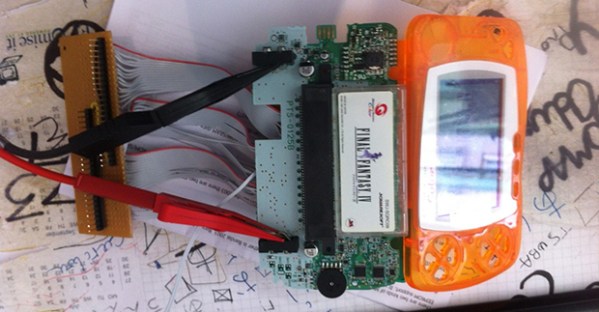
The first step towards [Godzil]’s efforts to create a Flash cart for the WonderSwan is to figure out the pinout of the cartridge connector – something that isn’t well documented for a system without a homebrew hardware scene. This was done in the usual way; with a lot of ribbon cable and patience This only provided an incomplete picture of how the WonderSwan interfaced with its carts, but after digging up an official development board, [Godzil] was able to make sense of all the signals.

After building a breakout board for the cartridge port, [Godzil] connected a DE0 Nano FPGA board and looked at all the signals. With just a little bit of VHDL, the memory controller could be reverse engineered and reimplemented. [Godzil] has his proof of concept working – video below – and the next part of his project will be to turn this into a proper Flash cart.

Continue reading “A Proof Of Concept Flash Cart For The WonderSwan”
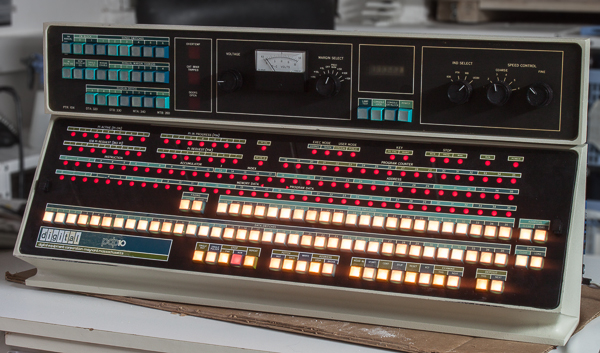
Restoring A PDP-10 Console Panel

The PDP-10 was one of the first computers [Jörg] had gotten his hands on, and there are very, very few people that can deny the beauty of a panel full of buttons, LEDs, dials, and analog meters. When one of the front panels for a PDP-10 showed up on eBay, [Jörg] couldn’t resist; a purchase that would lead him towards repairing this classic console and making it functional again with a BeagleBone.

The console [Jörg] picked up is old enough to have voted for more than one Bush administration, and over the years a lot of grime has covered the beautiful acrylic panels. After washing the panel in a bathtub, [Jörg] found the dried panel actually looked worse, like an old, damaged oil painting. This was fixed by carefully scraping off the clear coat over two weeks; an important lesson in preserving these old machines. They’re literally falling apart, even the ones in museums.

With the front panel cleaned, [Jörg] turned his attention to the guts of this panel. The panel was wired up for LEDs, and each of the tiny flashlight bulbs in the pushbuttons were replaced. The panel was then connected to a BlinkenBone with a ton of wiring, and the SIMH simulator installed. That turns this console into a complete, working PDP-10, without sucking down kilowatts of power and heating up the room

This isn’t the first time we’ve seen [Jörg] with a BeagleBone and some old DEC equipment; earlier he connected the front panel of a PDP-11 variant to one of these adapters running the same software.

Who Will Win The Hackaday Prize? Judging Begins Tonight

It’s been a long road for each of the five finalists; but after tonight they can breathe easy. The last judging round of the 2014 Hackaday Prize begins at 11:50pm PDT.

Each finalist must finish documenting their project by that time as a cached version of each of the project pages will be sent off to our orbital judges. Joining the panel that judged the semifinal round is [Chris Anderson], CEO of 3D Robotics, founder of DIY Drones, former Editor-in-Chief of Wired, and technology visionary. These nine are charged with deciding who has built a project cool enough to go to space.

In case you’ve forgotten, the final five projects selected by our team of launch judges are:

  • ChipWhisperer, an embedded hardware security research device for hardware penetration testing.
  • Open Source Science Tricorder, a realization of science fiction technology made possible by today’s electronics hardware advances.
  • PortableSDR, is a compact Software Defined Radio module that was originally designed for Ham Radio operators.
  • ramanPi, a 3D printed Raman Spectrometer built around a Raspberry Pi.
  • SatNOGS, a global network of satellite ground stations.

The ultimate results of the judging will be revealed at The Hackaday Prize party we’re holding in Munich during Electronica 2014. We’re also holding an Embedded Hardware Workshop with Moog synths, robots, hacked routers, computer vision, and a name that’s official-sounding enough to convince your boss to give you the day off work. We hope to see you there!

The Solution To The 10th Anniversary Code

A few weeks ago, [1o57], a.k.a. [Ryan Clarke] gave a talk about puzzles, DEFCON, and turning crypto puzzles into an art form at our 10th anniversary party. Ever the trickster, [1o57] included a crypto challenge in his talk, and a few days after our little shindig, nobody had yet solved the puzzle. Finally, someone bothered to sit down and figure it out. We don’t know what [tahnok] won, but as [1o57] said, solving it is its own reward.

Some of the slides in the presentation had a few characters sitting off to the side for no apparent reason. [tahnok] put these together and came up with:

DOXIYLDCYVDKIKNKUMKRYDNBYGONYMNXOC

In cases like this, you might try a Caesar cipher, or just shifting characters to the left or right a certain number of places. Since [1o57] noted this was the tenth anniversary of Hackaday, [tahnok] tried that first:

TENYOBTSOLTAYADAKCAHOTDROWEDOCDNES

It doesn’t look like much, but that’s only because the string is backwards. Tricky, tricky. tricky. With instructions to send a codeword to an email address, [tahnok] now needed to find a code word. There was one picture [1o57] put up on twitter that was still an unsolved part of the puzzle:

men

With no idea what these little stickmen are, he scoured google with variants of ‘stickmen code’ and ‘semaphore’ until he hit upon the Sherlock Holmes story, The Adventure of the Dancing Men. It’s a simple substitution cypher, translated to, “codeword psychobilly ciphers”

And that’s the entire puzzle. As far as we know, this took about a month to solve, and compared to the DEFCON challenges, was fairly simple. [1o57] will probably chime in down in the comments to tell everyone how many people have picked up on the clues and sent an email.

Hackaday Links Column Banner

Hackaday Links: BSAPEDWLOVKTUB.YBKAB

Here’s something that’s just a design study, but [Ivan]’s Apple IIe phone is a work of art. You’re not fitting a CRT in there, but someone out there has a 3D printer, an old LCD, and a GSM module. Make it happen. See also: the Frog Design Apple phone.

A few days ago we posted something on an old ‘286 machine that was able to load up the Hackaday retro site. For a few people, this was the first they’ve heard about our CSS and Javascript-less edition designed specifically for old computers. They dragged out some hardware, and [WTH] pulled up the site on a Dell Axim.It’s actually somewhat impressive that these machines have SD cards…

[Arduino Enigma] created a touchscreen Enigma machine. Why haven’t we seen an Arduino Colossus yet?

The crew at Adafruit now have a Flying Toaster OLED, which means we now have flying toaster bitmaps for all your OLED/graphic display projects.

[Ian] had an old rackmount programmable voltage standard. This was the remote programmable voltage standard, without front panel controls. No problem, just get an Arduino, shift register, and a few buttons. Video right here.

A few months ago, [Jan] released a neat device that stuffs a modelling synth inside a MIDI plug. He’s selling them now, and we’d love to see a few videos of this.

An SDK For The ESP8266 WiFi Chip

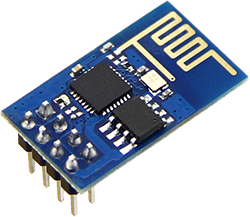
The ESP8266 is a chip that turned a lot of heads recently, stuffing a WiFi radio, TCP/IP stack, and all the required bits to get a microcontroller on the Internet into a tiny, $5 module. It’s an interesting chip, not only because it’s a UART to WiFi module, allowing nearly anything to get on the Internet for $5, but because there’s a user-programmable microcontroller in this board. If only we had an SDK or a few libraries…

The ESP8266 SDK is finally here. A complete SDK for the ESP8266 was just posted to the Expressif forums, along with a VirtualBox image with Ubuntu that includes GCC for the LX106 core used in this module.

Included in the SDK are sources for an SSL, JSON, and lwIP library, making this a solution for pretty much everything you would need to do with an Internet of Things thing. As far as LX106 core is concerned, there’s example code for using the spare pins on this board as GPIOs, I2C and SPI busses, and a UART.

This turns the ESP8266 into something much better than a UART to WiFi module; now you can create a Internet of Things thing with just $5 in hardware. We’d love to see some examples, so put those up on hackaday.io and send them in to the tip line.

FlowPaw, The Bear Paw Of Electronics Education

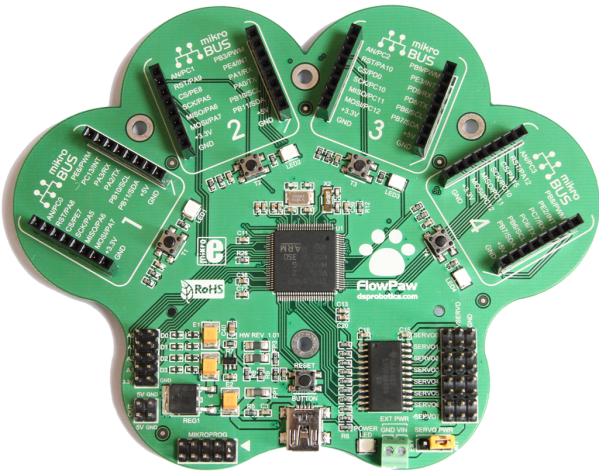
If the astonishing success of littleBits is any indication, there’s a huge market for ‘intro to electronics’ products that are much more capable than the classic Radio Shack ‘springs and components stuck to cardboard’ kits or even the very successful littleBits. FlowPaw is the latest entry in this space, combining the sensor module paradigm of littleBits with a largish microcontroller, digital and analog pins, and a great programming interface.

The big innovation in the FlowPaw is the FlowStone programming language. It’s a graphical programming language that allows young creators to connect blocks, modules, and functions together with virtual wires, but also allows the editing of different modules with Ruby. Best of both worlds, there.

The FlowPaw kickstarter includes rewards for just the FlowStone software, or the FlowPaw electronics board with a bunch of modules. Already, the team has LED, relay, accelerometer, buzzer, and capacitive touch sensors, along with a Bluetooth and speech recognition module. They’re working on a few more advanced modules for GPS, pressure, DC motor control, and RFID as well.