Anonabox: How To Fail Horribly At Kickstarter

Late last week, Anonabox hit Kickstarter, glomming on to concerns over security, privacy, and censorship. The project was picked up on the usual tech blogs, lauding this project as the pinnacle of the Open Source, Open Hardware movement and a great investment for the privacy-minded technocrat in a post-Snowden world.

Then, the creator of Anonabox did an AMA on reddit. It was quickly discovered that the entire project was an off the shelf router found on AliExpress with reflashed firmware. The router sells for $20 in quantity one, and the Anonabox Kickstarter is giving them away with a minimum $51 pledge. The new firmware is basically a standard OpenWrt installation with a few changes to the config files. The project claims to solve the problem of hardware backdoors, but ships with a backdoor root password (the password is ‘developer!’), open WiFi, and ssh open by default. The Anonabox also claims to be a plug and play solution to security and privacy on the Internet, meaning if this project ever ships, there will be a lot of people who won’t change the default configuration. That’s rather hilarious in its implications.

According to the Kickstarter campaign, the Anonabox has gone through four years of development and four generations of hardware. [August] even has a great graphic demonstrating that each successive generation has reduced the size in half and doubled the system resources:

Unscaled
Image taken from Kickstarter campaign

Anyone with the slightest eye for detail will quickly realize that components, like Ethernet jacks, SD cards, and CF cards are always the same size. I wonder what this graphic would look like if all the boards were scaled so they were in proportion to each other?

Rescaled
Image rescaled so all boards are proportional to each other

Oh. That’s not fishy at all.

As with most Kickstarters that have seen this much negative attention, the project was suspended just a few hours ago, but not before gathering more than $600,000 in pledges at its peak.

suspended

Although the Anonabox failed, there is a market for a Tor-enabled router, and luckily we have one on hackaday.io. It’s so great that some of the copy for the Kickstarter campaign was lifted directly from this project. With a wealth of market research available, we can only hope that [CaptainStouf] runs his own campaign for the UnJailPi.


The Joys Of Shipping From China

A few months ago, news of a new PCB fab service headed up by [Ian] over at Dangerous Prototypes leaked onto the Internet. It’s extremely cheap – $14 USD for a 5cm square board with free worldwide shipping. [Ian] admits the boards aren’t the greatest quality, that’s not the point; the site’s motto is simply, ‘No bull, just crappy PCBs.’

What began as an internal website to handle all of DP’s PCB orders was now on the Internet, and orders were flying in. At first, shipping a few dozen PCBs around the globe every week was easy, but since Dirty PCBs hit the big time, customers rightfully or not, started freaking out because of the oddities of Chinese shipping and logistics companies.

[Ian] is using Espeed Post for all their shipping, and if you’ve ever ordered anything from China off of Ebay, it’s possible you’ve had something shipped through Espeed before. Because of the oddities of shipping, and the fact that Shenzhen and Hong Kong are right next to each other, even the people at Dangerous Prototypes don’t know which countries your PCBs will go through on the trip from the fab house to your front door. This has caused much consternation with DirtyPCB customers that don’t seem to realize they’re getting custom PCBs for under two dollars a board, shipped to them across the world in a week for free. Some people’s children, huh?

Things get significantly, ahem, dirtier, when Chinese holidays are taken into account. China has a lot of them, and they’re long. They’re just wrapping up the National Day holiday, 10 days in the first week of October. Everyone is backlogged, and the China/Hong Kong border is the mess of trucks seen above.

If a holiday isn’t bad enough, the new President of China is cracking down on corruption. 500 officials were fired at the largest land border with Hong Kong, due in no small part to vans full of meth and tons of counterfeit currency. Every package leaving China is inspected individually, and shipping times have exploded.

To deal with this, Dangerous Prototypes has posted a big red warning on the dirtypcb site, but experience in dealing with people on the Internet tells them this won’t be a viable solution. They’re now dealing directly with DHL, and are apparently getting priority clearance through customs. It’s not fun, as DP will now have to figure out how to work with DHL’s API. It’s a lot of work and a lot of trouble, but DP still has a few tricks up their sleeve – they’re working on an online schematic entry and PCB layout site and the extremely interesting DirtyCables – custom cables shipped to your door.

Reverse Engineering Altium Files

Several times in the last few weeks, I’ve heard people say, ‘this will be the last PCB I design in Eagle.’ That’s bad news for CadSoft, but if there’s one thing Eagle has done right, its their switch to an XML file format. Now anyone can write their own design tools for Eagle without mucking about with binary files.

Not all EDA softwares are created equally, and a lot of vendors use binary file formats as a way to keep their market share. Altium is one of the worst offenders, but by diving into the binary files it’s possible to reverse engineer these proprietary file formats into something nearly human-readable.

[dstanko.au]’s first step towards using an Altium file with his own tools was opening it up with a hex editor. Yeah, this is as raw as it can possibly get, but simply by scrolling through the file, he was able to find some interesting bits hanging around the file. It turns out, Altium uses something called a Compound Document File, similar to what Office uses for Word and PowerPoint files, to store all the information. Looking through the lens of this file format, [dstanko.au] found all the content was held in a stream called ‘FileHeader’, everything was an array of strings (yeah, everything is in text), and lines of text are separated by ‘|’ in name=value pairs.

With a little bit of code, [dstanko] managed to dump all these text records into a pseudo plain text format, then convert everything into JSON. You can check out all the code here.

Hackaday Links Column Banner

Hackaday Links: October 12, 2014

Remember in the late 90s and early 2000s when everything had blue LEDs in them? Blinding blue LEDs that lit up a dark room like a Christmas tree? Nobel prize. There’s a good /r/askscience thread on why this is so important. The TL;DR is that it’s tough to put a p-type layer on gallium nitride.

Have a Segway and you’re a member of the 501st? Here’s your Halloween costume. It’s a model of the Aratech 74-Z speeder bike, most famously seen careening into the side of trees on the forest moon of Endor.

[Andrew] needed something to do and machined an iPhone 5 out of a block of aluminum. Here’s the video of icon labels being engraved. The machine is a Denford Triac with a six station auto tool changer. He’s running Mach3, and according to him everything – including the correct tooling – cost far too much money.

Another [Andrew] was working the LEGO booth at Maker Faire New York and has finally gotten his LEGO Mindstorms Minecraft Creeper build written up. Yes, it’s probably smarter than your average Minecraft Creeper, and this one also blows up. He also had a physical version of the classic video game from 1979, Lunar Lander. Both are extremely awesome builds, and a great way to attract kids of all ages to a booth.

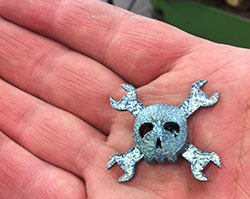
titanium[Wilfred] was testing a titanium 3D printer at work and was looking for something to print. The skull ‘n wrenches was a suitable candidate, and the results are fantastic. From [Wilfred]: “Just out of the printer the logo looks amazing because it isn’t oxidized yet (inside the printer is an Argon atmosphere) Then the logo moves to an oven to anneal the stress made by the laser. But then it gets brown and ugly. After sandblasting we get a lovely bluish color as you can see in the last picture.”



The folks at Lulzbot/Aleph Objects are experimenting with their yet-to-be-released printer, codenamed ‘Begonia’. They’re 2D printing, strangely enough, and for only using a standard Bic pen, the results look great.

Everyone is going crazy over the ESP8266 UART to WiFi module. There’s another module that came up on Seeed recently, the EMW3162. It’s an ARM Cortex M3 with plenty of Flash, has 802.11 b/g/n, and it’s $8.50 USD. Out of stock, of course.

Toaster Oven Reflow Controllers

With a lot of people who are suddenly too cool for through hole and of course the a few generations of components that are only available in SMD packages, it’s no surprise the humble toaster oven has become one of the mainstays of electronic prototyping. You’re gonna need a controller to ramp up those temperatures, so here are two that do the job quite nicely.

[Nathan]’s Zallus Oven Controller is a bit different than other reflow controllers we’ve seen on Kickstarter. He’s offering three versions, two with different sized touch screen displays, and one that is controlled with a PC and push buttons. The display for these is beautiful, and of course you can program your own temperature profiles.

If Kickstarter isn’t your thing, [Dirk] created his own reflow controller. Like the Zallus, this has a graphical display, but its homebrew lineage means it should be simpler to maintain. It uses a K-type thermocouple, and unlike every other reflow controller we’ve ever seen, [Dirk] is actually checking the accuracy of his temperature probe.

No, reflow oven controllers aren’t new, and they aren’t very exciting. They are, however, tools to build much cooler stuff, and a great addition to any lab.

Hackaday 10th Anniversary: Wrap-up

A little more than a month ago we saw the 10 year anniversary of the first Hackaday post ever, and last week we had a little get together in Pasadena to celebrate the occasion. Everyone had a great time, building tiny line-following robots and LiPo chargers, listening to some great talks, and in the evening we all had a lot of fun emptying some kegs. We couldn’t ask for a better crowd, and we thank everyone who came (and those of you who watched everything on the livestream) for participating.
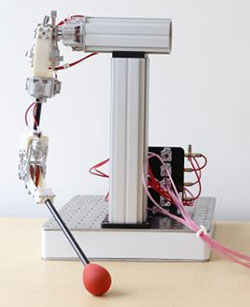
As far as specific people go, we need to thank [charliex], [arko] and everyone else from Null Space Labs for helping out with the weird rotary encoder two-player version of Duck Hunt. The folks from Crashspace were also there, helping out and lending a steady hand and hot soldering iron during the workshops. Shoutouts also go to [datagram] and [jon king] for running the lockpicking workshop, and [Todd Black] deserves a mention for his lithium battery charger workshop. All the speakers deserve to be mentioned again, and you can check out a playlist of their talks below:

Continue reading “Hackaday 10th Anniversary: Wrap-up”

Ask Hackaday: Who Is Going To Build This Pneumatic Transmission Thing?

fluid_transmission

Disney research is doing what they do best, building really cool stuff for Disney and telling the rest of the world how cool they are. This time, it’s a very low friction fluid transmission device designed for animatronics.

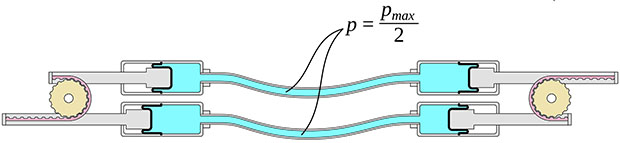
From testing a few toy robotic arms, we can say without a doubt that servos and motors are not the way to go if you’re designing robots and animatronics that need lifelike motion. To fix this, a few researchers at Disney Pittsburgh have turned to pneumatics and hydraulics, where one joint is controlled by two sets of pistons. It’s extremely similar to the pneumatic LEGO, but more precise and much more lifelike.

The system uses a pair of cylinders on each joint of a robot. Disney is using a rolling diaphragm to seal the working fluid in its tubes and cylinders. This is an extremely low-friction device without any shakiness or jitters found with simple o-ring pneumatics and hydraulics.

The system is backdriveable, meaning one robotic arm can control another, and the other way around. Since we’re dealing with hydraulics, the cylinders (and robotic/animatronic devices) don’t need to be the same size; a small device could easily control a larger copy of itself, and vice versa.

The devices are fairly simple, with gears, toothed belts, and bits of plastic between them. The only unique part of these robots is the rolling diaphragm, and we have no idea where to source this. It looks like it would be great for some robotics or an Iron Man-esque mech suit, but being able to source the components will be a challenge.

You can check out the videos of these devices below, and if you have any idea on how to build your own, leave a note in the comments.

Continue reading “Ask Hackaday: Who Is Going To Build This Pneumatic Transmission Thing?”