6502 Puts On An SDR Hat

The legendary 6502 microprocessor recently turned 50 years old, and to celebrate this venerable chip which brought affordable computing and video gaming to the masses [AndersBNielsen] decided to put one to work doing something well outside its comfort zone. Called the PhaseLoom, this project uses a few other components to bring the world of software-defined radio (SDR) to this antique platform.

The PhaseLoom is built around an Si5351 clock generator chip, which is configurable over I2C. This chip is what creates the phase-locked loop (PLL) for the radio. The rest of the components, including antenna connectors and various filters, are in an Arduino-compatible form factor that let it work as a shield or hat for the 65uino platform, an Arduino-form-factor 6502 board. The current version [Anders] has been working on is dialed in to the 40-meter ham band, with some buttons on the PCB that allow the user to tune around within that band. He reports that it’s a little bit rough around the edges and somewhat noisy, but the fact that the 6502 is working as an SDR at all is impressive on its own.

For those looking to build their own, all of the schematics and code are available on the project’s GitHub page. [Anders] has some future improvements in the pipe for this project as well, noting that with slightly better filters and improved software even more SDR goodness can be squeezed out of this microprocessor. If you’re looking to experiment with SDR using something a little bit more modern, though, this 10-band multi-mode SDR based on the Teensy microcontroller gets a lot done without breaking the bank.


Multi-Use Roof Eliminates Roof

One of the biggest downsides of installing solar panels on a rooftop is that maintenance of the actual roof structure becomes much more difficult with solar panels in the way. But for many people who don’t have huge tracts of land, a roof is wasted space where something useful could otherwise go. [Mihai] had the idea of simply eliminating traditional roofing materials altogether and made half of this roof out of solar panels directly, with the other half being put to use as a garden.

Normally solar panels are installed on top of a roof, whether it’s metal or asphalt shingles or some other material, allowing the roof to perform its normal job of keeping weather out of the house while the solar panels can focus on energy generation. In this roof [Mihai] skips this step, having the solar panels pull double duty as roof material and energy generation. In a way this simplifies things; there’s less to maintain and presumably any problems with the roof can be solved by swapping out panels. But we would also presume that waterproofing it might be marginally more difficult.

On the antisolar side of the roof, however, [Mihai] foregoes the solar panels in favor of a system that can hold soil for small garden plants. Putting solar panels on this side of the roof wouldn’t generate as much energy but the area can still be useful as a garden. Of course we’d advise caution when working on a garden at height, but at least for the solar panels you can save some trips up a ladder for maintenance by using something like this robotic solar panel scrubber.

Continue reading “Multi-Use Roof Eliminates Roof”

FPGA Brings UNIX V1 To The DEC J-11

If you’ve never used a PDP-11 before it’s probably because you simply weren’t around in the 70s and 80s. Although they started as expensive machines only in research labs and industry, they eventually became much more accessible. They’re a bit of a landmark in computing history, too, being largely responsible for the development of things like UNIX and the C programming language. [ryomuk] is using an FPGA in combination with an original DEC J-11 to bring us a new take on this machine. (Google Translate from Japanese)

The FPGA used in this build is a Tang Nano 20k, notable for its relatively low cost. The FPGA emulates the memory system and UART of a PDP-11 system down to the instruction set, while the original, unmodified DEC chip is left to its own devices. After some initial testing [ryomuk] built a PC11 paper tape emulator to ensure the system was working which runs a version of BASIC from the era. The next thing up was to emulate some disk drives and co-processors so that the machine can run the first version of UNIX. 

[ryomuk] also developed a PCB for the DEC microprocessor and the FPGA to sit on together, and it includes all of the jumpers and wiring needed to allow the computer to run UNIX, as well as handling other miscellaneous tasks like power. It’s an interesting build that gets to the heart of the early days of computer science. PDP-11 computers did eventually get smaller and more accessible, and if you want to build a modern version this build fits a complete system into an ATX case.

Thanks to [RetepV] for the tip!

NFC Hidden In Floppy Disk For Retro-Themed PC

As we all look across a sea of lifeless, nearly identically-styled consumer goods, a few of us have become nostalgic for a time when products like stereo equipment, phones, appliances, homes, cars, and furniture didn’t all look indistinguishable. Computers suffered a similar fate, with nearly everything designed to be flat and minimalist with very little character. To be sure there are plenty of retro computing projects to recapture nostalgia, but to get useful modern hardware in a fun retro-themed case check out this desktop build from [Mar] that hides a few unique extras.

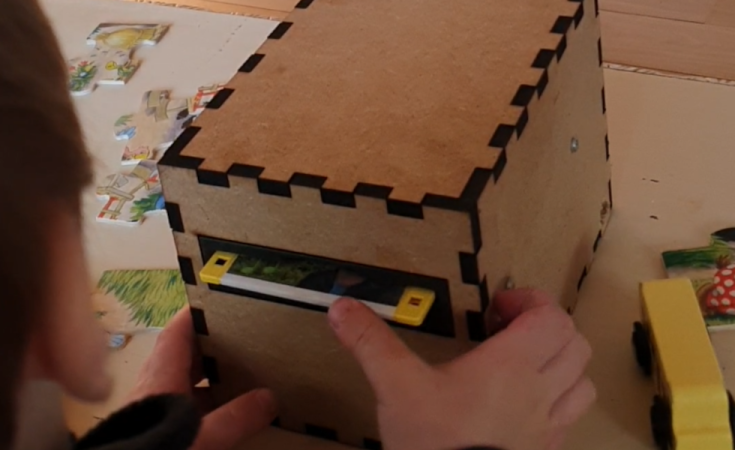
The PC itself is a modern build with an up-to-date operating system, but hidden in a 386-era case with early-90s styling. The real gem of this build though is the floppy disk drive, which looks unaltered on the surface. But its core functionality has been removed and in its place an Arduino sits, looking for NFC devices. The floppy disks similarly had NFC tags installed so that when they interact with the Arduino, it can send a command to the computer to launch a corresponding game. To the user it looks as though the game loads from a floppy disk, much like it would have in the 90s albeit with much more speed and much less noise.

Modern industrial design is something that we’ve generally bemoaned as of late, and it’s great to see some of us rebelling by building unique machines like this, not to mention repurposing hardware like floppy drives for fun new uses (which [Mar] has also open-sourced on a GitHub page). It’s not the first build to toss modern hardware in a cool PC case from days of yore, either. This Hot Wheels desktop is one of our favorites.

Receiving Radio Signals From Space Like It’s 1994

For certain situations, older hardware is preferred or even needed to accomplish a task. This is common in industrial applications where old machinery might not be supported by modern hardware or software. Even in these situations though, we have the benefit of modern technology and the Internet to get these systems up and running again. [Old Computers Sucked] is not only building a mid-90s system to receive NOAA satellite imagery, he’s doing it only with tools and equipment available to someone from this era.

Of course the first step here is to set up a computer and the relevant software that an amateur radio operator would have had access to in 1994. [Old Computers Sucked] already had the computer, so he turned to JV-FAX for software. This tool can decode the APT encoding used by some NOAA satellites without immediately filling his 2 MB hard drive, so with that out of the way he starts on building the radio.

In the 90s, wire wrapping was common for prototyping so he builds a hardware digitizer interface using this method, which will be used to help the computer interface with the radio. [Old Computers Sucked] is rolling his own hardware here as well, based on a Motorola MC3362 VHF FM chip and a phase-locked loop (PLL), although this time on a PCB since RF doesn’t behave nicely with wire wrap. The PCB design is also done with software from the 90s, in this case Protel which is known today as Altium Designer.

In the end, [Old Computers Sucked] was able to receive portions of imagery from weather satellites still using the analog FM signals from days of yore, but there are a few problems with his build that are keeping him from seeing perfectly clear imagery. He’s not exactly sure what’s wrong but he suspects its with the hardware digitizer as it was behaving erratically earlier in the build. We admire his dedication to the time period, though, down to almost every detail of the build. It reminds us of [saveitforparts]’s effort to get an 80s satellite internet experience a little while back.

Continue reading “Receiving Radio Signals From Space Like It’s 1994”

Acoustic Coupling Like It’s 1985

Before the days of mobile broadband, and before broadband itself even, there was a time where Internet access was provided by phone lines. To get onto a BBS or chat on ICQ required dialing a phone number and accoustically coupling a computer to the phone system. The digital data transmitted as audio didn’t have a lot of bandwidth by today’s standards but it was revolutionary for the time. [Nino] is taking us back to that era by using a serial modem at his house and a device that can communicate to it through any phone, including a public pay phone.

As someone in the present time can imagine, a huge challenge of this project wasn’t technical. Simply finding a working public phone in an era of smartphones was a major hurdle, and at one point involved accidentally upsetting local drug dealers. Eventually [Nino] finds a working pay phone that takes more than one type of coin and isn’t in a loud place where he can duct tape the receiver to his home brew modem and connect back to his computer in his house over the phone line like it’s 1994 again.

Of course with an analog connection like this on old, public hardware there were bound to be a few other issues as well. There were some quirks with the modems including them not hanging up properly and not processing commands quickly enough. [Nino] surmises that something like this hasn’t been done in 20 years, and while this might be true for pay phones we have seen other projects that use VoIP systems at desk phones to accomplish a similar task.

Continue reading “Acoustic Coupling Like It’s 1985”

A New Screen Upgrade For The GBA

The Game Boy Advance (GBA) was released in 2001 to breathe some new life into the handheld market, and it did it with remarkable success. Unfortunately, the original models had a glaring problem: their unlit LCD screens could be very difficult to see. For that reason, console modders who work on these systems tend to improve the screen first like this project which brings a few other upgrades as well.

The fully open-source modification is called the Open AGB Display and brings an IPS display to the classic console. The new screen has 480×480 resolution which is slightly larger than the original resolution but handles upscaling with no noticeable artifacts and even supports adding some back in like scanlines and pixelation to keep the early 00s aesthetic. The build does require permanently modifying the case though, but for the original GBA we don’t see much downside. [Tobi] also goes through a ton of detail on how the mod works as well, for those who want to take a deep dive into the background theory.

There has been a lot of activity in the Game Boy Advance communities lately though as the hardware and software become more understood. If you don’t want to modify original hardware, want an upgraded experience, but still want to use the original game cartridges we might recommend something like the Game Bub instead.