Slippy Slapper Uselessly Uses All The Arduinos

Want to take that annoyingly productive coworker down a notch? Yeah, us too. How dare they get so much done and be so happy about it? How is it possible that they can bang on that keyboard all day when you struggle to string together an email?

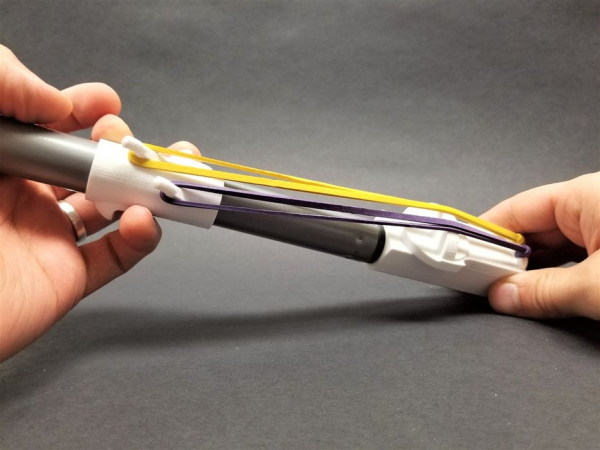
The Slippy Slapper is a useless machine that turns people into useless machines using tactics like endless distraction and mild physical violence. It presses your buttons by asking them to press buttons for no reason other than killing their productivity. When they try to walk away, guess what? That’s another slappin’. Slippy Slapper would enrage us by proxy if he weren’t so dang cute.

You’re right, you don’t need an Arduino for this. For peak inefficiency and power consumption, you actually need four of them. One acts as the master, and bases its commands to the other three on the feedback it gets from Slippy’s ultrasonic nostrils. The other three control the slappin’ servos, the speakers, and reading WAV files off of the SD card. Slap your way past the break to see Slippy Slapper’s slapstick demo.

Need to annoy a group of coworkers all at once? Slip a big bank of useless machines into the conference room while it’s being set up.

Continue reading “Slippy Slapper Uselessly Uses All The Arduinos”

One Anti-Static Ring To Delight Them All

What’s the worst thing about winter? If you’re as indoorsy as we are, then static electricity is probably pretty high on the list. It can ruin your chips, true, but you always wear a wrist ground strap when you handle those, right? But away from the bench, every doorknob and light switch is lying in wait, ready to shock you. If you had an anti-static ring like [LaPuge], you could be watching a tiny neon bulb light up instead of the air between your poor finger and the discharge point.

The ring itself is printed in TPU 95A filament for comfort and flexibility. There isn’t a whole lot to the circuit, just a neon bulb, a 1MΩ resistor, and some copper tape, but this piece of functional jewelry has the potential to spark up plenty of charged conversations. Zap your way past the break to see it light up against a door handle.

If you want to light up neon bulbs all year long, build a field of them and wave them near your Tesla coil!

Continue reading “One Anti-Static Ring To Delight Them All”

Custom Tibia Keyboard For A Leg Up In The Game

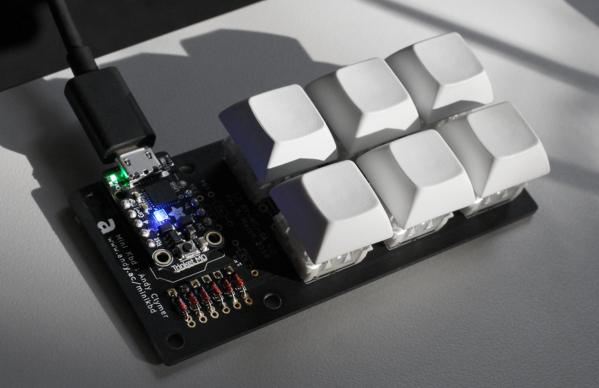
[Elite Worm] wrote in to tell us about a cool little keyboard designed to make playing a certain game a whole lot easier. One of the ways you can move your character is with the numpad in directional mode plus Control and Shift, but those are too far apart to drive blindly with one hand. This is all the motivation [Elite Worm] needed to build a custom keyboard with only the essentials.

The keyboard is controlled by an Arduino Pro Micro, which is fairly standard for this type of build — it’s usually that or a Teensy. [Elite Worm] used Cherry MX browns for a nice tactile feel, and added LEDs for a purple-white under-glow. We love the way the printed keycaps turned out, and are impressed because tolerances are notoriously tight for those fruity switch stems.

Starting to think of a few uses for a small custom keypad? This thing is wide open, and [Elite Worm] will even send you the PCB files if you ask nicely. See if you can get past the break without your mouse, and check out the build video while you wait.

Want more flexibility? Just use more switches! Continue reading “Custom Tibia Keyboard For A Leg Up In The Game”

Smart Speakers “Accidentally” Listen Up To 19 Times A Day

In the spring of 2018, a couple in Portland, OR reported to a local news station that their Amazon Echo had recorded a conversation without their knowledge, and then sent that recording to someone in their contacts list. As it turned out, the commands Alexa followed came were issued by television dialogue. The whole thing took a sitcom-sized string of coincidences to happen, but it happened. Good thing the conversation was only about hardwood floors.

But of course these smart speakers are listening all the time, at least locally. How else are they going to know that someone uttered one of their wake words, or something close enough? It would sure help a lot if we could change the wake word to something like ‘rutabaga’ or ‘supercalifragilistic’, but they probably have ASICs that are made to listen for a few specific words. On the Echo for example, your only choices are “Alexa”, “Amazon”, “Echo”, or “Computer”.

So how often are smart speakers listening when they shouldn’t? A team of researchers at Boston’s Northeastern University are conducting an ongoing study to determine just how bad the problem really is. They’ve set up an experiment to generate unexpected activation triggers and study them inside and out.

Continue reading “Smart Speakers “Accidentally” Listen Up To 19 Times A Day”

IoT Cassette Scroller Never Needs A Pencil

The see-through electronics craze of the ’80s and ’90s clearly had an effect on [MisterM], and we can totally relate. Those candy-colored components inside undoubtedly launched a few thousand kids in the direction of electronics, as we can attest.

Though the odds seemed very much against him, [MisterM] was able to fit all the necessary components for a scrolling IoT notifier inside a standard cassette tape. It took a bit of surgery on both the Raspberry Pi Zero W and the donor cassette in the name of getting all the components to fit in such a tight space. We’re glad he kept at it, because it looks amazing.

The Raspi uses Adafruit.IO and IFTTT to get all kinds of notifications — tweets, weather, soil moisture, you name it — and scrolls them across an 11×7 LED matrix. A vibrating disc motor gives a buzzing heads up first, so [MisterM] doesn’t miss anything. Hit the break button and flip this thing over, because the build video is all queued up on the B-side.

If you’d rather play around with cassette decks, add in some playback speed potentiometers to mess with the sound, or go all out and make a Mellotron.

Continue reading “IoT Cassette Scroller Never Needs A Pencil”

Tiny Duck Hunt Looks Like Big Fun

Unless you’ve held on to an old tube TV, did the hack that lets you use a light gun with an LCD via Wiimote receiver and a couple of microcontrollers, or live close to one of those adult arcades, you might be really jonesing to play Duck Hunt by now. It’s time to renew that hunting license, because [Danko] has recreated the game for NodeMCU boards, and it’s open season.

Instead of ducks, you get to shoot cute little Twitter-esque birds of varying sizes and point values, and a tiny cab-over truck if you wish. There’s a 60-second free-for-all, and then time is up and your score is displayed. As a special bonus, there’s no smug dog to laugh at you if don’t hit anything. Be sure to check out the demo and build video after the break.

This pocket console lives on a nicely-wired breadboard for now while [Danko] works on a custom PCB. He’s also planning to add support for Arduboy games in the future, and maybe a joystick instead of a D-pad of buttons.

There are a lot of myths floating around about how the old CRTs read the NES light gun, but our own [Will Sweatman] shot them down in his fascinating Duck Hunt: Reloaded write-up.

Continue reading “Tiny Duck Hunt Looks Like Big Fun”

Robot Fights Fire With IR

Fighting fire with robots may take jobs away from humans, but it can also save lives. [Mell Bell Electronics] has built a (supervised) kid-friendly version of a firefighting robot that extinguishes flames by chasing them down and blowing them out.

This hyper-vigilant robot is always on the lookout for fire, and doesn’t waste movement on anything else. As soon as it detects the presence of a flame, it centers itself on the source and speeds over to snuff it out with a fan made from a propeller and a DC motor.

Here comes the science: fire emits infrared light, and hobbyist flame sensors use IR to, well, detect fire. This fire bot has three of these flame sensors across the front that output digital data to what has got to be the world’s smallest Arduino – the ATmega32U4-based PICO board that [Mell Bell] just so happens to sell. Cover your mouth and nose and crawl along the floor toward the break to see how responsive this thing is.

Firefighters aren’t the only brave humans involved in the process of keeping the forests standing, or who feel the rising pressure of automation. Hackaday’s own [Tom Nardi] wrote a piece on a dying breed called fire lookouts that will no doubt ignite your interest.

Continue reading “Robot Fights Fire With IR”