Do You Smell What The Magic Chef Is Cookin’?

Automata are already pretty cool, but the ones that can fool us are something extraordinary. The legendary [Greg Zumwalt] has recently turned his toy-making attentions toward illusory automata, and we think he’s off to a great start with his admirable appetizer, the Magic Chef.

The Chef aims to please, and as long as he has the power to do so, he’ll keep offering dishes from his six-item menu of hamburger, hot dog, pizza slice, BLT, sunny-side-up egg, and banded gelatinous chunk we can’t quite identify. Amazingly, this one-man restaurant does everything with a single 6VDC gear motor, some magnets, and 58 printed parts including gears, cams, and levers. The way the food carousel moves on a sort of magnetic slip ring system is the icing on the cake.

If you want to whip up a Magic Chef of your own, all the STL files are available for take-out from the Instructables page. Hungry for more details? go wash up and get situated after the break, ’cause we’re serving up a demo video with some close-up views of the inner workings. Oh, and here’s some automata-brewed coffee for dessert.

Continue reading “Do You Smell What The Magic Chef Is Cookin’?”

Seven-Segment Shelves Do Double Duty

[Lewis] of [DIY Machines] was always on the lookout for that perfect something to hang above the couch. After spending a lot of time fruitlessly searching, he designed and built this awesome shelving unit with recessed lighting that doubles as a huge 7-segment clock.

The clock part works as you probably expect — an Elegoo Nano fetches the time from a real-time clock module and displays it on the WS2812B LED strips arranged in 7-segment formations. There’s a photocell module to detect the ambient light level in the room, so the display is never brighter than it needs to be.

Don’t have a 3D printer yet? Then you may need to pass on this one. Aside from the wood back plane and the electronics, the rest of this build is done with printed plastic, starting with 31 carefully-designed supports for the shelves. There are also the LED strip holders, and the sleeve pieces that hide all the wires and give this project its beautifully finished look.

You may have noticed that the far left digit isn’t a full seven segments. If you’re committed to 24-hour time, you’d have to adjust everything to allow for that, but you’d end up with two more shelves. Given the fantastic build video after the break, it probably wouldn’t take too long to figure all that out.

We like big clocks and we cannot lie. If you have room for it, build something like this blinkenlit beauty.

Continue reading “Seven-Segment Shelves Do Double Duty”

This Is Not An Argument Bot

While in-person arguments are getting harder to come by these days, we’ll always have the internet (hopefully). So what can you do to stay on your game in a time when a little levity is lauded? Build an argument bot and battle wits with the best — a stern-faced John Cleese!

This latest offering from [8 Bits And A Byte] refers to a Monty Python sketch featuring an argument service — an office with a receptionist who will take your money and send you down the hall for a healthy and heated discussion. If you’ve never gone on a Monty Python binge, well, it’s probably as good a time as any.

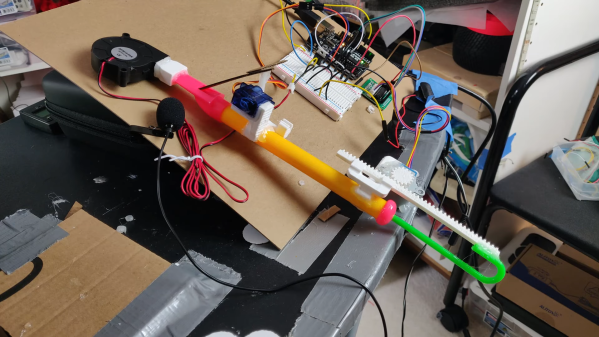
Electronics-wise, the argument bot is a pretty simple build. A Raspberry Pi B+ outfitted with a Google AIY hat listens to your side of things and decides which bones to pick. Your obviously misguided statements are then matched with DialogFlow intents, and dissent is sent back through the speaker. Meanwhile, Mr. Cleese’s jaw moves up and down on a printed and servo-driven linear actuator while he maintains a stiff upper lip. Before you go off on that Python binge, check out the build video after the break.

Have you seen what can happen two robots argue? ‘Tis but a scratch. Continue reading “This Is Not An Argument Bot”

Hot Wire Ribbon Cutter Ceremoniously Heats Up Productivity

Anyone who’s ever cut ribbon, grosgrain or otherwise, may be dismayed by the frayed edge. There are methods of avoiding this, like cutting the ribbon diagonally, or double-diagonally into a forked point, or cutting it straight across and cauterizing the threads with a lighter. But if you have a thirteen dozen baker’s dozens’ worth of goodies to festoon, ain’t nobody got time for that.

[IgorM92] made this hot wire ribbon cutter for his wife, who has a yummy-looking baking business. It combines the cutting and the heat-sealing into a single step by using the heating element from an old soldering iron. If you don’t have one of those, you could just as easily use the nichrome wire from an old hair dryer, a toaster, or wire-wound resistor.

Since the idea is essentially shorting a power source to heat up a wire, it should be done safely. [IgorM92] used a phone charger to condition mains power down to 5 V. There isn’t much else to the circuit, just a rocker switch, a power-indicating LED, and its resistor, but this simple project will no doubt save a lot of time and labor. Burn past the break to watch it ramp up production.

Nichrome wire is good for cutting foam, too. Here’s a bare-bones version that can be made in minutes.

Continue reading “Hot Wire Ribbon Cutter Ceremoniously Heats Up Productivity”

Watchman Watches You Watching Him Watch You

At this point, society has had over three decades to get used to the Blue Man Group. Maybe that’s why we’re less disturbed by [Graham Jessup]’s face-tracking Watchman than we should be. Either that, or it’s because it reminds us of Data from Star Trek: The Next Generation. Frankly, this is just way too cool to be dismissed out of hand as creepy.

The Watchman finds faces via video feed from a camera module positioned in his forehead as a third eye. The camera is connected to a Pi Zero that’s wearing a Google AIY vision bonnet. The Pi translates the face locations into servo positions and feeds them to an Arduino UNO located in the frontal lobe region to move the eyeballs and lids accordingly.

[Graham] had a bit of trouble with tracking accuracy at first, so he temporarily replaced the pupils with 5 mW lasers and calibrated them by tracking a printed stand-in of his head to avoid burning out his retinas.

This project builds on previous work by [Tjahzi] and the animatronic eye movements of [Will Cogley]. We can only imagine how awesome the Watchman would look with a pair of [Will]’s incredibly realistic eyeballs. Either way, we would totally trust the Watchman to defend our modest supply of toilet paper in the coming weeks. Check out a brief demo after the break, and a whole lot more clips on [Graham]’s site.

Continue reading “Watchman Watches You Watching Him Watch You”

Repurposed UV Curer Makes Your Prints Hard As Nails

The price of resin printers has dropped significantly in the last couple of years, and it’s down to the point where you can pick up a fairly decent DLP machine for less than $500. While this is great news, you still need several things beyond resin for successful prints, like a way to do post-process UV curing.

[Inhibit] picked up the formidably-priced Wanhao D7 awhile back. Rather than spending another printer’s worth of paper on a UV curing box, he rescued and repurposed a small commercial curing device meant for gel-based nail polish. You stick your fingertips in, switch it on, and it runs for 60 seconds and then shuts off.

It’s a great idea, but unfortunately prints don’t cure as fast as fingernails. So the first order of business was to bypass the dual 555-based timing system by wiring the UV LEDs directly to power. The manufacturer never intended for the lights to run continuously, so to keep the board from melting, [Inhibit] added in a small 12 V computer fan for cooling. There’s even a little printed grille with angled fins to keep UV light from leaking out and burning nearby retinas.

[Inhibit] also designed and printed a tray for the prints to sit on, and a front enclosure piece to focus as much light on the parts as possible. Files for both parts are floating around the Thingiverse, and we’ve got the build video all cured queued up after the break.

These little commercial boxes don’t cost all that much, but you could always just build your own.

Continue reading “Repurposed UV Curer Makes Your Prints Hard As Nails”

This Barometer Looks Mighty Fine, Rain Or Shine

Mythological legend has it that Tempestas, the Roman goddess of storms and sudden weather, saved the consul Scipio when his fleet of ships got caught in a storm off of Corsica. In return, she demanded that a temple be dedicated to her.

[SephenDeVos]’ beautiful barometer, dubbed Tempestas II,  demands nothing of the viewer, but will likely command attention anyway because it looks so cool. If the weather is anything but clear and sunny, the appropriate sun-obscuring weather actor, be it clouds, more clouds, rain, or lightning will swing into place, blocking out the blue sky in layers, just like real life.

There’s a total of five weather-serving servos, and they’re all controlled by an Arduino Nano through a 16-channel PWM driver. The Nano gets the news from a BMP280 barometric pressure/temperature sensor and drives the servos accordingly.

Nine layers of nicely-decorated Plexiglas® hide the clouds and things in the wings while it’s nice outside. We totally love the way this looks —  it’s even pretty on the back, where the sun don’t shine. This one is new and ongoing, so it seems likely that [Sephen] will post the code before the sun sets on this project. In the meantime, check out the demo after the break.

We don’t see too many barometers builds around here — maybe there’s too much pressure. This one tells you to lay off the coffee when the pressure’s too low.

Continue reading “This Barometer Looks Mighty Fine, Rain Or Shine”