Retrotechtacular: Blue Collar, Red Nightmare

This week’s presentation is a well-cast piece of anti-Communist propaganda perpetrated by a division of the DoD that you’ve probably never heard of: the Directorate for Armed Forces Information and Education.

It’s narrated by Jack Webb of Dragnet and Adam-12 fame. He tells us of a fake American town located somewhere behind the Iron Curtain. It’s full of young comrades who sock hop and bebop while studying and playacting the bourgeoisie activities of the American economy and way of life. After introducing this, Webb pulls back the cushy, velvet curtain to profile a typical American household led by one [Jerry Donavan].

[Jerry] has it all: a wise-cracking wife played by Jeanne Cooper (most notably of The Young and the Restless), a son with a healthy interest in war games, a young daughter with pretty blond hair, and a beautiful older daughter who would go on to fame up the road at Petticoat Junction. After some unsettling news from this daughter at the dinner table, Jerry heads up to bed early to catch a few Zs.

Jack Webb denies [Jerry] any visions of sugar plums and instead drops him in the middle of Fakesville, USSR for a vivid nightmare of an America reconstructed by Communism. Watch as he figures out what’s going on and what the new regime means for him and his good-looking family.

Continue reading “Retrotechtacular: Blue Collar, Red Nightmare”

Fail Of The Week: [Chris] Vs. The Gorn

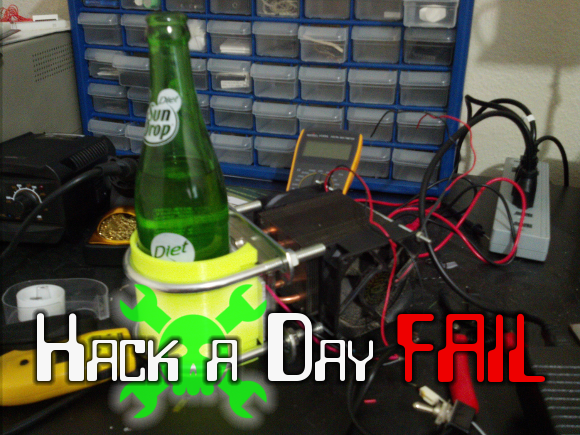
This week, [Chris] tips the scales but ultimately fails. He’s on the road, hacking through the Great White North and improvising from a poorly-lit echo chamber that happens to have a vise.

Knowing nothing about firearms (do you believe that?), he decided to build a BB cannon out of pure scrap. Several kinds of sparks fly, starting with a Hitachi drill-as-lathe and ending with a tiny cupcake sparkler. [Chris] proceeds to bore out some redi-rod by eyeballing it and offers helpful tips for course correction should you attempt same. Having centered the cavity, he drills out a tiny hole for a fuse.

His first fuse is of the crushed up match head paste variety. It burns kind of slowly and does not launch the BB. Naturally, Plan B is to make napalm glue to adhere Pyrodex pistol powder to paper. As you might imagine, it worked quite well. The wadding was singed, but still no joy. After packing her full of propellant, it still didn’t explode and merely burned out the blowhole. So, what gives? Insufficient barrel length? Should have used bamboo instead of redi-rod? Didn’t want it badly enough? Give us your fodder below.

Continue reading “Fail Of The Week: [Chris] Vs. The Gorn”

Goldilocks Climate Box Keeps Lager Fermentation Environment Just Right

September was warmish in many places around the world including [Ole]’s native Denmark. But that did not stop him from brewing lager flavored with plums from his own garden, and neither did his indifference to lagers in general.

Lager fermentation requires a consistent, low temperature. While many homebrewers might modify an electric refrigerator, [Ole] wasn’t interested in the cost of running a second one just for brewing beer. Instead, he built a climate box to work with the cool temperature in his garage. Starting with scrap wood from other projects, he lined the walls with polystyrene and put a layer of wood on the floor to help support the fermentation bucket.

Maintaining a consistent temperature in the box called for both heating and cooling. He pulled the Peltier from a 12V cooler meant to run off a car’s cigarette lighter, and used a spare ceramic heater that was lying around in case his primary reptile warmer went on the fritz.

An Arduino and a custom shield drive separate PID controllers for the Peltier and the heater. The shield has a temperature probe, and he extended the USB outside the climate box so the PIDs can be adjusted without disturbing the inside temperature. The schematic, board file, and code are all available in a zip you can get from his post.

The Peltier couldn’t quite compensate for the overly warm weather and the heat caused by the fermentation, but it was stable enough to produce a nice, plum-flavored lager he has dubbed Lektor Blom­mes malt­bol­che, which is a triple Danish pun he explains in the write-up.

Palatable Pallet Procurement Procedures

Wooden pallets are a versatile and widely-available starting point for a multitude of projects. Best of all, they can usually be acquired free of charge. But choose the wrong kind of pallet and you could end up paying dearly. [Eric] has compiled a great deal of useful information about pallets that will help you find ideal candidates and prepare them for whatever project you have in mind, be it a coffee table or a backyard roller coaster.

Pallets come in several styles and loader configurations. Some are made with space between the boards, and others are closed. If you take nothing else away from his article, just remember to look for plain, untinted pallets with no markings and you’ll be fine.

No markings means the pallet was used domestically, so markings aren’t required. Marked pallets from abroad should feature the IPPC logo as well as a treatment code indicating the method used on the material. Debarked (DB), heat treated (HT), and pallets with the European Pallet Association logo (EPAL) are all safe choices. Pallets labeled (MB) were treated with methyl bromide, which is a poisonous fungicide. Colored pallets should be avoided as well. If you find one in a cool color, take a picture of it and find some paint in a similar hue.

Safe pallets can be had from many places ranging from hardware stores to feed and tack supply stores. Find someone you can ask for permission to take pallets—they might even help you load them. Keep some gloves in your trunk to avoid splinters.

Retrotechtacular: Core Competencies

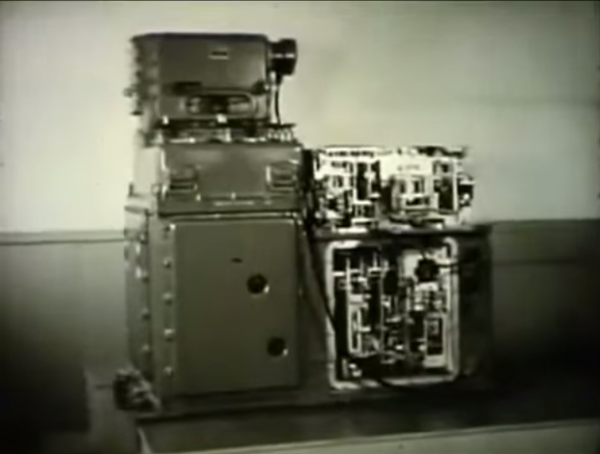
As the dashing officer shown above will tell you, early data processing machines and ADP systems employed two types of magnetic cores for memory and other purposes. This 1961 U.S. Army training film is an introduction to the properties of ferrite cores, which are commonly made from nickel alloy and other magnetic materials. As this is only part one of a series, the metallic ribbon type of magnetic core is covered in some other segment we have yet to locate.

The use of magnetic cores for random access memory was built upon transformer theory and provided a rugged and low-power solution until the semiconductor came into vogue. Before that time, the humble ferrite core served many uses and did so very well. The Apollo Guidance Computer had erasable magnetic core memory, and much of its software was stored in core rope memory.

binary 1The film covers a lot of theory and does so clearly and concisely. It begins by explaining what a magnetic core is and why it’s used, and then moves on to describe how the cores are used to store bits and the method by which they can transfer information to other cores. Along the way, it provides background on bi-stable devices and provides explanation of magnetization behavior in terms of magnetizing force and flux density.

Continue reading “Retrotechtacular: Core Competencies”

Your Halloween Costume May Be Cool, But It’s Not Laser-Cut Cardboard Vintage Airplane Cool

While others are absorbed in baseball playoffs, [Aidan] has spent his recent Octobers planning incredible Halloween costumes for his son. We don’t know what he did last year, but there’s no way it’s better than this laser-cut cardboard airplane costume.

He had a few specs in mind and started with a model of a Grumman F4F-4 Wildcat from 3D Warehouse. Using SketchUp, he simplified the model and removed the landing gear and the propeller. [Aidan] created a simpler model on top of that, and set to work changing the proportions to make it adorable and toddler-sized.

To build around his son’s proportions, he inserted a 10-inch diameter scaled tube vertically into the model and squished down the fuselage in SketchUp. The plan was to have it laser-cut by Ponoko, which meant turning the design into flat pieces for them to cut. He ended up with 58 parts, many of them mirror images due to the symmetry of his design.

When the box from Ponoko arrived, [Aidan] was giddy. He was astonished at the quality of the pieces and found the plane very satisfying to build. But, he didn’t stop there. Using LayOut, he created a custom instrument cluster with reflections and shadows. The plane also has a Wii steering wheel, a motorized propeller, and of course, decals.

Toddler Jukebox Requires No Quarters Or Button Mashing

Ahh, toddlers. They’re as ham-fisted as they are curious. It’s difficult to have to say no when they want to touch and engage with the things that we love and want them to play with. [Shawn] feels this way about his son’s interest in the family Sonos system and engineered an elegant solution he calls Song Blocks.

The Sonos sits on a dresser that hides a RasPi B+. Using bare walnut blocks numbered 1-12, his son can use the Sonos without actually touching it. Each block has a magnet and an NFC tag. When his son sticks a block on the face of the right drawer containing embedded magnets and an NFC controller board, the B+ reads the tag and plays the song. It also tweets the song selection and artist.

The blocks themselves are quite beautiful. [Shawn] numbered them with what look like Courier New stamps and then burned the numbers in with a soldering iron. His Python script is on the git, and he has links to the libraries used on his build page. The Song Blocks demo video is waiting for you after the jump.

Continue reading “Toddler Jukebox Requires No Quarters Or Button Mashing”