Finished pipe crimper made from recycled parts

Making A Pipe Crimper From Scrap

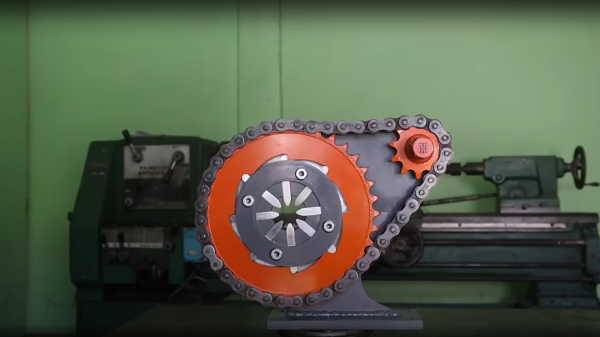
We love upcycling around these parts — taking what would be a pile of rusty scrap and turning it into something useful — and this project from YouTuber [Hands on Table] is no different. Starting with a pair of solid looking sprockets, one big, one small, and some matching chain, a few lumps of roughly hewn steel plate were machined to form some additional parts. A concentric (rear mounted) plate was temporarily welded to the sprocket so matching radial slots could be milled, before it was removed. Next, the sprocket was machined on the inside to add a smooth edge for the crimping fingers (is that the correct term? We’re going with it!) to engage with.

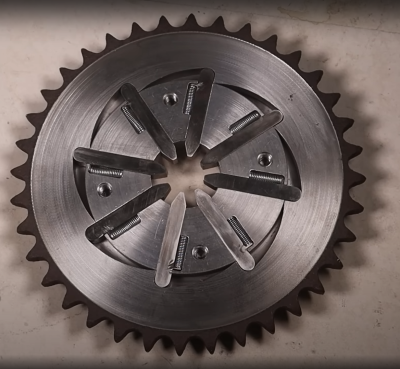
These fingers started life as an off the shelf 3/8″ HSS tool bit, ground down by hand, to produce the desiredInternal view of crimper mechanism shows the fingers and retraction springs crimping profile. A small piece of steel was welded on to each, to allow a small spring to act on the finger, enabling it to retract at the end of the crimping action. We did spot the steel plate being held in place with a small magnet, prior to welding. The heat from that would likely kill off the magnetic field in a short space of time, but they’re so cheap as to be disposable items anyway.
A small ring rides on top of the assembly, bolted to the fixed rear plate. The prevents the crimping fingers from falling out . The fingers are constrained by the slots in the rear plate, so the result is that they can only move radially. As the big sprocket is rotated, they get progressively pushed towards the center, giving that nice, even crimping action. Extra mechanical advantage is provided by driving the small sprocket with a wrench. Super simple stuff, and by the looks of the device in action, pretty effective at crimping the hose fittings it was intended for.

Taking one thing and turning it into something else may well be the very essence of hacking. We’ve seen many hacky upcycling efforts, such as this bench disk sander built from a dryer machine motor. Of course, upcycling is not limited to machines, tools and electronic doodads. Here a trapper hat made out of an old skirt. And why not?

Continue reading “Making A Pipe Crimper From Scrap”

DIY guide saw

A Beautiful DIY Guided Saw

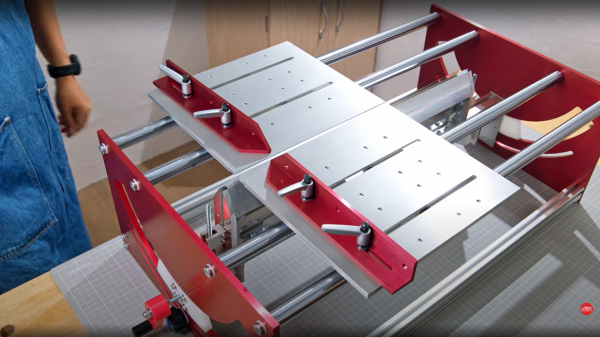
[JSK-koubou] has quite the talent for creative woodwork, particularly building interesting tools or improving existing ones. This recent project (multiple build videos below: part 1, part 2, and part 3) is a very flexible type of guided pull saw, whereby a fine-toothed saw blade is fixed in the bed, and the workpiece is pulled over it it. By fixing it at a shallow angle, and enabling the blade to be raised up through the bed, the workpiece can be progressively cut by simply pulling it over the blade, then winding it up a little until the final cut length is achieved.

From a construction perspective, the tool is all-metal, built from a collection of the off-the-shelf parts, and thick, hand-cut aluminium alloy plate, nary a CNC tool in sight. The only unusual component is the saw blade itself, which might be a bit tricky to track down if you were so inclined to reproduce the build. It appears (well if you believe the auto-translation by Google Lens, anyway) to be a spare blade for a commercial guide saw available in Japan at least.

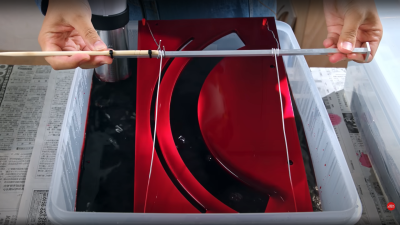
We found it particularly pleasing to see the use of a home-built anodizing setup to give it a bit of a jazzy color scheme for some of the plates, just because. Like with many of the build videos from this YouTuber, it is well worth watching all of them, if only just to gather a few ideas for one’s own workspace, if you can stop yourself getting distracted looking at all the other neat tools he uses on the way.

DIY tool builds are not uncommon in these parts, here’s a neat DIY combo table-based project, and here’s a homebrew auto-lowering metal bandsaw which could be a real timesaver.

Continue reading “A Beautiful DIY Guided Saw”

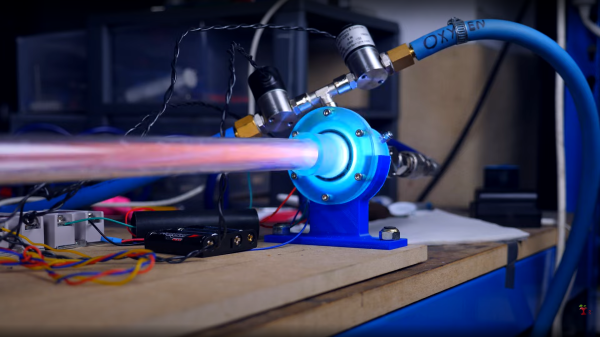
resin printed pulsejet engine in operation

A Detonation Engine Prototyped Using Resin Printing

Over the years [Integza] has blown up or melted many types of jet engine, including the humble pulsejet. Earlier improvements revolved around pumping in more fuel, or forced air intakes, but now it’s time for a bit more refinement of the idea, and he takes a sidestep towards the more controllable detonation engine. His latest experiment (video, embedded below) attempts to dial-in the concept a little more. First he built a prototype from a set of resin printed parts, with associated tubing and gas control valves, and a long acrylic tube to send the exhaust down. Control of the butane and air injection, as well as triggering of the spark-ignition, are handled by an Arduino — although he could have just used a 555 timer — driving a few solid state relays. This provided some repeatable control of the pulse rate. This is a journey towards a very interesting engine design, known as the rotating detonation engine. This will be very interesting to see, if he can get it to work.

supersonic exhaust plume from a pulsejet engine
Supersonic exhaust plume with the characteristic ‘mushroom’ shape

Detonation engines operate due to the pressure part of the general thrust equation, where the action is in the detonative combustion. Detonative combustion takes place at constant pressure, which theoretically should lead to a greater efficiency than boring old deflagration, but the risks are somewhat higher. Apparently this is tricky to achieve with a fuel/air mix, as there just isn’t enough oomph in the mixture. [Integza] did try adding a Shchelkin spiral (we call them springs around here) which acts to slow down the combustion and shorten the time taken for it to transition from deflagration to detonation.

It sort of worked, but not well enough, so running with butane and pure oxygen was the way forward. This proved the basic idea worked, and the final step was to rebuild the whole thing in metal, with CNC machined end plates and some box section clamped with a few bolts. This appeared to work reasonably well at around 10 pulses/sec with some measurable thrust, but not a lot. More work to be done we think.

We hinted at earlier work on forced-air pulsejets, so here that is. Of course, whilst we’re on the subject of pulsejets, we can’t not mention [Colinfurze] and his pulsejet go kart.

Continue reading “A Detonation Engine Prototyped Using Resin Printing”

2022 Hackaday Prize: Boondock Echo Connects Your Radios With The Cloud

[Mark J Hughes] volunteers as a part of a local community fire watch which coordinates by radio. The La Habra Heights region of Los Angeles is an area of peaks and valleys, which makes direct radio connections challenging. Repeaters work well for range improvement, but in such areas, there is no good place to locate these. [Mark] says that during an emergency (such as a wildfire) the radio usage explodes, with him regularly tracking as many as eight radio frequencies and trying to make sense of it, whilst working out how to send the information on and to whom.

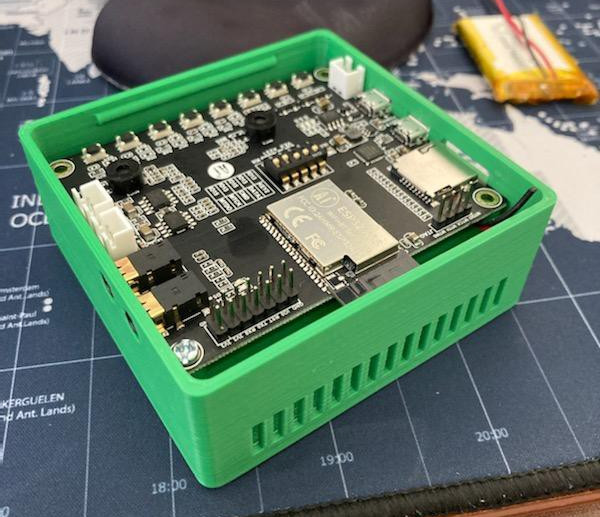
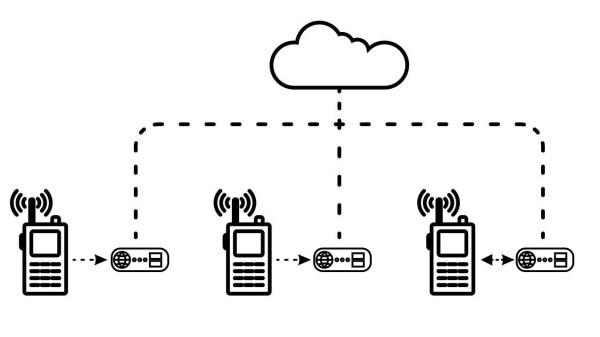
This led him together with collaborator [Kaushlesh Chandel] to create Project Boondock Echo, to help alleviate some of the stress of it all. The concept is to use a cheap Baofeng radio to feed into a gateway based around an ESP32 audio development kit. Mount this in a box with a LiPo based power supply, and you’ve got yourself a movable radio-to-cloud time-shift audio recorder.

By placing one or more of these units in the properties of several of the community group radio operators, all messages can be captured to an audio file, tagged with the radio frequency and time of transmission, and uploaded to a central server. From there they can be retrieved by anybody with access, no matter the physical location, only an internet connection is needed.

The next trick that can be performed, is to reverse the process and queue up previous recordings, and send it back over the cloud to remote locations for re-transmission via radio into the field. This is obviously a massive asset, because wherever there is some urbanization, there is likely an internet connection. With the addition of a Boondock Echo unit, anyone that has a receiver within a few miles can be fully connected with what’s going on outside the range of direct radio communications.

Source for the ESP32’s firmware as well as the web side of things can found on the project Boondock Echo GitHub, complete with some STLs for a 3D printed box to sit it in. Like always, there’s more than one way to solve a particular problem. Here’s an amateur radio repeater based using an RTL-SDR and a Raspberry Pi.

Bit-Banged Ethernet On The Raspberry Pi Pico

Whilst the Raspberry Pi RP2040 is quite a capable little chip, on the whole it’s nothing really special compared to the big brand offerings. But, the PIO peripheral is a bit special, and its inclusion was clearly a masterstroke of foresight, because it has bestowed the platform all kinds of capabilities that would be really hard to do any other way, especially for the price.

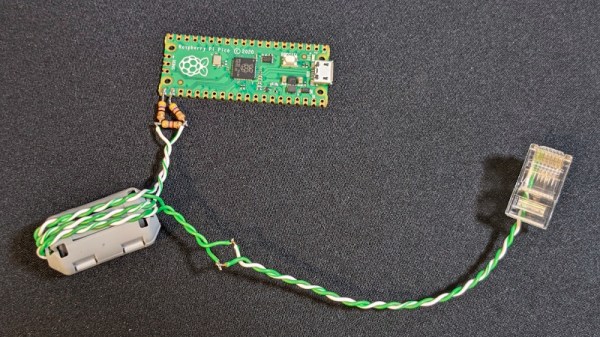
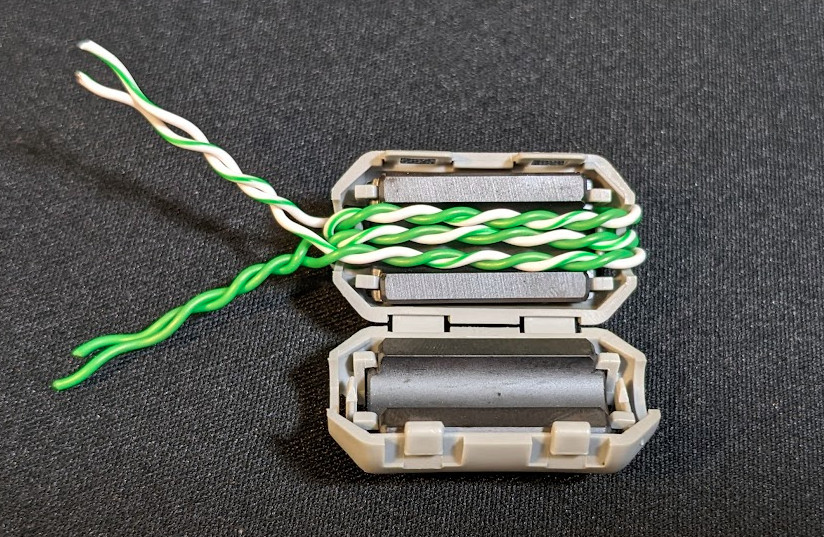
Our focus this time is on Ethernet, utilizing the PIO as a simple serialiser to push out a pre-formatted bitstream. [kingyo] so far has managed to implement the Pico-10BASE-T providing the bare minimum of UDP transmission (GitHub project) using only a handful of resistors as a proof of concept. For a safer implementation it is more usual to couple such a thing magnetically, and [kingyo] does show construction of a rudimentary pulse transformer, although off the shelf parts are obviously available for this. For the sake of completeness, it is also possible to capacitively couple Ethernet hardware (checkout this Micrel app note for starters) but it isn’t done all that much in practice.

Inside the expedient pulse transformer.

UDP is a simple Ethernet protocol for transferring application data. Being connection-less, payload data are simply formatted into a packet buffer up front. This is all fine, until you realize that the packets are pretty long and the bitrate can be quite high for a low-cost uC, which is why devices with dedicated Ethernet MAC functionality have a specific hardware serialiser-deserialiser (SERDES) block just for this function.

Like many small uC devices, the RP2040 does not have a MAC function built in, but it does have the PIO, and that can easily be programmed to perform the SERDES function in only a handful of lines of code, albeit only currently operating at 10 MBit/sec. This will cause some connectivity problems for modern switch hardware, as they will likely no longer support this low speed, but that’s easily solved by snagging some older switch hardware off eBay.

As for the UDP receive, that is promised for the future, but for getting data out of a remote device over a wired network, Pico-10BASE-T is a pretty good starting point. We’ve seen a few projects before that utilize the PIO to generate high speed signals, such as DVI, albeit with a heavy dose of overclocking needed. If you want a bit more of an intro to all things Pico, you could do worse than check out this video series we highlighted a while back.

Integrated Circuit Manufacturing At Bell Labs In 1983

With the never ending march of technological progress, arguably the most complex technologies become so close to magic as to be impenetrable to those outside the industry in which they operate. We’ve seen walkthrough video snapshots of just a small part of the operation of modern semiconductor fabs, but let’s face it, everything you see is pretty guarded, hidden away inside large sealed boxes for environmental control reasons, among others, and it’s hard to really see what’s going on inside.

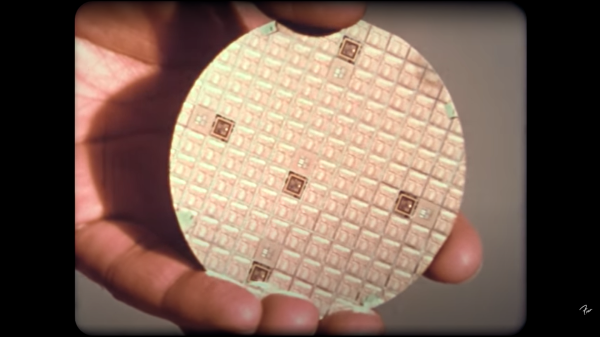
Let’s step back in time a few decades to 1983, with an interesting tour of the IC manufacturing facility at Bell Labs at Murray Hill (video, embedded below) and you can get a bit more of an idea of how the process works, albeit at a time when chips hosted mere tens of thousands of active devices, compared with the countless billions of today. This fab operates on three inch wafers, producing about 100 die each, with every one handled and processed by hand whereas modern wafers are much bigger, die often much smaller with the total die per wafer in the thousands and are never handled by a filthy human.

Particle counts of 100 per cubic foot might seem laughable by modern standards, but device geometries back then were comparatively large and the defect rate due to it was not so serious. We did chuckle somewhat seeing the operator staff all climb into their protective over suits, but open-faced with beards-a-plenty poking out into the breeze. Quite simply, full-on bunny suits were simply not necessary. Anyway, whilst the over suits were mostly for the environment, we did spot the occasional shot of an operator wearing some proper protective face shielding when performing some of the higher risk tasks, such as wafer cleaning, after all as the narrator says “these acids are strong enough to eat through the skin” and that would certainly ruin your afternoon.

No story about integrated circuit processing would be complete without mentioning the progress of [Sam Zeloof] and his DIY approach to making chips, and whilst he’s only managing device counts in the hundreds, this can only improve given time.

Continue reading “Integrated Circuit Manufacturing At Bell Labs In 1983”

Is This The Oldest Open Source HVAC Project In Existence?

Homebrew HVAC systems are one of those projects that take such a big investment of time, effort and money that you’ve got to be a really dedicated (ideally home-owning) hacker with a wide variety of multidisciplinary skills to pull off an implementation that can work in reality. One such HVAC hacker is [Vadim Tkachenko] with his multi-zone Home Climate Control (HCC) project that we covered first back in 2007. We now have rare opportunity to look at the improvements fifteen years of part-time development can produce, when a project is used all day, all year round in their own home. At the start, things were simple, just opening and closing ventilators with none of those modern MQTT-driven cloud computing stuff. Continue reading “Is This The Oldest Open Source HVAC Project In Existence?”