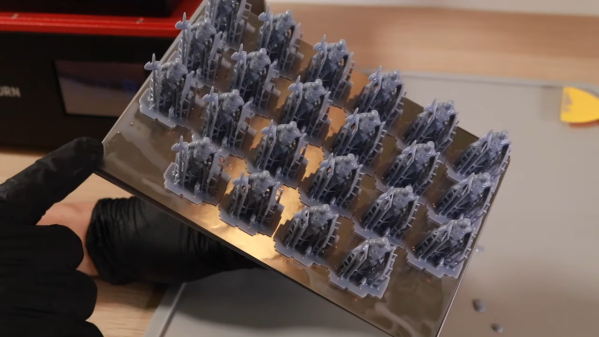
Lots of parts printed at once with a resin printer

Making The Most Of Your Resin Printer Investment

To the extent that we think of 3D printers as production machines, we tend to imagine huge banks of FDM machines slowly but surely cranking out parts. These printer farms are a sensible way to turn a slow process into a high-volume operation, but it turns out there’s a way to do the same thing with only one printer — as long as you think small.

This one comes to us by way of [Andrew Sink], who recently showed us a neat trick for adding a dash of color to resin printed parts. As with that tip, this one centers around his Elegoo resin printer, which is capable of intricately detailed prints but like any additive process, takes quite a bit of time to finish a print. Luckily, though, the printer uses the MSLA, or masked stereolithography, process, which exposes the entire resin tank to ultraviolet light in one exposure. That means that, unlike FDM printers, it takes no more time to print a dozen models than it does to print one. The upshot of this is that however many models can fit on the MSLA print platform can be printed in the same amount of time it takes to print the part with the most layers. In [Andrew]’s case, 22 identical figurine models were printed in the same three hours it took to print just one copy.

It seems obvious, but sometimes the simplest tips are the best. And the next step is obvious, especially as MSLA printer prices fall: a resin printer farm, with each printer working on dozens of small parts at a time. Such a setup might rival injection molding in terms of throughput, and would likely be far cheaper as far as tooling goes. Continue reading “Making The Most Of Your Resin Printer Investment”

Hackaday Links Column Banner

Hackaday Links: October 3, 2021

It’s one thing to speculate about what’s happening with the Mars helicopter Ingenuity, but it’s another to get an insider’s view on recent flight problems. As we previously reported, Ingenuity is starting to face a significant challenge, as a seasonal atmospheric pressure drop on Mars threatens to make the already rarefied air too thin to generate useful lift. Mission controllers tested the chopper at higher rotor speeds, and while that worked, later attempts to fly using that higher speed resulted in an abort. The article, written by one of the NASA/JPL engineers, is a deep dive into the problem, which occurred when Ingenuity sensed excessive wiggle in two of the servos controlling the rotor swashplate. The thought is that accumulated wear in the servos and linkages might be causing the problem; after all, Ingenuity has made thirteen flights so far, greatly exceeding the five flights originally programmed for it. Here’s hoping they can adapt and keep the helicopter flying, but whatever they do, it’ll have to wait a few weeks until Mars completes its conjunction and pops back out from behind the Sun.

With all the attention understandably paid to the recent 20th anniversary of the 9/11 terror attacks, it’s easy to forget that barely a month after that day, a series of what appeared to be follow-on attacks started: the Anthrax Attacks. Members of Congress and media outlets were targeted via the mail with highly refined anthrax spores, leading to the deaths of five people, with dozens more injured and exposed to anthrax. IEEE Spectrum has an interesting article that goes into some of the technology that was rapidly deployed in an attempt to sanitize the mail, including electron beam and X-ray irradiation to kill any spores. The article also points out how this wasn’t the first time people were afraid of the mail; outbreaks of yellow fever in 1899 led to fumigation of the mail with sulfur, after perforating it with a wicked-looking paddle.

Attention PCB-design newbies — now’s your chance to learn the entire PCB design process from the ground up, with the guidance of industry professionals. TeachMePCB is back again this year, offering to teach you everything you need to know about properly laying out a PCB design in pretty much any EDA software you want. The course requires a two- to five-hour commitment every week for two months, after which you’ll have designed a PCB for a macropad using a Raspberry Pi Pico. The course facilitator is Mark Hughes from Royal Circuits, who did a great Hack Chat with us last year on PCB finishes. This seems like a great way to get up to speed on PCB design, so if you’re interested, act soon — 460 people are already signed up, and the deadline is October 10.

Some of us really love factory tours, no matter what the factory is making. All the better when the factory makes cool electronics stuff, and better still when it’s our friends at Adafruit showing us around their New York City digs. True, it’s a virtual tour, but it has pretty much become a virtual world over the last couple of years, and it’s still a great look inside the Adafruit factory. Hackaday got an in-person tour back in 2015, but we didn’t know their building used to be a Westinghouse radio factory. In fact, the whole area was once part of the famed “Radio Row” that every major city seemed to have from the 1920s to the 1960s. It’s good to get a look inside a real manufacturing operation, especially one that’s right in the heart of a city.

And finally, those with a fear of heights might want to avoid watching this fascinating film on the change-out of a TV transmitter antenna. The tower is over 1,500′ (450 m) tall, lofting an aging antenna over the flat Florida terrain. Most of the footage comes from body-mounted cameras on the riggers working the job, including the one very brave soul who climbed up the partially unbolted antenna to connect it to the Sikorsky S64 Skycrane helicopter. It’s a strange combination of a carefully planned and slowly executed ballet, punctuated by moments of frenetic activity and sheer terror. The mishap when releasing the load line after the new antenna was placed could easily have swept the whole rigging crew off the antenna, but luckily nobody was injured.

Continue reading “Hackaday Links: October 3, 2021”

A stepper-powered flip clock

Steppers And ESP32 Make This Retro-Modern Flip-Clock Tick

Before LEDs became cheap enough to be ubiquitous, flip-card displays were about the only way to get a digital clock. These entirely electromechanical devices had their own charm, and they have a certain retro cachet these days. Apart from yard sales and thrift stores, though, they’re a bit hard to source — unless you roll your own, of course.

Granted, [David Huang]’s ESP32-based flip clock is worlds apart from the flip cards of the “I Got You, Babe” era. Unfortunately, the video below is all we have to go on to get the story behind this clock, but it’s pretty self-explanatory. [David] started the build by making the flip cards themselves, a process that takes some topological tricks as well as a laser cutter. 3D-printed spools are loaded with the cards, which are then attached to frames that hold a stepper motor and a Hall-effect sensor. The ESP32 drives the steppers via L298N H-bridge drivers, but it’s hard to say if there’s an RTC chip or if the microcontroller is just getting time via an NTP server.

[David] might not be the only one trying to recapture that retro look, but we’ve got to hand it to him — it’s a great look, and it takes a clever maker to not only build a clock like this, but to make a video that explains it all so clearly without a single word of narration.

Continue reading “Steppers And ESP32 Make This Retro-Modern Flip-Clock Tick”

Recreating Ben Franklins kite experiment with a drone

Drone Replaces Kite In Recreation Of Famous Atmospheric Electricity Experiment

Finally, someone decided to answer the question that nobody was asking: what if [Benjamin Franklin] had had a drone rather than a kite?

Granted, [Jay Bowles] didn’t fly his electricity-harvesting drone during a thunderstorm, but he did manage to reach some of the same conclusions that [Dr. Franklin] did about the nature of atmospheric electricity. His experimental setup was pretty simple: a DJI Mini2 drone with enough payload capacity to haul a length of fine-gauge magnet wire up to around 100 meters above ground level. A collecting electrode made of metal mesh was connected to the wire and suspended below the drone. Some big nails were driven into the soil to complete the circuit between the drone and the ground.

[Jay] went old-school for a detector, using a homemade electroscope to show what kind of static charge was accumulating on the electrode. Version 1 didn’t have enough oomph to do much but deliver a small static shock, but a larger electrode was able to deflect the leaves of an electroscope, power a beer can version of a Franklin bell, and also run a homemade corona motor. [ElectroBOOM] makes a guest appearance in the video below to explain the physics of the setup; curiously, he actually managed to get away without any injuries this time. Continue reading “Drone Replaces Kite In Recreation Of Famous Atmospheric Electricity Experiment”

MicroSynth, the business card-sized synthesizer

MicroSynth Mixes All-Analog Fun With A Little Business

While [MicroKits]’ MicroSynth is an all-analog synthesizer that fits on a business card-sized PCB, and he actually does use it to break the ice in business meetings, that’s not really the idea behind this project. Rather, [MicroKits] is keen to get people playing with synths, and what better way than a synth you can build yourself?

There was an ulterior motive behind this project, too: prototyping circuits for a more complete synthesizer. Thus, the design is purposely very simple — no microcontrollers, no logic chips, and not even a 555 to be found. It doesn’t even have buttons; instead, the one-octave keyboard just has interdigitated traces that are bridged by the player’s fingers, forming resistive touchpads. The keyboard interface circuit is clever, too — [MicroKits] uses a pair of op-amps to convert the linear change in resistance across the keyboard to a nearly exponential voltage to drive the synth’s voltage-controlled oscillator (VCO). The video below shows what it can do.

We love projects like these because they show what can be accomplished strictly using analog circuits. We don’t have any problem with other synth designs, mind you — this 555-based dub siren we featured recently was great, too. Continue reading “MicroSynth Mixes All-Analog Fun With A Little Business”

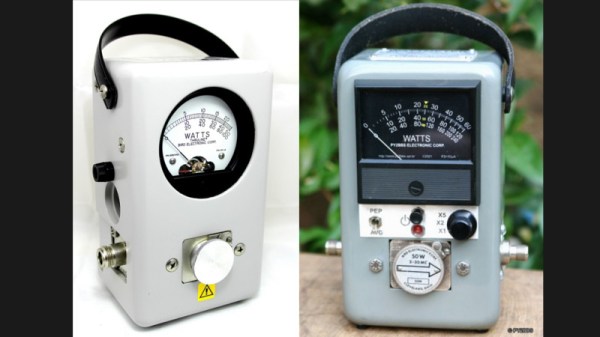
A Bird 43 wattmeter and its homebrew equivalent

Homebrew Wattmeter Pays Homage To Sturdy Original

If there’s one instrument that hams and other radio enthusiasts covet, it’s the venerable Bird 43 Thruline wattmeter. The useful RF tool has barely changed in the nearly 70 years since it was first introduced, and they’re built like a tank. This makes Bird meters highly desirable, and therefore quite expensive either brand new or on the swap-meet circuit.

But radio amateurs are nothing if not resourceful, and building a homebrew version of the Bird wattmeter (in Portuguese; Google translate tool at the bottom of the page) as Brazilian ham [Luciano Sturaro (PY2BBS)] did is a good way to get your hands on one. Granted, [Luciano] had a head start: a spare line set, which is the important bit from a Bird wattmeter. The machined metal part is in effect an air-insulated section of coaxial cable that the RF signal passes through on its way from transmitter to antenna. A “slug” is inserted into the cavity in the line set to sense the RF and couple it to the meter electronics; the slug can be rotated to measure RF traveling in either direction, allowing the user to determine how much RF is getting reflected by the antenna system.

[Luciano]’s version of the meter is faithful to the sturdy construction of the original, with a solid steel case that mimics its classic lines — the case even sports the same color scheme and stout leather carry handle. There are some changes to the electronics, and the meter movement itself is different from the original, but all in all, the “Buzz 50” looks fantastic. We especially love the detailed nameplate as an homage to Bird.

The thing about Bird — and Bird-like — meters is that the slugs are like potato chips; you can’t have just one. Curious as to how these slugs work? Check out this slug repair project.

[Featured image of Bird 43 Wattmeter: Martin RF Supply]

Thanks to [Niko Huenk] for the tip!

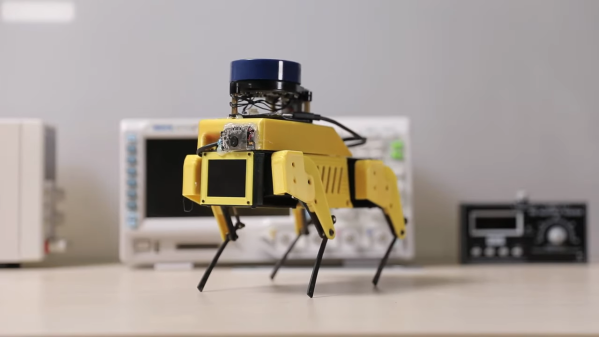
MiniPupper

Robot Dogs Hack Chat

Join us on Wednesday, September 29 at noon Pacific for the Robot Dogs Hack Chat with Afreez Gan!

Thanks to the efforts of a couple of large companies, many devoted hobbyists, and some dystopian science fiction, robot dogs have firmly entered the zeitgeist of our “living in the future” world. The quadrupedal platform, with its agility and low center of gravity, is perfect for navigating in the real world, where the terrain is rarely even and unexpected obstacles are to be expected.

The robot dog has been successful enough that there are commercially available — if prohibitively priced — dogs on the market, doing everything from inspecting factory processes and off-shore oil platforms to dancing for their dinner. All the publicity around robot dogs has fueled a crush of DIY and open-source versions, so that hobbyists can take advantage of what the platform has to offer. And as a result, the design of these dogs has converged somewhat, with elements that provide a common design language for these electromechanical pets.

Afreez Gan has been exploring the robot dog space for a while now, and his MiniPupper is generating some interest. He’ll stop by the Hack Chat to talk about MiniPupper specifically and the quadruped platform in general. We’ll talk about what it takes to build your own robot dog, what you can do with one once you’ve built it, and how these bots can play a part in STEM education. Along the way, we’ll touch on ROS, lidar, machine vision with OpenCV, and pretty much anything involved in the care and feeding of your newest electronic pal.

join-hack-chatOur Hack Chats are live community events in the Hackaday.io Hack Chat group messaging. This week we’ll be sitting down on Wednesday, September 29 at 12:00 PM Pacific time. If time zones have you tied up, we have a handy time zone converter.