Hackaday Links Column Banner

Hackaday Links: March 28, 2021

If you thought the global shortage of computer chips couldn’t get any worse, apparently you weren’t counting on 2021 looking back at 2020 and saying, “Hold my beer.” As if an impacted world waterway and fab fires weren’t enough to squeeze supply chains, now we learn that water restrictions could potentially impact chip production in Taiwan. The subtropical island usually counts on three or four typhoons a year to replenish its reservoirs, but 2020 saw no major typhoons in the region. This has plunged Taiwan into its worst drought since the mid-1960s, with water-use restrictions being enacted. These include a 15% reduction of supply to industrial users as well as shutting off the water entirely to non-industrial users for up to two days a week. So far, the restrictions haven’t directly impacted chip and display manufacturers, mostly because their fabs are located outside the drought zone. But for an industry where a single fab can use millions of gallons of water a day, it’s clearly time to start considering what happens if the drought worsens.

Speaking of the confluence of climate and technology, everyone problem remembers the disastrous Texas cold snap from last month, especially those who had to endure the wrath of the unusually brutal conditions in person. One such victim of the storm is Grady, everyone’s favorite YouTube civil engineer, who recently released a very good post-mortem on the engineering causes for the massive blackouts experienced after the cold snap. In the immediate aftermath of the event, we found it difficult to get anything approaching in-depth coverage on its engineering aspects — our coverage excepted, naturally — as so much of what we found was laden with political baggage. Grady does a commendable job of sticking to the facts as he goes over the engineering roots of the disaster and unpacks all the complexity of the infrastructure failures we witnessed. We really enjoyed his insights, and we wish him and all our friends in Texas the best of luck as they recover.

If you’re into the demoscene, chances are pretty good that you already know about the upcoming Revision 2021, the year’s big demoscene party. Like last year’s Revision, this will be a virtual gathering, but it seems like we’re all getting pretty used to that by now. The event is next weekend, so if you’ve got a cool demo, head over and register. Virtual or not, the bar was set pretty high last year, so there should be some interesting demos that come out of this year’s party.

Many of us suffer from the “good enough, move on” mode of project management, leaving our benches littered with breadboarded circuits that got far enough along to bore the hell out of us make a minimally useful contribution to the overall build. That’s why we love it when we get the chance to follow up on a build that has broken from that mode and progressed past the point where it originally caught our attention. A great example is Frank Olsen’s all-wood ribbon microphone. Of course, with magnets and an aluminum foil ribbon element needed, it wasn’t 100% wood, but it still was an interesting build when we first spied it, if a bit incomplete looking. Frank has fixed that in grand style by continuing the wood-construction theme that completes this all-wood replica of the iconic RCA Model 44 microphone. It looks fabulous and sounds fantastic; we can’t help but wonder how many times Frank glued his fingers together with all that CA adhesive, though.

Continue reading “Hackaday Links: March 28, 2021”

CNC Scroll Saw Add-On Cuts Beautiful Wooden Spirals

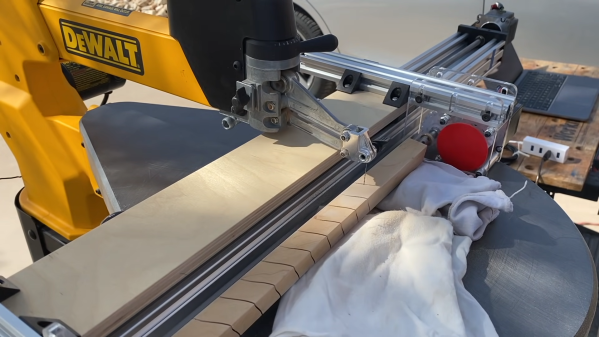
If there’s one thing that woodworkers have always been good at, it’s coming up with clever jigs and work-holding solutions. Most jigs, however, are considerably simpler and more static than this CNC-controlled scroll saw add-on that makes cool wooden spirals a snap.

As interesting as the products of this setup are, what we like about this is the obvious care and craftsmanship [rschoenm] put into making what amounts to a hybrid between a scroll saw and a lathe. Scroll saws are normally used to make narrow-kerf cuts in thin, delicate materials, often with complicated designs using very tight radius turns. In this case, though, stock is held between centers on the lathe-like carriage. The jig uses a linear slide driven by a stepper and a lead screw to translate the workpiece perpendicular to the scroll saw blade while a geared headstock rotates it. Starting with the blade inserted into a through-hole, the saw slowly cuts a beautiful nested spiral down the length of the workpiece. An Uno, a GRBL shield, and some stepper drivers let a little G-code control the two axes of the jig.

The video below shows it in action; things do get a bit wobbly as the cut progresses, but in general the jig works wonderfully and results in some lovely pieces. At first we thought these would purely be objets d’art, but then we thought about this compression screw grinder for DIY injection molding machines and realized these wooden screws look pretty similar.

Continue reading “CNC Scroll Saw Add-On Cuts Beautiful Wooden Spirals”

The $50 Ham: WSPR-ing Around The World

Everybody has a bucket list,  things to be accomplished before the day we eventually wake up on the wrong side of the grass. Many bucket-list items are far more aspirational than realistic; very few of us with “A trip to space” on our lists are going to live to see that fulfilled. And even the more realistic goals, like the trip to Antarctica that’s been on my list for ages, become less and less likely as your life circumstances change — my wife hates the cold.

Luckily, instead of going to Antarctica by myself — and really, what fun would that be? — I’ve recently been getting some of the satisfaction of world travel through amateur radio. The last installment of “The $50 Ham” highlighted weak-signal digital modes using WSJT-X; in that article, I mentioned a little about the Weak Signal Propagation Reporter, or WSPR. It’s that mode that let me test what’s possible with very low-power transmissions, and allowed me to virtually visit six continents including Antarctica and Sweden-by-way-of-Alaska.

Continue reading “The $50 Ham: WSPR-ing Around The World”

A Simple But Effective High-Flow Oxygen Concentrator From Hardware Store Parts

To say that a lot has happened in the year since the COVID-19 pandemic started is an understatement of epic proportions, so much so that it may be hard to remember how the hardware hacking community responded during those early days, with mass-produced PPE, homebrew ventilators and the like. But we don’t recall seeing too many attempts to build something like this DIY oxygen concentrator during that initial build-out phase.

Given the simplicity and efficacy of the design, dubbed OxiKit, it seems strange that we didn’t see more of these devices. OxiKit uses zeolite, a porous mineral that can be used as a molecular sieve. The tiny beads are packed into columns made from hardware store PVC pipes and fittings and connected to an oil-less air compressor through some solenoid-controlled pneumatic valves. After being cooled in a coil of copper pipe, the compressed air is forced through one zeolite column, which preferentially retains the nitrogen while letting the oxygen pass through. The oxygen stream is split, with part going into a buffer tank and part going into the outlet of the second zeolite column, where it forces the adsorbed nitrogen to be released. An Arduino controls the valves that alternate the gas flow back and forth, resulting in 15 liters per minute of 96% pure oxygen.

OxiKit isn’t optimized as a commercial oxygen concentrator is, so it’s not particularly quiet. But it’s a heck of a lot cheaper than a commercial unit, and an easy build for most hackers. OxiKit’s designs are all open source, but they do sell kits and some of the harder-to-source parts and supplies, like the zeolite. We’d be tempted to build something like this just because the technology is so neat; having a source of high-flow oxygen available isn’t a bad idea, either.

MIDI All The Things Hack Chat

Join us on Wednesday, March 24 at noon Pacific for the MIDI All the Things Hack Chat with Tim Alex Jacobs!

In our technologically complex world, standards are a double-edged sword. While they clearly make it possible for widgets and doodads to interoperate with each other, they also tend to drift away from their original intention over time, thanks to the march of progress or even market forces. If there’s one thing you can expect about standards, it’s that they beget other standards.

One standard that has stood the test of time, with modification of course, is the Musical Instrument Digital Interface, or MIDI. It’s hard to overstate the impact MIDI has had on the music world since it was first dreamed up in the early 1980s. Started amid a Wild West of competing proprietary synchronization standards, MIDI quickly became the de facto interface for connecting electronic musical instruments together. And as it did, it moved from strictly pro-grade equipment down the market to prosumer and home users, fueled in part by the PC revolution.

Tim Alex Jacobs, who is perhaps better known as Mitxela on his YouTube channel, has long been interested in applying MIDI to unusual corners of the musical world. We’ve seen him MIDI-fy things that barely qualify as musical instruments, and also build a polyphonic synthesizer so small it fits within the shell of the DIN connector that’s so strongly associated with the MIDI standard. Tim joins us on the Hack Chat this week to talk about his experiences with MIDI, and to help us understand all the ways we can work with the interface in our builds.

join-hack-chatOur Hack Chats are live community events in the Hackaday.io Hack Chat group messaging. This week we’ll be sitting down on Wednesday, March 24 at 12:00 PM Pacific time. If time zones have you tied up, we have a handy time zone converter.

Click that speech bubble to the right, and you’ll be taken directly to the Hack Chat group on Hackaday.io. You don’t have to wait until Wednesday; join whenever you want and you can see what the community is talking about.
Continue reading “MIDI All The Things Hack Chat”

Hackaday Links Column Banner

Hackaday Links: March 21, 2021

If you think you’re having a bad day at work, pity the poor sysadmin at Victoria University of Wellington in Australia New Zealand, who accidentally nuked the desktops of pretty much everyone at the university. This apparently happened last week and impacted everyone connected to the university network with a Windows machine, which had any files stored on their desktops deleted and also appears to have reset user profiles to the default state. This caused no end of consternation, especially among those who use their desktop folder to organize work in progress; we’d imagine more than one student at VUW is hating life right now for not storing work on a backed-up network drive. The problem seems to have started with an attempt to clean up files and profiles left behind by former students; how that escalated to nuking files on the desktop will require some ‘splaining.

Speaking of mea culpas, there was quite a dustup this week in the Cricut community. It started when the maker of CNC cutting machines announced its intention to limit uploads to their online design software unless the user signs up for a $10 a month account. After getting an earful from the users, the CEO of the company announced that these changes would be delayed until the end of 2021. That decision still didn’t sit well with the community, which includes a fair number of users designing PCBs, and two days later, the CEO announced that they were throwing in the towel on the whole plan, and that everything was going back to status quo ante. Story over? We’ll see — it seems like Cricut has tipped its hand here that they’re looking to extract more money from the users, and the need for that likely hasn’t gone away just because they relented. As Elliot Williams pointed out when we discussed the whole debacle, it’s easy to see how Cricut could start adding new features to the paid version of their software, basically abandoning the free user base. We’ll have to see how the obviously vociferous community responds to something like that.

Much interesting news from Mars this week, where the Perseverance rover is getting used to its new home and getting itself ready to roll. Late last week, Perseverance successfully dropped the “belly pan” that was covering the sensitive instruments under the rover, including the Adaptive Sample Caching system that will seal up Martian core samples and drop them out onto the surface for later pickup. This seemingly simple task was a critical one; had the pan not cleanly separated, the mission could have been severely impacted. Perseverance also did a little test drive this week, and recorded what it sounds like to drive on Mars. The audio clip is 16 minutes long, and the noises coming from the billion-dollar rover are just awful at times. We hear clunks and clanks and squeals galore, and while we’re sure they all have a good explanation and will provide valuable engineering data, they sound somewhat alarming to us.

But not so alarming as the sounds that must have come from a Jeep that suffered a bad tow job recently. The cringe-making story starts with a brand-new Jeep being towed on its wheels behind a motorhome, which allows the RV owners to park their rig and still have something to drive around in while they camp. The towed vehicle, or “pusher”, is normally equipped with a manual transmission, as towing with the wheels on the ground for extended distances is easier with them. Unfortunately, the Jeep’s owner set up the shift levers wrong and left the transmission in first gear, with the transfer case in low range. The linked article estimates the gearing ratios meant that the poor Jeep’s engine was being spun at something like 54,000 RPM; chances are good the engine exploded long before that point. The damage shown in the video accompanying the article is just brutal — the oil pan and bell housing are gone, the bottom of the crankcase is blown out, and at least two pistons and their share of the crankshaft are missing in action. We feel sorry for the owner, but really wish the Jeep had had a belly cam like the one on Perseverance.

Retrotechtacular: Manufacturing Philco Germanium Transistors

There was a time when all major corporations maintained film production departments to crank out public relations pieces, and the electronic industry was no exception. Indeed, in the sea-change years of the mid-20th century, corporate propaganda like this look at Philco transistor manufacturing was more important than ever, as companies tried to pivot from vacuum tubes to solid-state components, and needed to build the consumer electronics markets that would power the next few decades of rapid growth.

The film below was produced in 1957, just a decade since the invention of the transistor and only a few years since Philco invented the surface-barrier transistor, the technology behind the components. It shows them being made in their “completely air-conditioned, modern plant” in Pennsylvania. The semiconductor was germanium, of course — the narrator only refers to “silly-con” transistors once near the end of the film — but the SBT process, with opposing jets of indium sulfate electrolyte being used to both etch the germanium chip and form the collector and emitter of the transistor, is a fascinating process, and these transistors were quite the advance back in the day. It’s interesting, too, to watch the casual nature of the manufacturing process — no clean rooms, no hair nets, and only a lab coat and “vacuum welcome mats” to keep things reasonably clean.

As in most such corporate productions, superlatives abound, so be prepared for quite a bit of hyperbole on the part of the Mid-Atlantic-accented narrator. And we noticed a bit of a whoopsie near the end, when he proudly intoned that Philco transistors would be aboard the “first Earth satellite.” They were used in the radio of Explorer 1, but the Russians had other ideas about who was going to be first.

And speaking of propaganda, don’t forget that at around this time, vacuum tube companies were fighting for their lives too. That’s where something like this designer’s guide to the evils of transistors came from.

Continue reading “Retrotechtacular: Manufacturing Philco Germanium Transistors”