3D-Printed Film Scanner Brings Family Memories Back To Life

There is a treasure trove of history locked away in closets and attics, where old shoeboxes hold reels of movie film shot by amateur cinematographers. They captured children’s first steps, family vacations, and parties where [Uncle Bill] was getting up to his usual antics. Little of what was captured on thousands of miles of 8-mm and Super 8 film is consequential, but giving a family the means to see long lost loved ones again can be a powerful thing indeed.

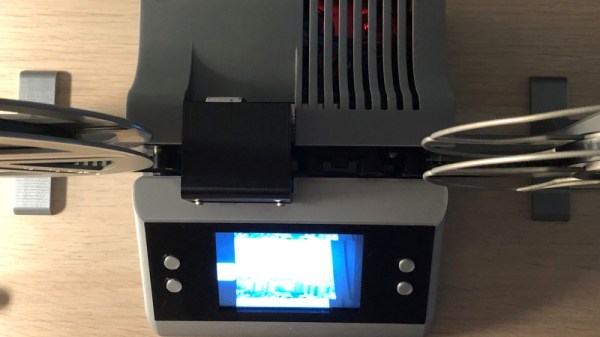
That was the goal of [Anton Gutscher]’s automated 8-mm film scanner. Yes, commercial services exist that will digitize movies, slides, and snapshots, but where’s the challenge in that? And a challenge is what it ended up being. Aside from designing and printing something like 27 custom parts, [Anton] also had a custom PCB fabricated for the control electronics. Film handling is done with a stepper motor that moves one frame into the scanner at a time for scanning and cropping. An LCD display allows the archivist to move the cropping window around manually, and individual images are strung together with ffmpeg running on the embedded Raspberry Pi. There’s a brief clip of film from a 1976 trip to Singapore in the video below; we find the quality of the digitized film remarkably good.

Hats off to [Anton] for stepping up as the family historian with this build. We’ve seen ad hoc 8-mm digitizers before, but few this polished looking. We’ve also featured other archival attempts before, like this high-speed slide scanner.

Continue reading “3D-Printed Film Scanner Brings Family Memories Back To Life”

Clean Water Technologies Hack Chat

Join us on Wednesday, September 4th at noon Pacific for the Clean Water Technologies Hack Chat with Ryan Beltrán!

Access to clean water is something that’s all too easy to take for granted. When the tap is turned, delivering water that won’t sicken or kill you when you drink it, we generally stop worrying. But for millions around the world, getting clean water is a daily struggle, with disease and death often being the penalty for drinking from a compromised source. Thankfully, a wide range of water technologies is available to help secure access to clean water. Most are expensive, though, especially at the scale needed to supply even a small village.

Seeing a need to think smaller, Ryan started MakeWater.org, a non-profit program that seeks to give anyone the power to make clean water through electrocoagulation, or the use of electric charge to precipitate contaminants from water. There’s more to MakeWater than electrocoagulation kits, though. By partnering with STEM students and their teachers, MakeWater seeks to crowdsource improvements to the technology, incorporating student design changes into the next version of the kit. They also hope to inspire students to develop the skills they need to tackle real-world problems and make a difference in the lives of millions.

join-hack-chatOur Hack Chats are live community events in the Hackaday.io Hack Chat group messaging. This week we’ll be sitting down on Wednesday, September 4 at 12:00 PM Pacific time. If time zones have got you down, we have a handy time zone converter.

Click that speech bubble to the right, and you’ll be taken directly to the Hack Chat group on Hackaday.io. You don’t have to wait until Wednesday; join whenever you want and you can see what the community is talking about.

Scrapyard Milling Machine Gets Work Done On A Budget

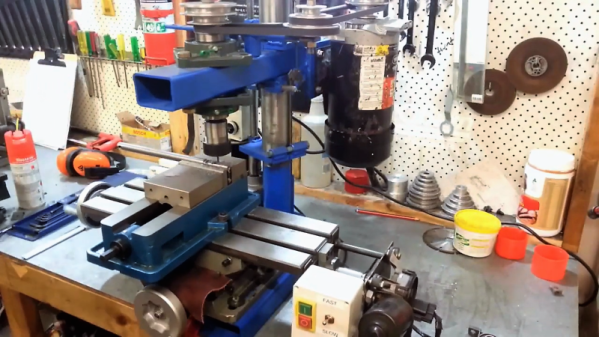
Which to buy first, a lathe or a mill? It’s a tough question for the aspiring home machinist with limited funds to spend on machine tools, but of course the correct answer is a lathe. With a lathe, we are told, all other machine tools can be built, including a milling machine. Granted that might be a slight  exaggeration, but [Maximum DIY] was still able to use his budget-blowing lathe to make a decent milling machine mostly from scrap.

Details are a bit sparse in the forum post, but there’s enough there and in the video after the break to be mightily impressed with the build. Unlike many DIY mills that are basically modified drill presses, [Maximum DIY] started with things like a scrapped bench grinder pedestal and surplus steel tubing. The spindle motor is from a paint sprayer and the Z-axis power feed is a treadmill incline motor. The compound table was a little too hard to make, so the purchased table was fitted with windshield wiper motor power feeds.

Therein lies perhaps the most clever hack in this build: the use of a plain old deep 19mm socket as a clutch for the power feeds. The 12-point socket slides on the square shaft of the wiper motor to engage the drive screw for the compound table – simple and bulletproof.

To be sure, the finished mill is far from perfect. It looks like it needs more mass to quell vibration, and those open drive pulleys are a little nerve wracking. But it seems to work well, and really, any mill is better than no mill. Of course, if you’re flush with cash and want to buy a mill instead of making one, this buyer’s guide should help.

Continue reading “Scrapyard Milling Machine Gets Work Done On A Budget”

Hackaday Links Column Banner

Hackaday Links: September 1, 2019

The sun may be spotless, but that doesn’t mean it isn’t doing interesting things. A geomagnetic storm is predicted for this weekend, potentially giving those at latitudes where the Northern Lights are not common a chance to see a cosmic light show. According to SpaceWeather.com, a coronal hole, a gap in the sun’s atmosphere that can let the solar wind escape, is about to line up with Earth. The last time this hole was on the Earth-facing side of the sun, the resultant storm gave aurora as far south as Colorado. So if you’re in any of the northern tier states, you might want to find somewhere with dark skies and a good view to the north this weekend.

It’s not only space weather that’s in the news, but weather-weather too. Hurricane Dorian will probably make landfall as a Category 4 storm, probably along Florida’s Atlantic coast, and probably in the middle of the night on Monday. That’s a lot of uncertainty, but one thing’s for sure: amateur radio operators will be getting into the action. The Hurricane Watch Net will activate their net for Dorian on Saturday afternoon at 5:00 PM Eastern time, ready to take reports from stations in the affected area. Not a ham? You can still listen to the live feed once the net activates.

Hams aren’t the only ones getting geared up for Dorian, though. Weather satellite enthusiasts are pointing their SDRs at the sky and grabbing some terrifyingly beautiful pictures of Dorian as it winds up. Some of the downloaded images are spectacular, and if you’ve got an SDR dongle and a couple of pieces of coat hanger wire, you too can spy on Dorian from any number of satellites.

Speaking of which, over on r/RTLSDR, someone has done a little data mining and shown that NOAA 15 is still very much alive. u/amdorj plotted the scan motor current draw and found that it steadily decreased over time, possibly indicating that the bearings aren’t as worn as previously thought. We recently covered the story of the plucky satellite that’s almost two decades past its best-by date; here’s hoping our report on its death was greatly exaggerated.

In one of the weirder bits of marketing we’ve seen lately, NASA decided to name a rock on Mars after septuagenarian rockers The Rolling Stones. The golf ball size rock was blasted about a meter across the Martian landscape when the Mars InSight lander touched down in 2018, leaving a small scar in the dust. The stone had obviously rolled, so phone calls were made and one thing led to another, and before you know it, Robert Downey Jr. is making the announcement before a Stones concert at the Rose Bowl, right in JPL’s backyard. There’s even a cute animation to go along with it. It’s a nice piece of marketing, but it’s not the first time the Stones have been somewhat awkwardly linked to the technology world. We dare you not to cringe.

We’ll finish up today with something not related to space. As Al Williams recently covered, for about fifty bucks you can now score a vector network analyzer (VNA) that will do all sorts of neat RF tricks. The NanoVNA sounds like a great buy for anyone doing RF work, but its low price point and open-source nature mean people are finding all kinds of nifty uses for it. One is measuring the length of coax cables with time-domain reflectometry, or TDR. Phasing antenna arrays? the NanoVNA sounds like the perfect tool for the job.

See If Someone Has Been In Your Drawers With This Simple Alarm

There’s a spy movie – probably from the [James Bond] franchise – in which our hero is staying in a fancy hotel. It’s crawling with enemies, naturally, and eager to see if one has been snooping in his room while he’s out for martinis, he sticks a hair across the gap in the door. When he comes back and finds the hair missing, he knows the game is afoot.

This hotel safe intrusion detector is what [Q] might have thought up for such a job if he’d had access to PIC microcontrollers and SMD LEDs. [Andy]’s “LightSafer” is a silent alarm for hotel safes, drawers, closets, or even the refrigerator – anywhere where the transition from dark to light indicates an unwanted visit. It’s tiny – only 33 x 21 mm – and is powered by a CR2032 coin cell. A Broadcom APDS-9300 light sensor watches for openings while the PIC monitors a joystick control for the correct PIN entry. There’s no audible alarm; rather, an LED blinks to indicate an unauthorized intrusion and blinks once for every 15 minutes since the event.

LightSafer is simple but effective, with a clever UI that keeps the current draw low and the battery life long. [Andy] used a similar technique for this low-draw cat tracking collar that we featured a while back.

Giant LED Display Is 1200 Balls To The Wall

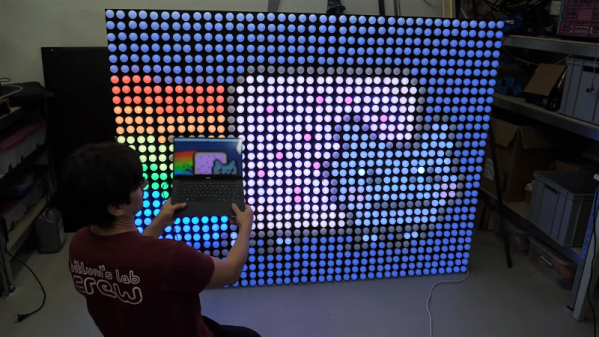
When you’re going to build something big, it’s often a good idea to start small and work out the bugs first. That’s what [bitluni] did with his massive 1200-pixel LED video wall, which he unveiled at Maker Faire Hanover recently.

We covered his prototype a while back, a mere 300 ping pong ball ensconced-LEDs on a large panel. You may recall his travails with the build, including the questionable choice of sheet steel for the panel and the arm-busting effort needed to drill 300 holes with a hand drill. Not wanting to repeat those mistakes, [bitluni] used the custom hole punch he built rather than a drill, and went with aluminum sheet for the four panels needed. It was still a lot of work, and he had to rig up some help to make the tool more comfortable to use, but in the end the punched holes appear much neater than their drilled counterparts.

[bitluni] mastered enough TIG welding to make nice aluminum frames for the panels, making them lightweight and easy to transport. 1200 ping pong balls, a gunked-up soldering iron, and a package of hot glue sticks later, the wall was ready for electronics. It took a 70-amp power supply and an ESP32 to run everything, but that’s enough horsepower to make some impressive graphics and even stream live video – choppy and low-res, but still usable.

We love the look this wall and we appreciate the effort that went into it. And it’s always good to see just how much fun [bitluni] has with his builds – it’s infectious.

Continue reading “Giant LED Display Is 1200 Balls To The Wall”

FM Signal Detection The Pulse-Counting Way

Compared to the simple diode needed to demodulate AM radio signals, the detector circuits used for FM are slightly more complicated. Wrapping your head around phase detectors, ratio detectors, discriminators, and quadrature detectors can be quite an exercise. There’s another demodulation method that’s not so common, but thankfully it’s also pretty easy to understand: the pulse counting detector.

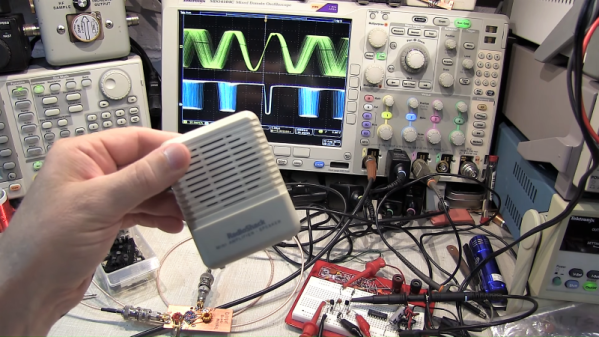
As [Allan (W2AEW)] notes in the video below, pulse counting is a bit of a misnomer. Pulse counting works by generating a narrow, fixed-width square wave pulse at a set point in the received FM signal’s waveform, usually at the zero-crossing point. Since the frequency of the modulated carrier changes, the duty cycle of the resulting pulse train varies. That means there will be a fixed number of pulses, but by taking the average voltage of the pulse train, we can tease out the original audio frequency signal.

Simple in theory is often more complicated in practice, and [W2AEW] goes into some detail about those complications, such as needing to use a down-converter to make the peak-to-peak frequency deviation in the pulse train more easily detectable. As is his style, he walks us through a test circuit to prove that the theory works in practice. A simple two-transistor circuit generates the pulses at the zero-crossing point, a low-pass filter cleans up the signal, and a cheap audio amplifier reproduces the original audio. It’s a crude circuit to be sure, relying on the stray capacitance of the breadboard to work, but it proves the point and serves as a jumping-off point for further experiments – perhaps using an Arduino to count the pulses?

We always enjoy [W2AEW]’s videos and learn a lot from them. Not long ago we featured another of his videos talking about the mysteries of RF modulation; SSB, anyone?

Continue reading “FM Signal Detection The Pulse-Counting Way”