Jaw-Dropping, IC-Free Pong On An Oscilloscope

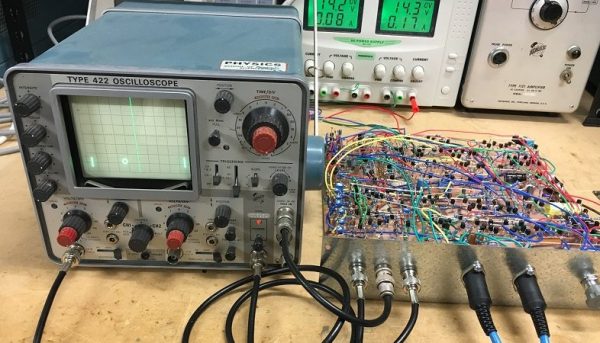
Pong may not be much anymore, but it’s the granddaddy of all video games, and there’s still a lot to learn by studying its guts. And what better way to do that than by having it all laid out before you as you play? All it takes is 200 discrete transistors and two large handfuls of passives tacked to a piece of copper clad board to get a version of Pong executed without a single chip that’s playable on an oscilloscope.

Clearly a labor of love, if not an act of temporary insanity, [GK]’s realization of Pong is a sight to behold. Every scrap of it is circuits of his own design, executed dead bug style, apparently because [GK] enjoys life on hard mode. The game itself is surprisingly playable and you can even play against the machine. The video below is a little hard to watch, what with some glare on the oscilloscope CRT, but we’ll cut [GK] plenty of slack on this one; after all, it looks like this whole project was pulled off in one marathon weekend build session.

We’re still busy poring over the hand-drawn Forrest Mims-style schematics, which by themselves are almost a complete course in analog design. A lot of the circuits remind us [GK]’s bouncing ball simulation, which we covered a while back.

Continue reading “Jaw-Dropping, IC-Free Pong On An Oscilloscope”
The Right Circuit Turns Doppler Module Into A Sensor

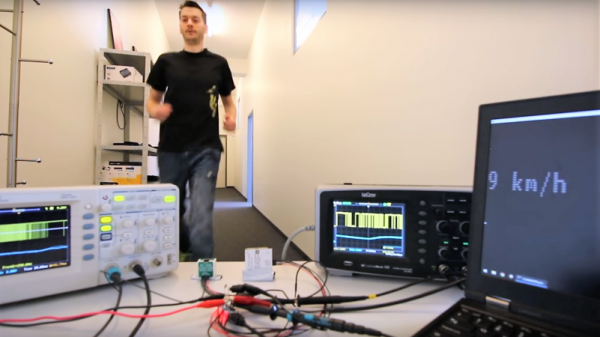
Can you buy a working radar module for $12? As it turns out, you can. But can you make it output useful information? According to [Mathieu], the answer is also yes, but only if you ignore the datasheet circuit and build this amplification circuit for your dirt cheap Doppler module.

The module in question is a CDM324 24-GHz board that’s currently listing for $12 on Amazon. It’s the K-band cousin of the X-band HB100 used by [Mathieu] in a project we covered a few years back, but thanks to the shorter wavelength the module is much smaller — just an inch square. [Mathieu] discovered that the new module suffered from the same misleading amplifier circuit in the datasheet. After making some adjustments, a two-stage amp was designed and executed on a board that piggybacks on the module with a 3D-printed bracket.

Frequency output is proportional to the velocity of the detected object; the maximum speed for the sensor is only 14.5 mph (22.7 km/h), so don’t expect to be tracking anything too fast. Nevertheless, this could be a handy sensor, and it’s definitely a solid lesson in design. Still, if your tastes run more toward using this module on the 1.25-cm ham band, have a look at this HB100-based 3-cm band radio.

Continue reading “The Right Circuit Turns Doppler Module Into A Sensor”

Creepy Tracking At The House Of Mouse

If it’s been a few years since you’ve been to Disney World, you’re in for a surprise on your next visit. It seems the Happiest Place on Earth has become the Trackiest Place on Earth thanks to the Disney MagicBand, a multipurpose wristband that acts as your pass to all the Disney magic.

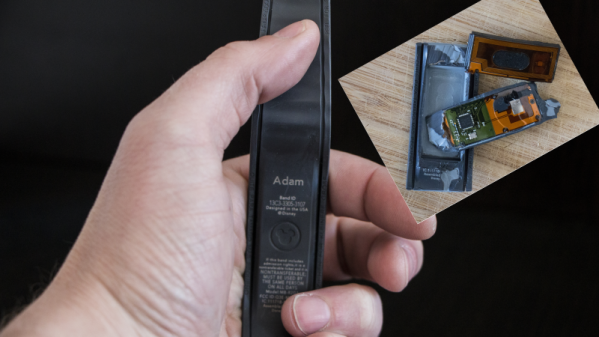
[Adam] recently returned from a Disney vacation and brought back his MagicBand, which quickly went under the knife for a peek at the magic inside. It turns out the technology is fairly mundane — a couple of flex PCBs with trace antennas and the usual trappings of an RFID transponder. But there’s also another antenna and a chip identified in a separate teardown as an NRF24LE1 2.4 GHz transceiver and microcontroller. The whole thing is powered by a coin cell, meaning the band isn’t just being interrogated by RFID – it’s actively transmitting and receiving.

What exactly it’s doing isn’t clear; Disney was characteristically cagey about specifics when [Adam] looked into the details, saying only that the bands “provide information that helps us improve the overall experience in our parks”. If you put aside the privacy concerns, it’s truly mind-boggling to think about the systems that must be in place to track thousands of these MagicBands around the enormous Disney property. And we can’t help but wonder if some of Disney R&D’s EM-Sense technology is at work in these wearables.

Thanks to [JohnU] for the tip.

Power Sipping Master Keeps Slave Clock On Time

Few things are as infuriating as clocks that are not synchronized. It’s frustrating when the clock on the range and the clock on the microwave act like they’re in time zones that are one minute apart. Now picture that same issue over dozens of clocks in a train station, or hundreds in a school or factory. It’s no wonder that slave clocks, which advance on signals from a master clock, were developed.

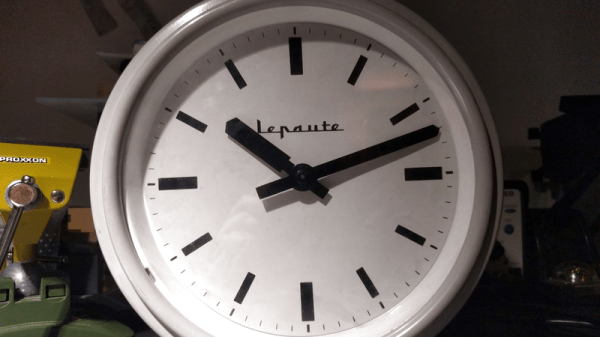
When a pair of vintage Lepaute slave clocks made their way to [melka], he knew just what to do – build his own master clock to keep the slave on track. This particularly stylish slave clock uses pulses of alternating polarity every 30 seconds and will work on 1.5-volt pulses, which let [melka] meet his design goal of running for a year off a single AA battery. To keep the power needs low, [melka] relies on the RTC to wake up the MSP430 every second to increment a counter. When it hits 30, a pulse is sent to the clock’s motor through an H-bridge; the MCU alternates the polarity of every other pulse to advance the clock.

It’s not immediately clear how the clock is set; we recall the slave clocks in high school rapidly advancing for Daylight Saving adjustments, so we assume [melka] has provided some way of pulsing the clock quickly to set the time. Regardless, it’s a good lesson in low-power design. And be sure to check out this PIC-based master clock replacement, too.

Save Big By Hacking Your Car Keys

Three hundred bucks for a new car key? Nonsense! When you lose your keys or want to have an extra made for that new teen driver, don’t let the stealership lighten your wallet. Just pull the ECU and hack some hex to add the new keys.

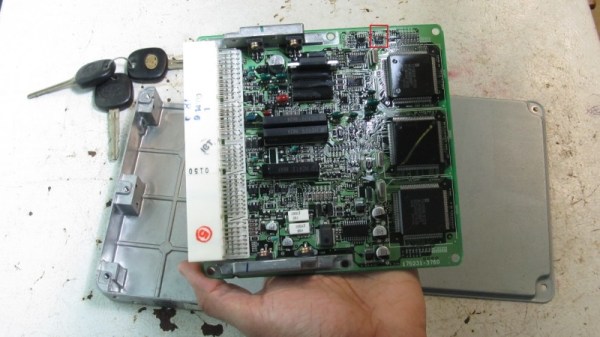
The video below is a whirlwind tour of the process [speedkar9] uses to reprogram Toyota ECUs to allow new keys to pass the security test on your new(er) car. Since the early 2000s or so, most manufacturers have included RFID chips in their keys so that only known keys will start a car. In Toyotas, this is done by an RFID reader in the steering column that passes the inserted key’s code to the engine control unit. If the 8-byte key code matches one of three values stored in the ECU, the car will start. Clearing the EEPROM in the ECU is the focus of [speedkar9]’s process, which connecting to the EEPROM and reading the contents. His rig includes an RS-232 serial connection, so the hardest part of this hack might be rounding up a PC with a DB-9 jack, but once you’ve got that covered, it’s just a little bit-bashing to “virginize” the ECU to ready it for reprogramming.

The details of the procedure will vary by manufacturer, of course, and cars of a more recent vintage will likely have even more security to worry about. Might you even run afoul of DRM like you would by hacking a tractor? Perhaps. But $300 is $300.

Continue reading “Save Big By Hacking Your Car Keys”

A Wallflower Jumps Into The Los Angeles Unconference

When I was asked to cover the Unconference in Los Angeles last week, I have to admit that I was a more than a little uncomfortable with the idea. I’m not big on traveling, and the idea of meeting a lot of folks was a little intimidating. Surely meeting Hackaday readers in person would be like walking into a real-life version of the comments section of a particularly controversial post. Right?

I couldn’t have been more wrong.

The LA Unconference, held at the Supplyframe Design Lab in Pasadena, was a far more collegial and engaging conference than any I’ve been to in my professional life. I couldn’t have asked for a better group to share the afternoon and evening with, and the quality of the talks was excellent. The Design Lab turned out to be a great space for the event — a large main room for the talks with plenty of little areas to break away for impromptu discussions and networking.

Continue reading “A Wallflower Jumps Into The Los Angeles Unconference”

“Norman, Coordinate!”

If Star Trek taught us anything, it’s clearly that we’re not quite in the future yet. Case in point: androids are not supposed to be little flecks of printed circuits with wires and jacks sprouting off them. Androids are supposed to be gorgeous fembots in polyester kimonos with beehive hairdos, designed to do our bidding and controlled by flashing, beeping, serial number necklaces.

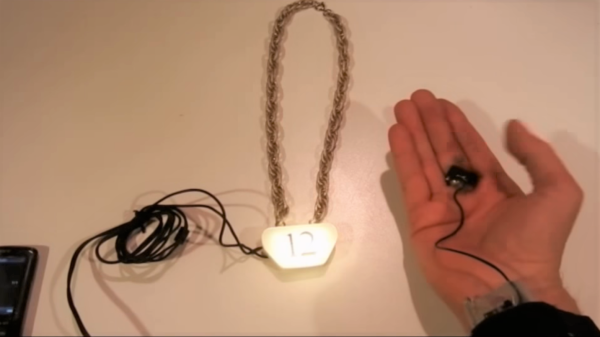
Not willing to wait till the 23rd century for this glorious day, [Peter Walsh] designed and built his own android amulet prop from the original series episode “I, Mudd.” There’s a clip below if you need a refresher on this particularly notable 1967 episode, but the gist is that the Enterprise crew is kidnapped by advanced yet simple-minded androids that can be defeated by liberal doses of illogic and overacting.

The androids’ amulets indicate when they BSOD by flashing and beeping. [Peter]’s amulet is a faithful reproduction done up in laser-cut acrylic with LEDs and a driver from a headphone. The leads for the amulet go to a small control box with a battery pack and the disappointing kind of Android, and a palmed microswitch allows you to indicate your current state of confusion.

You’ll be sure to be the hit of any con with this one, although how to make smoke come out of your head is left as an exercise for the reader. Or if you’d prefer a more sophisticated wearable from The Next Generation, check out this polished and professional communicator badge. Both the amulet and the communicator were entries in the Hackaday Sci-Fi contest.

Continue reading ““Norman, Coordinate!””