POV Globe Display Spins Up Full Color Tupac

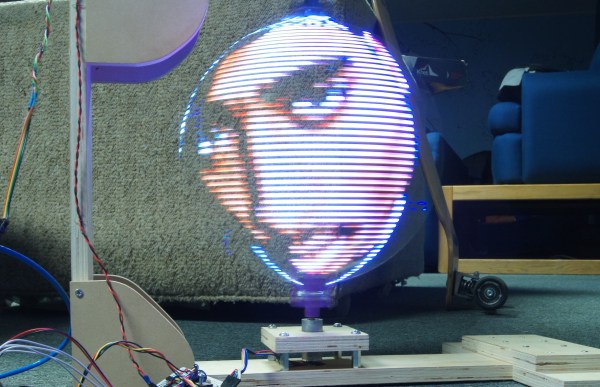
Persistence of vision projects were once all the rage, judging by a quick review of the literature here on Hackaday. They’ve tapered off a bit lately, but this impressive full-color globe display might just kick-start some new POV projects.

Built as a final project for an EE course, [Evan] and [Kyle]’s project is more about the control electronics and programming than the mechanical end of the build. Still, spinning a 12″ ring of 1/4″ thick acrylic with a strip of APA102 LEDs glued to the edge takes some thoughtful engineering. While the build appears sturdy, [Evan] does admit to a bit of wobble under full steam, which was addressed by adding some weight to the rig. We wonder if mounting half the LEDs on each side of the ring to balance the forces wouldn’t have worked better. True, it would have complicated the coding for the display, but maybe that would have been good for extra points. In any case, the display turned out well and the quality of the images is great. And as an aside: how awesome is it that we live at a time when you can order a six-circuit slip-ring for a project like this for less than $20?

It’s the end of the semester and we love seeing the final projects that have just made it across the finish line. This globe is one, yesterday we saw a voice-controlled digital eye exam, and if you have or know of a final project, don’t forget send us the link!

If POV globes are your thing, be sure to set the Hackaday WABAC machine a few years and check out this Death Star design from 2012 or this globe from 2010.


Lise Meitner: A Physicist Who Never Lost Her Humanity

It is said that the first casualty of war is the truth, and few wars have demonstrated that more than World War II. One scientist, whose insights would make the atomic age possible, would learn a harsh lesson at the outset of the war about how scientific truth can easily be trumped by politics and bigotry.

Lise Meitner was born into a prosperous Jewish family in Vienna in 1878. Her father, a lawyer and chess master, took the unusual step of encouraging his daughter’s education. In a time when women were not allowed to attend institutions of higher learning, Lise was able to pursue her interest in physics with a private education funded by her father. His continued support, both emotional and financial, would prove important throughout Lise’s early career. Continue reading “Lise Meitner: A Physicist Who Never Lost Her Humanity”

Netflix And Chill – And Socks?

Waking up to spoilers in the last episode after falling asleep during the first episode of a Netflix binge-watching session ranks right up there on the list of first-world problems. Luckily there’s a solution in the form of a pair of Netflix enabled socks, which looks like a pretty neat wearable IoT project.

To be sure, calling these socks Netflix enabled is a bit of a stretch. Aside from the sock designs, which are based on popular Netflix original series, there’s nothing about the electronics that’s specific to the popular streaming service. These socks, with their Arduino Pro Trinket and accelerometer, detect when you stop moving and send an IR signal to do your bidding – pause the movie, kill the TV, or whatever. The electronic side of the build is pretty approachable – it’s just a couple of modules soldered together. The fiber arts side of the project might be a little outside the wheelhouse of the typical hardware hacker, but you can either team up with someone who knits – an experienced knitter, as socks are not a beginner’s pattern – or just slip the felt-clad hardware into your favorite comfy socks. We’d be a bit concerned about ESD protection for the hardware in the wooly environment, though.

“Netflix and chill” is the current version of last century’s “Watching the submarine races,” and as such the need for special socks or a custom Netflix switch for the occasion is a bit puzzling. Still, the underlying wearables idea is pretty good, with plenty of possibilities for expansion and repurposing.

Continue reading “Netflix And Chill – And Socks?”

Remote PC Power Control Thwarts Button Pushers

Pervasive connectivity is a mixed blessing at best, especially when it creates the expectation that we’ll always have access to everything we need. When what you need is on your work or home PC, there are plenty of options for remotely accessing files using your phone. But if your roomie or the cleaning crew powers the machine down, you’ve got a problem – unless you’ve got a way to remotely power the machine back up.

[Ahmad Khattab]’s hack required getting up close and personal with his PC’s motherboard. A Particle Photon steals power from the always-on 3.3 volt line of the vacant Trusted Platform Module connector on his machine. Outputs from the Photon are connected to the motherboard’s power switch connection and a smartphone app drives the outputs and turns the machine on and off. As [Ahmad] admits, there are plenty of ways to attack this problem, including Wake-on-LAN. But there’s something to be said for the hardware approach, especially when a Photon can be had for $20.

Astute readers will note that we recently covered a very similar project using a Particle Core. Be sure to check that one out for a little more detail on using Particle’s cloud, and for some ideas on powering the module if your motherboard lacks a TPM port. In the meantime, enjoy [Ahmad]’s video.

Continue reading “Remote PC Power Control Thwarts Button Pushers”

SparkFun, AT&T To Sponsor Hackathon At Troy’s TVCoG

Big-name corporate sponsors, top-notch judges and mentoring, 36 hours to play in a huge new hackerspace, and all the Cheetos and Red Bull you need to stoke the creative fires. Sounds like a hackathon, and it’ll roll into The Tech Valley Center of Gravity in Troy, New York next month. And from the look of it, it’s going to be a big deal. You should be there.

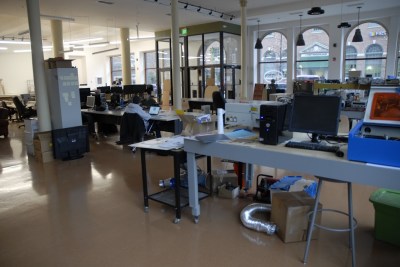
_DSC0140You might recall the TVCoG from a story we did this summer on the grand opening of their amazing newly renovated space in downtown Troy. Occupying an entire city block in a historic department store building and housing not only a huge hackerspace but a tech company incubator with manufacturing capabilities and a STEM outreach space, the CoG now has the room to reach out into the community and host big events. The hackathon scheduled for January 30 and 31 and is only the first of four events planned for 2016. This one has the theme “Internet of Things” and will feature SparkFun’s Jeff Branson as mentor and judge.

Here’s a call to arms for Hackaday readers in the northeast: let’s pack this hackathon and make it huge. There’s already a bunch of Jolly Wrencher stickers scattered all over from our last visit, so you’ll feel right at home. Head over to the TVCoG site and sign up for this one. We’d really like to see HaD take home bragging rights. And you can be sure we’ll be covering the event and bringing some swag of our own.

[Thanks to Duncan Crary for the tip!]

Heathkit’s Triumphant Return?

Heathkit, the storied purveyor of high-quality DIY electronics kits that inspired a generation of enthusiasts and launched the careers of many engineers, has returned from the dead. We think. At least it seems that way from this build log by [Spritle], an early adopter of the rebooted company’s first offering. But if [Spritle]’s experience is any indication, Heathkit has a long way to go to recreating its glory days. Continue reading “Heathkit’s Triumphant Return?”

Gutted USB Power Packs Run Your TV

With a computer in every pocket, being tethered to large mains-powered appliances is a bit passe. No longer must you be trapped before the boob tube when you can easily watch YouTube on your phone. But you might be jonesing for the big screen experience in the middle of a power outage, in which case learning to build a simple battery bank built from cheap cell-phone power packs might be a good life skill to practice.

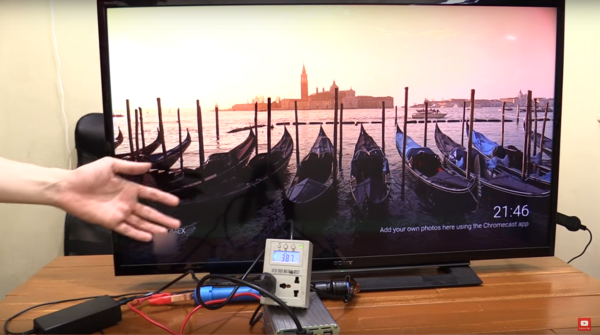
Looking more for proof of concept than long-term off-grid usability from his battery bank, [Stephen] cobbled together a quick battery bank from 18650 lithium ion batteries and a small 300W inverter. All the hardware was had on the cheap from an outfit called Cd-r King, a Phillipines-based discount gadgetorium we’d like to see in the states. He got a handful of USB power packs and harvested the single 18650 battery from each, whipped up a quick battery holder from 1/2″ PVC pipe and some bolts to connect the inverter. With four batteries in series he was able to run a flat-screen TV with ease, as well as a large floor fan – say, is that a Mooltipass on [Stephen]’s shelf in the background? And what’s nice about the gutted USB power packs is that they can still be used to recharge the batteries.

As [Stephen] admits, this is a simple project and there’s plenty of room to experiment. More batteries in parallel for longer run times is an obvious first step. He might get some ideas from this laptop battery bank project, or even step up to Tesla Li-ion battery hacking – although we doubt Cd-r King will be of much help with the latter.

Continue reading “Gutted USB Power Packs Run Your TV”