RC Mini Flame Thrower Brings The Burn

It goes without saying that a radio controlled mini flame thrower can be nothing but a bad idea and you should never, ever build one. But once you watch the video below, you’ll be tempted to try. But don’t do it – you’ve been warned.

That said, the video below shows that [Make-log]’s remarkably compact build is chock full of safety interlocks and sports a thoughtful and informative user interface. It’s fueled by a small can of spray deodorant whose valve is actuated by a servo and ignited by a spark-gap igniter. Alas, this final critical component is no longer available from SparkFun, so if you choose to roll your own – which you shouldn’t – you’ll need to find a substitute.

We’ve featured an unreasonable number of flame thrower projects before, including a ton of wristmounted units. Of course if you’re a musically inclined pyromaniac, you’ll also want to check out this mini Doof Warrior setup too.


Continue reading “RC Mini Flame Thrower Brings The Burn”

Small-farm Automation Keeps Livestock Safe And Happy

Life down on the farm isn’t easy, and a little technology can go a long way to making things easier for the farmer. It’ll be a while before any farmer can kick back on the beach and run his place from a smartphone, but that’s clearly the direction things are heading with this small farm automation project.

1239891449500446540[Vince]’s livestock appears to consist of chickens and sheep at this point, and the fact that they share housing helped him to deploy some tech for both species. The chickens got an automated door that lets them out in the morning and shuts them in safely once they’ve returned to roost for the night – important protection against predators. The door is hoisted by a Somfy window-treatment motor, which seems a little on the overkill side to us; a thrift-store electric drill and a homebrew drum might have worked too. A Teensy with an RTC opens and closes the door according to sunrise and sunset times, and temperature and humidity sensors provide feedback on conditions inside the coop. The sheep benefit from a PTZ webcam to keep an eye on their mischief, and the whole thing is controlled by a custom web interface from [Vince]’s smartphone.

There’s just something about automating chicken coop doors that seems to inspire hackers; check out this nice self-locking design. As for [Vince]’s farm, it looks like his system has a lot of room for expansion – food and water status would be a great next step. We’re looking forward to seeing where he goes from here.

Spectacular View Of The Eiffel Tower Is All Done With Mirrors

What Parisian wouldn’t want an apartment with a view of the Eiffel Tower? Alas, not every window can face the famed landmark, and for some, the million Euro view is tantalizingly out of reach. Such was the case for [Lurluberlu], but with a little optical trickery he was able to peer around a corner to deliver spectacular views of the Eiffel Tower to his bedroom.

[Lurluberlu] devised a simple horizontal periscope using two full-length mirrors. The video after the break shows the build – as a side note, we’re very jealous of his hand tool packed workshop. With some plywood backing and simple swivels, the mirrors were mounted on his window sill to bounce the iconic tower’s image inside. After a little adjustment, the image is perfectly framed by the window, and with the lights off in the apartment, the view from the bed is quite spectacular. Our bet is that it’s quite a bit cheaper than moving to a flat with a better view.

Of course, with a little ingenuity (and a balcony) anyone can have a view of the City of Light. Or anywhere else for that matter.

Continue reading “Spectacular View Of The Eiffel Tower Is All Done With Mirrors”

Industrial Automation In Action: Steam Controller Assembly

Right up front, we’ll cop to the inevitable “not a hack” comments on this one. This video of the Steam Controller assembly plant is just two minutes of pure robotics porn, plain and simple.

From injection molding of the case parts through assembly, testing and final palletizing of packaged controllers for the trip to distributors, Valve’s video is amazingly detailed and very well made. We’d wager that the crane shots and the shots following product down conveyors were done with a drone. A grin was had with the Aperture Labs logo on the SCARA arms in the assembly and testing work cell, and that inexplicable puff of “steam” from the ceiling behind the pallet in the final shot was a nice touch too. We also enjoyed the all-too-brief time-lapse segment at around 00:16 that shows the empty space in Buffalo Grove, Illinois being fitted out.

This may seem like a frivolous video, but think about it: if you’re a hardware hacker, isn’t this where you want to see your idea end up? Think of it as inspiration to get your widget into production. You’ll want to get there in stages, of course, so make sure you check out [Zach Fredin]’s 2015 Hackaday Superconference talk on pilot-scale production.

Continue reading “Industrial Automation In Action: Steam Controller Assembly”

Quick Network Bridge Gets Off-grid Home Back Online

Off-grid living isn’t for everyone, but it has gotten easier in recent years. Cheap solar panels and wind turbines let you generate your own power, and there are plenty of strategies to deal with fuel, water and sanitation. But the one thing many folks find hard to do without – high-speed internet access – has few options for the really remote homestead. [tlankford01] wants to fix that and is working on an open-source mesh network to provide high-speed internet access to off-grid communities.

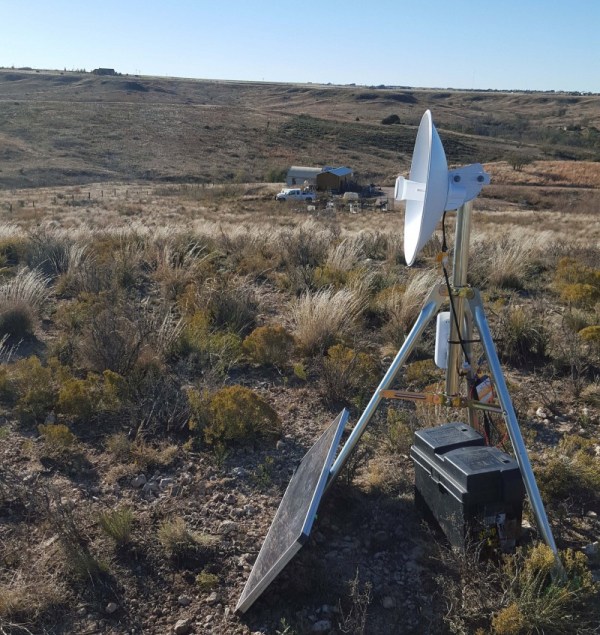
But first he had to deal with a major problem. With high-speed access provided by a Clearwire wireless network, streaming content to his two flat-screen TVs wasn’t a problem. At least until Sprint bought Clearwire and shut down the service in early November. Another ISP covered his area, but his house lies in a depression out of line of sight of their tower. So he rigged up a bridge between the WiMAX network and his lab. The bridge sits on a hill in sight of the ISP’s tower 3.5 miles away. Solar panels, a charge controller and deep-cycle batteries power everything, and a wireless link down the hill rounds out the build.

This is obviously a temporary solution, and probably wouldn’t last long in winter weather. But it’s working for now, and more importantly it’s acting as proof of concept for a larger mesh system [tlankford01] has in mind. There are plenty of details on what that would look like on his project page (linked above), and it’s worth a look too if you’re interested in off-grid connectivity.

Gitaar Van Schroot – The Scrap Metal Guitar

Sheet metal. Beer cans. Pieces of chain. Not items you’ll typically find on the BOM for a custom guitar. But nobody told [Maarten van Halderen] that, and so he threw them all together into a gitaar van schroot, or scrap guitar for the Dutch impaired (YouTube link).

The video shows the build process, starting with plasma cutting and welding sheet steel for the body. The neck is fabricated from rectangular steel tube, with nails serving as frets. Overall it looks like a Les Paul, except for the sink strainer basket mounted in the sound hole and the crushed beer and soda cans tacked to the body for decoration. The chains are a nice touch too. And this doesn’t appear to be [Maarten]’s first attempt at scrapyard lutherie  – toward the end of the video we see that the beer can axe joins a very steam-punk looking older brother. They’re both good-looking builds, and the video after the break proves they can sound pretty good too.

For a more classical take on the building of string instruments, check out this post on mandolins and violas. Or maybe you can just 3D print your next guitar?

Continue reading “Gitaar Van Schroot – The Scrap Metal Guitar”

Old School Analog Meters Tell You The Weather

A home weather station is great geek street cred. Buying a commercially available station will get you all the bells and whistles, but the look tends to the utilitarian. And then there’s the trouble of placing the sensor array somewhere. To solve both problems, [GradyHillhouse] built this unique weather station with analog meters.

Based on a Particle Photon pulling weather data from the forecast.io API, values for temperature, pressure and the like are sent to analog IO pins. Each pin has a meter with a trimmer pot for calibration and a custom printed label. There’s also a digital output that goes high when a severe weather alert is posted; that drives an LED behind the bezel of one of the meters. Everything is mounted in a walnut plaque which makes for a nice presentation. The video after the break details the build.

As you can imagine, we’ve featured lots of weather stations before. Some display their data on a screen, some in more unique ways. But we really like the old school look and simplicity of this project.

Continue reading “Old School Analog Meters Tell You The Weather”