Arduino Radar Watches You Breathe

We’ve all likely watched an episode of “Star Trek” and admired the level of integration on the sick bay diagnostic bed. With its suite of wireless sensors and flat panel display, even the 1960s imagining of the future blows away the decidedly wired experience of a modern-day ICU stay. But we may be getting closer to [Dr. McCoy]’s experience with this radar-based respiration detector.

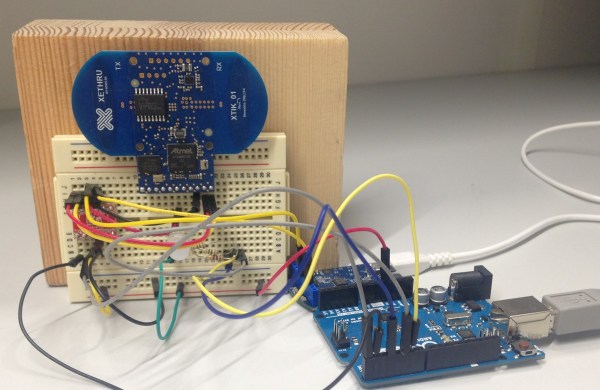
[Øyvind]’s build, which takes the origin of the term “breadboard” to heart, is based on a not-inexpensive Xethru module, which appears to be purpose-built for detecting respiration. The extra-thick PC board seems to house the waveguides internally, which is a neat trick but might limit how the module can be deployed. The module requires both a USB interface and level shifter to interface the 2.8V levels of the module to the 5V Arduino Uno. In the video below, [Øyvind]’s prototype simply lights an RGB LED in response to the chest movement it detects, but there’s plenty of potential for development here. We’ve seen a laser-based baby breathing monitor before; perhaps this systems could be used to the same end without the risk of blinding your tyke. Or perhaps better diagnostics for sleep apnea patients than an intrusive night in a sleep study lab.

Clocking in at $249 for the sensor board and USB interface, this build is not exactly for the faint of heart or the light of wallet. But as an off-the-shelf solution to a specific need that also has a fair bit of hacking potential, it may be just the thing for someone. Of course if radar is your thing, you might rather go big and build something that can see through walls.
Continue reading “Arduino Radar Watches You Breathe”

Simple, Cheap Nitrate Tester Is Open Source

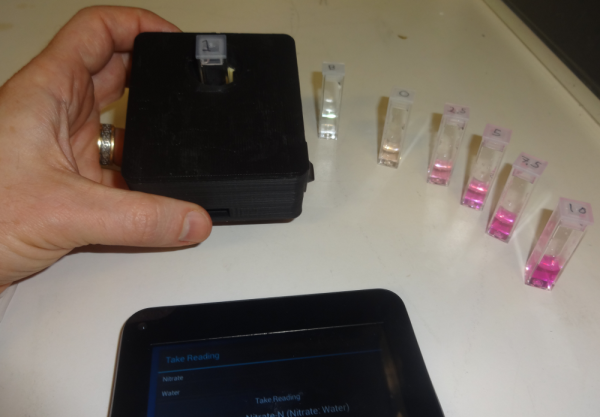
Too much of a good thing can be a bad thing, and nitrate pollution due to agricultural fertilizer runoff is a major problem for both lakes and coastal waters. Assessing nitrate levels commercially is an expensive process that uses proprietary instruments and toxic reagents such as cadmium. But [Joshua Pearce] has recently developed an open-source photometer for nitrate field measurement that uses an enzyme from spinach and costs a mere $65USD to build.

The device itself is incredibly simple – a 3D printed enclosure houses an LED light source and a light sensor. The sample to be tested is mixed with a commercially available reagent kit based on the enzyme nitrate reductase, resulting in a characteristic color change proportional to the amount of nitrate present. The instrument reads the amount of light absorbed by the sample, and communicates the results to an Android device over a Bluetooth link.

Open-source instruments like this can really open up educational opportunities for STEM groups to get out into the real world and start making measurements that can make a difference. Not only can this enable citizen scientists and activists, but it also opens the door for getting farmers involved in controlling nitrate pollution at its source – knowing when a field has been fertilized enough can save a farmer unnecessary expense and reduce nitrate runoff.

There are a lot of other ways to put an open-source instrument like this to use in biohacking – photometery is a very common measuring modality in the life sciences, after all. We’ve seen similar instruments before, like a DIY spectrophotometer, or this 2015 Hackaday Prize entry medical tricorder with a built-in spectrophotometer. Still, for simplicity of build and potential impact, it’s hard to beat this instrument.

Hackaday Prize Entry: Gas Grenade Helps Instead Of Exploding

If someone lobs a grenade, it’s fair to expect that something unpleasant is going to happen. Tear gas grenades are often used by riot police to disperse an unruly crowd, and the military might use a smoke grenade as cover to advance on an armed position, or to mark a location in need of an airstrike. But some gas grenades are meant to help, not hurt, like this talking gas-sensing grenade that’s a 2015 Hackaday Prize entry.

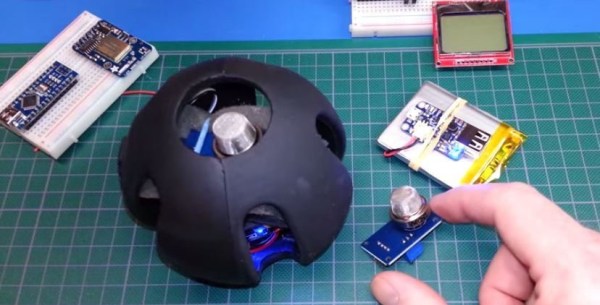
Confined space entry is a particularly dangerous aspect of rescue work, especially in the mining industry. A cave in or other accident can trap not only people, but also dangerous gasses, endangering victims and rescuers alike. Plenty of fancy robots have been developed that can take gas sensors deep into confined spaces ahead of rescuers, but [Eric William] figured out a cheaper way to sniff the air before entering. An MQ2 combination CO, LPG and smoke sensor is interfaced to an Arduino Nano, and a 433MHz transmitter is attached to an output. A little code measures the data from the sensors and synthesizes human voice readings which are fed to the transmitter. The whole package is stuffed into a tough, easily deployed package – a Nerf dog toy! Lobbed into a confined space, the grenade begins squawking its readings out in spoken English, which can be received by any UHF handy-talkie in range. [Eric] reports in the after-break video that he’s received signals over a block away – good standoff distance for a potentially explosive situation.

Continue reading “Hackaday Prize Entry: Gas Grenade Helps Instead Of Exploding”

Visualizing RF Standing Waves

Standing waves are one of those topics that lots of people have a working knowledge of, but few seem to really grasp. A Ham radio operator will tell you all about the standing wave ratio (SWR) of his antenna, and he may even have a meter in the shack to measure it. He’ll know that a 1.1 to 1 SWR is a good thing, but 2 to 1 is not so good. Ask him to explain exactly what a standing wave is, though, and chances are good that hands will be waved. But [Allen], a Ham also known as [W2AEW], has just released an excellent video explaining standing waves by measuring signals along an open transmission line.

[Source: Wikipedia]
[Source: Wikipedia]
To really understand standing waves, you’ve got to remember two things. First, waves of any kind will tend to be at least partially reflected when they experience a change in the impedance of the transmission medium. The classic example is an open circuit or short at the end of an RF transmission line, which will perfectly reflect an incoming RF signal back to its source. Second, waves that travel in the same medium overlap each other and their peaks and troughs can be summed. If two waves peak together, they reinforce each other; if a peak and a trough line up, they cancel each other out.

Continue reading “Visualizing RF Standing Waves”

Custom Machined Triple Threat Slingshot

Time was when a lad in need of a ranged weapon would hack a slingshot together out of a forked tree branch and a strip of inner tube. Slingshot design has progressed considerably since [Dennis the Menace]’s day, but few commercially available slingshots can match up to the beauty and functionality of this magnificently machined multipurpose handheld weapon system.

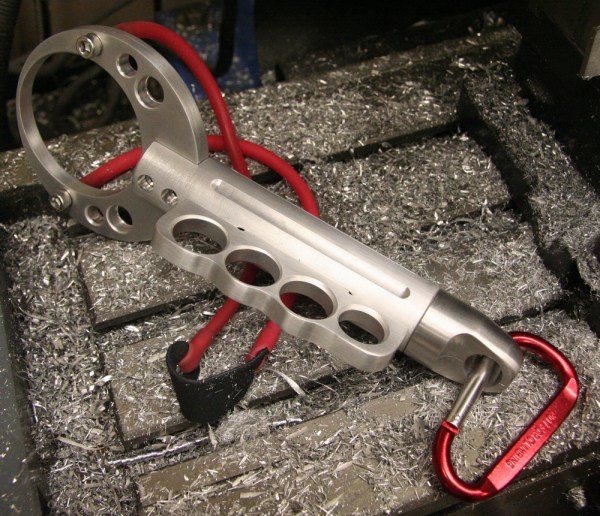
Making it clear in his very detailed build log that this is but a prototype for a design he’s working on, [Gord] has spared little effort to come up with a unique form factor that’s not only functional as a slingshot, but also provides a few surprises: a magazine that holds nine rounds of ammo with magnets; knuckle protection on the hand grip that would deal a devastating left hook; and an interchangeable base that provides a hang loop or allows mounting a viciously sharp broadhead hunting arrow tip for somewhat mysterious purposes. There’s plenty to admire in the build process as well – lots and lots of 6061 billet aluminum chips from milling machine and lathe alike. All told, a nice piece of craftsmanship.

For a more traditional slingshot design with a twist, check out this USB-equipped slingshot that talks to Angry Birds. And when your taste in slingshots run more toward the ridiculously lethal, [Jörg Sprave]’s machete launcher never disappoints.

[Thanks Leslie!]

Dissolve Steel Drill Bits In Alum From The Grocery

Breaking a stud or a bolt is a pretty common shop catastrophe, but one for which a fair number of solutions exist. Drill it out, shoot in an extractor, or if you’re lucky, clamp on some Vise-Grips and hope for the best. But when a drill bit breaks off flush in a hole, there aren’t a lot of options, especially for a small bit. If the stars align, though, you may follow this video guide to dissolve the drill bit and save the part.

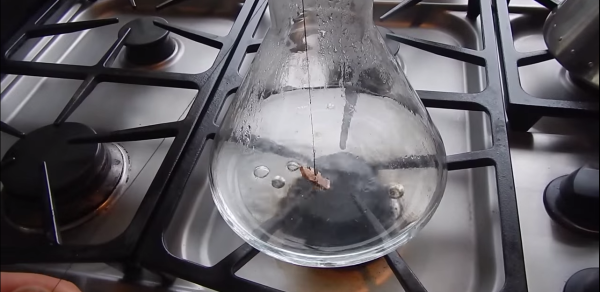
Looks like [Adam Prince] lucked out with his broken bit, which he was using to drill the hole for a pin in a small custom brass hinge. It turns out that a hot solution of alum (ammonium aluminum sulfate), which is available in the spice rack of your local supermarket, will dissolve the steel drill bit without reacting with the brass. Aluminum is said to be resistant to the alum as well, but if your busted bit is buried in steel, you’re out of luck with this shop tip.

We’re a bit disappointed that [Adam]’s video ends somewhat abruptly and before showing us the end result. But a little Googling around reveals that this chemical technique is fairly well-known among a group that would frequently break bits in brass – clockmakers. It remains to be seen how well it would work for larger drill bits, but the clocksmiths seem to have had success with their tiny drills and broaches.

As for the non-dissolved remains of the broken bit, why not try your hand at knife making?

How To Rescue Your Quadcopter From A Tree

Whether it’s a new rocket, your latest quadcopter, or [Charlie Brown]’s kite, it always seems like there’s a tree waiting to catch and eat airborne projects. Sometimes you get lucky and find a way to climb up the tree to retrieve your wayward build, but most times you’re reduced to looking for rocks or sticks to fling up there in an attempt to shake it loose. But if you want to improve your chances of getting your stuff back, [U.S. Water Rockets] has a build for a retrieval tool made mostly from scrap bin parts that will help.

All you need is some PVC tubing, an old fishing reel and line, some latex surgical tubing, and a few dowels for projectiles. You can tell everything about the build from the BOM and stills, but the video after the break gives detailed instructions and shows it in action. Adding some fins to the dart or even substituting a cheap arrow from the sporting goods department of your favorite retailer might help with your aim. Even without fletching, the accuracy of the launcher is pretty good, and the range isn’t half bad either. Once the fishing line is over the branch that ate your quad it can be used to haul up successively stouter ropes, and pretty soon you’ll be shaking the tree like a boss.

Even if getting stuff out of trees isn’t on your immediate to-do list, this little hack could be put to other uses. Hams will use it to loft antennas up into trees, and tag-line placement for tree removal could be simplified with this tool. But if you still find yourself needing to retrieve stuff, you might want to be proactive and make your aerial robot tree-proof. That still won’t eliminate the need for drone-on-drone rooftop rescues.

Continue reading “How To Rescue Your Quadcopter From A Tree”