Hackaday Prize 2022: DIY Brushless Hand Cranked Generator

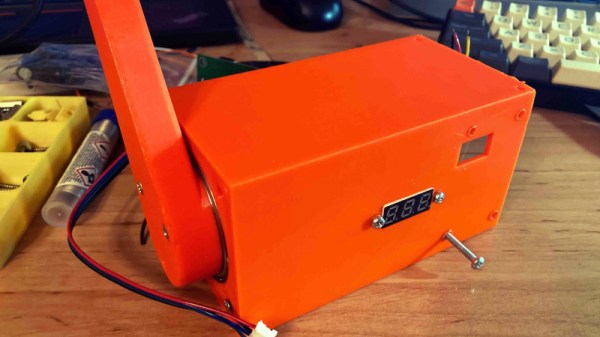
A standard part of travel kit for the 2020s is now a battery pack — a hefty lithium-ion cell with onboard electronics for USB charging, that ensures all of our devices stay topped up while we’re out of range of a socket. But what happens when there is no handy mains supply to recharge it from? Step in [Chleba], with a hand cranked generator.

There are plenty of hand cranked generators to be found online, from tiny devices intended to top up a single phone to sturdy metal boxes intended for battery charging. This one differs from those in that most use a brushed DC motor as a cheap generator, while here that function comes from a stepper motor feeding a rectifier pack and thence a DC-to-DC converter. A step-up gearbox provides the necessary shaft speed, and a neat 3D-printed case rounds everything off.

The result is about as neat a generator as you could imagine, and would certainly be of use shoved into any off-grid backpack. Meanwhile it’s not the first we’ve shown you, we’ve even see one that could start a car.


Buzzword Bingo Bitcoin Burial Burrowing Blueprint Balked At By Bureaucracy

Many of you will at some time have heard the unfortunate tale of [James Howells], a Welsh IT worker who threw away a hard drive containing 8,000 Bitcoin back in 2013. Over the years he’s hatched various schemes to persuade his local council to let him dig up the landfill where it’s reputed to be buried, and every time he’s been rebuffed. Despite the fall in the price of cryptocurrencies he’s back with another. With the added spice of AI and robot dogs alongside the cryptocurrency angle, it reads like a buzzword bingo card and adds a whole new meaning to “Bitcoin mining”. Seemingly despite generous offers the local council are still not keen on letting him dig for the drive.

We can’t help feeling sorry for the guy — after all, in the early days of cryptocurrency the coins were a worthless curiosity so it’s not impossible there are readers with similar stories. But we’re curious how well the drive will have survived its 9-year interment even if the AI robot arm and robot dog security would ensure its recovery. With that much cash at stake the best in the data recovery business will no doubt be unleashed on whatever remains they might recover, but in the unfriendly environment of a festering landfill we’d be curious as to whether chemical action might have corroded the platters to the point at which nothing might remain. Wales has a high rainfall unlike the American southwest, so we doubt it would survive as well as an Atari cartridge.

Meanwhile, tell us your cryptocurrency might-have-beens in the comments.

Landfill Site sign by Geographer, CC BY-SA 2.0.

The Hackaday Summer Camp Survival Guide

It’s a feature of summer for us, the round of hacker camps in which members of our community gather in fields and spend a few days relaxing and doing what we do best. This summer I’ll have been to four of them by September, one of which was unexpected because a last-minute ticket came my way. For Hackaday they’re a chance to connect with our readers and maybe see come of the coolest stuff in person.

If you consult the wiki for your hacker camp of choice then you’ll usually find a page of tips about what to bring. Starting with a tent and a sleeping bag and probably going on to sunscreen, a hat, and maybe how to avoid dehydration. I’d probably add spare toilet paper and disinfectant spray in case the toilets are nightmarish. All very practical stuff, but expressed in a dry list format that doesn’t really tell you what to expect. A hacker camp can be overwhelming if you’ve not been to one before, so how do you get the best out of it? Here are a few tips based on our experience. Continue reading “The Hackaday Summer Camp Survival Guide”

Self-Hosted Pi Pico Development

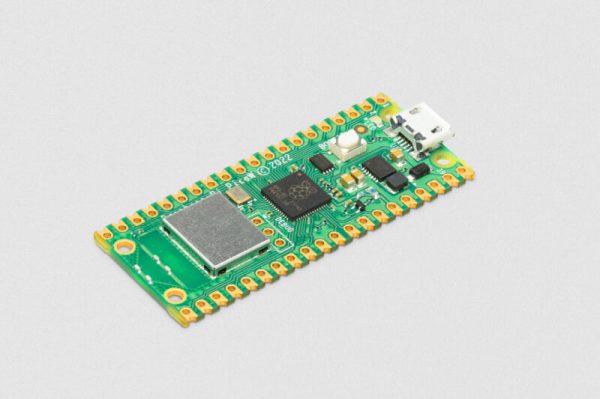
Older readers and those with an interest in retrocomputing may remember the days when a computer might well have booted into a BASIC interpreter. It was simultaneously a general purpose device that could run any software it would load, and also a development environment. Not something that can be said for today’s development boards which typically require a host computer on which to write code. Have we lost something along the way? Perhaps an answer to that question can be found in [lurk101]’s self-hosted development environment for the Raspberry Pi Pico.

It presents itself as a shell, with a flash file system, a port of the vi editor, and a C compiler. We might think of vi as being more at home on a UNIX-derived system, but in this case it’s a port of the vi included in BusyBox. Meanwhile the compiler comes from amacc project.

Of course, this still requires a terminal of some type which in practice will mean a host computer. But the feat is nevertheless an interesting one, and we can see that it might not be impossible given the Pico’s surprising versatility to being some of the terminal features onto the chip itself.

It’s worth noting that this isn’t the first attempt we’ve seen to put a command line interface on a development board.

Electrolytes, They’re What Dehydrated Hackaday Writers Crave!

The oddly prophetic 2006 comedy film Idiocracy features an isotonic drink called Brawndo, whose marketing continuously refers to its electrolytes as a miraculous property. Brawndo is revealed in the film to be useless for agricultural irrigation, but yesterday perhaps a couple of Hackaday writers could have used a bottle or two. At the MCH hacker camp, the record heat of a Dutch summer under the influence of global warming caused us to become dehydrated, and thus necessitated a trip to the first aid post for some treatment. We’d done all the right things, staying in the shade, keeping as cool as we could, eating salty foods like crisps, and drinking plenty of liquids, so what had gone wrong?

Perhaps Club-Mate Should Have An Isotonic Version

The answer will probably be obvious to trained observers, we’d become deficient in those electrolytes. Our bodily stocks of sodium and potassium salts had become exhausted by sweat and all that extra water requiring trips to the toilet, so while we weren’t dehydrated in liquid terms we had exhausted some of the essentials to our cellular function.

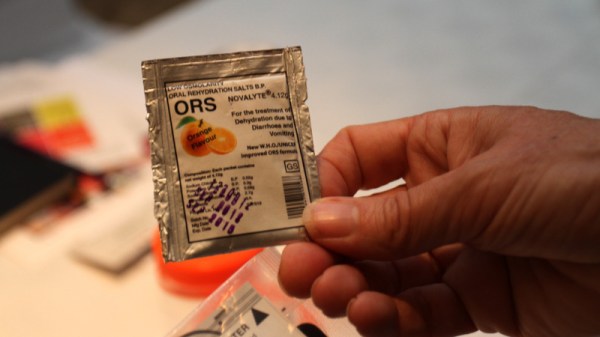
The symptoms would have been easy to spot given the right training, but at a hacker camp it was too easy to attribute a headache and tiredness to a late night. For me the point at which it became obvious something was significantly wrong came when my thought processes started to slow down and my movement became a lot less easy. I’m a long-distance walker and cyclist, yet here I was walking like an octogenarian. If I’d know what to spot I might also have noticed that I had stopped sweating despite the heat. I found a friend (Thanks Gasman!), and together we made our way to the first aid post. MCH2022 first aiders were very efficient, and I was given a cup of oral rehydration salts which restored me to health in a matter of minutes. Continue reading “Electrolytes, They’re What Dehydrated Hackaday Writers Crave!”

McTerminals Give The Hamburglar A Chance

The golden arches of a McDonald’s restaurant are a ubiquitous feature of life in so many parts of the world, and while their food might not be to all tastes their comforting familiarity draws in many a weary traveler. There was a time when buying a burger meant a conversation with a spotty teen behind the till, but now the transaction is more likely to take place at a terminal with a large touch screen. These terminals have caught the attention of [Geoff Huntley], who has written about their surprising level of vulnerability.

When you’re ordering your Big Mac and fries, you’re in reality standing in front of a Windows PC, and repeated observation of start-up reveals that the ordering application runs under an administrator account. The machine has a card reader and a receipt printer, and it’s because of this printer that the vulnerability starts. In a high-traffic restaurant the paper rolls often run out, and the overworked staff often leave the cabinets unlocked to facilitate access. Thus an attacker need only gain access to the machine to reset it and they can be in front of a touch screen with administrator access during boot, and from that start they can do anything. Given that these machines handle thousands of card transactions daily, the prospect of a skimming attack becomes very real.

The fault here lies in whoever designed these machines for McDonalds, instead of putting appropriate security on the software the whole show relies on the security of the lock. We hope that they don’t come down on the kids changing the paper, and instead get their software fixed. Meanwhile this isn’t the first time we’ve peered into some McHardware.

Is 3D Printing Up To A Turntable?

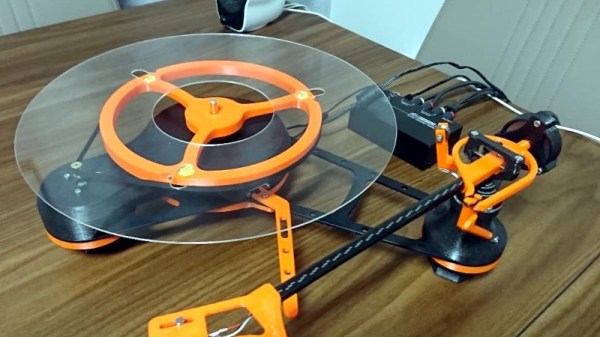
Thanks to a feature by Prusament because it uses their filament, we’ve been interested to read about the SongBird turntable from the British outfit Frame Theory (Note: at time of writing, they have an expired certificate). It’s a commercial product with an interesting twist for the Hi-Fi business: buy the completed turntable or buy a kit of parts and print the rest yourself.

We’re always interested to see new things here at Hackaday but we’re not in the business of promoting commercial products without a tech angle. This turntable has us interested then not because it happens to be 3D printed but because it’s instantly raised our curiosity over how suitable 3D printing is as a medium for a high quality audio component. Without descending into audiophile silliness we cannot overstate the effect that rigidity and mass of turntable components has on its audio quality. Take a look at this one we featured in the past for an extreme example.

So looking more closely at the design, we find that the chassis is aluminium, which makes sense given its visibly thin construction. Close examination of the photos on their site also reveals the tonearm to be made of carbon fibre tube, so it’s clear that they’ve put some effort into making a better turntable rather than a novelty one. This does raise the question though: manufacturing practicalities aside could you 3D print the whole thing? We think that a 3D printed chassis could replace the aluminium one at the cost of much more bulk and loss of the svelte looks, but what about the tonearm? Would one of the carbon-fibre-infused filaments deliver enough stiffness? It would be particularly interesting we think, were someone to try.