No MicroDrive? No Problem!

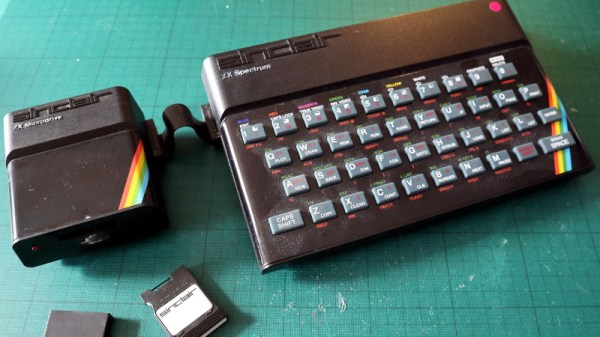
The Sinclair ZX Spectrum and QL computers contained many of Sir Clive’s signature quirks, but perhaps chief among them was their take on mass storage. The Microdrive was something similar to a miniaturised version of an 8-track cartridge, with a continuous loop of tape inside that gave about 80k of storage. At the best of times, their reliability was a little suspect, but with all examples now being over four decades old, a working one is something to be cherished in 2026. If you have a QL or a Spectrum with Interface 1, though, all is not lost. [Alexander Vollschwitz] has your back with Oqtadrive, an emulator for Sinclair microdrives. What it delivers is an emulated eight daisy-chained Microdrives, and even the Sinclair networking system over the Internet, something that many users never even saw locally back in the day.

At its heart is an Arduino Nano that connects to the Microdrive port and, if necessary, the network port, which in turn connects to a daemon running on a host computer. This can be anything from a PC or Mac to a Pi Zero. The Arduino emulates the hardware and the protocol for the Sinclair machine, while the daemon manages the storage and networking.
Continue reading “No MicroDrive? No Problem!” →

A Replacement PCB For The Echo Dot

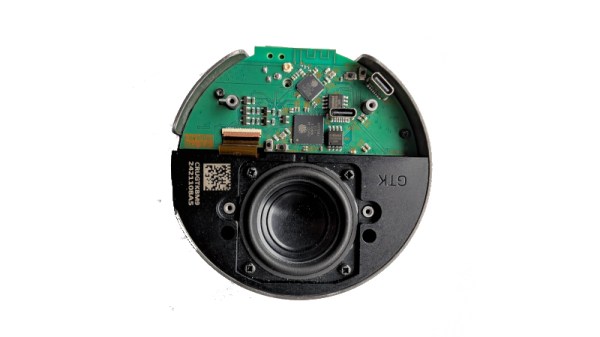
The Amazon Echo and other voice-controlled home assistants provide so much promise of a Jetsons style future of machines at your service. They would be a must-have accessory, were it not that they rely on the data centres of a large corporation that does not necessarily have your best interests at heart. But what if you like the Echo, but not the cloud? If you’re [ale1800], you take a 3rd generation Echo Dot, gut it, and put your own PCB inside to offer a local service.

The device keeps the Dot interface and microphone array, and connects to a Home Assistant server. As you’d imagine it needs a more powerful computer at its heart than a run-of-the-mill microcontroller, so it  uses an ESP32-P4 application processor, with the usual ESP32-S3 companion for connectivity. We’ve been following P4 projects as they gather steam, and it’s interesting to see one that’s not using a screen-based interface. There’s a YouTube video below the break, so you can see it in action.

We like this device, on many levels. In using the P4 it’s pushing forward with the next generation of microcontrollers, and in providing a local voice assistant it’s freeing its users from the cloud. What’s not to like!

Continue reading “A Replacement PCB For The Echo Dot” →

HDMI To CSI For Anyone

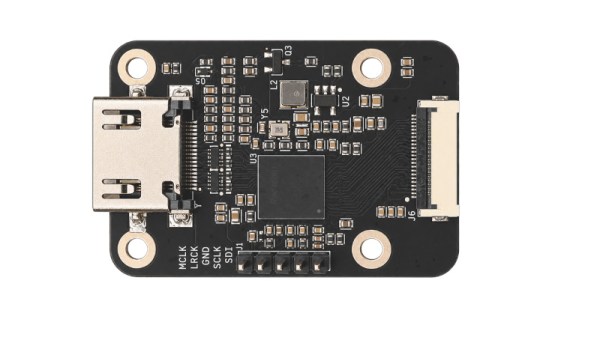
Digitizing an HDMI source should in theory be straightforward, but the interfaces on offer are often disappointing. But happily there’s another way, which is to transform the HDMI into CSI as found on the camera interface for many systems-on-chip. More than one manufacturer makes silicon to do this, and the [WarpKVM] folks have released one using a part from Rockchip. In fact, given that different SBCs have varying connectors, they’ve released three versions of the same board, all under the CERN OHL.

The three boards are tailored for the Luckfox Aura, Raspberry Pi 4 and CM4, and Firefly ROC-RK3576-PC, with versions having 1 lane and 2 lane. It supports 4K at 30 FPS and 1080p at 120 FPS, which should satisfy most people. There are also software configurations for the boards, which instills confidence. Though they were designed for use in a KVM environment, we can see that they could find plenty of application for anyone who wants to work with digital video.

This isn’t the first time we’ve seen an HDMI-to-CSI setup, this one used an ESP32-P4. The P4’s interface is intentionally electrically the same as the Raspberry Pi, so anyone wanting to run one of these boards with a P4 might find the drivers for that project to be of use.

Local Prusa Connect Cuts Out The Cloud

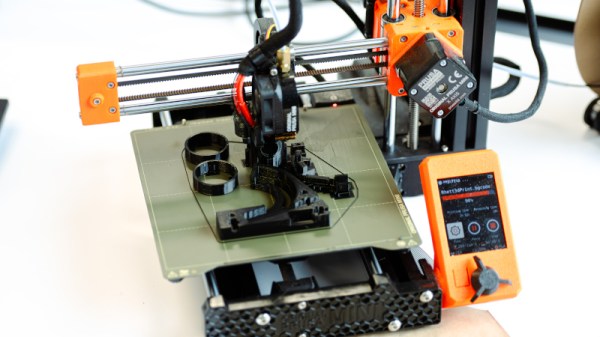
One of the ways 3D printing has changed over the last few years has come in the form of cloud services that exist alongside your printer. In some cases they are locked-in to using the thing, while in others such as Prusa Connect, they are an adjunct that provides useful services but doesn’t restrict the printer to using it.

Now Prusa have gone a step further in keeping control closer to the owner of the printer, by releasing a local version. You can run it on your own server, giving all the benefits with none of the ties.

All the code can be found in a GitHub repository, under their Open Community Licence, which makes everything available but puts some restrictions on who can use it, for example requiring that large enterprises have a paid version. As well as in code form it’s supplied pre-built for Apple, Windows, and Linux platforms, on different architectures including the Raspberry Pi. Out of the box it supports Prusa printers, but it’s not restricted to them as there is a driver API should you wish to add a non-Prusa model.

We know there’s a reaction to the heavier reliance on the cloud found in for example Bambu Labs printers, and we know that some users may have commercially sensitive parts they may not wish to pass off their own network. So we see this as a clever move from Prusa, offering a more palatable way towards a networked printer service without relying on the vendor.

Thanks [Renze] for the tip.

Header image: US Embassy New Zealand, Public domain.

Can’t Get The Right Cassette Mechanism? Have A Go At Making Your Own!

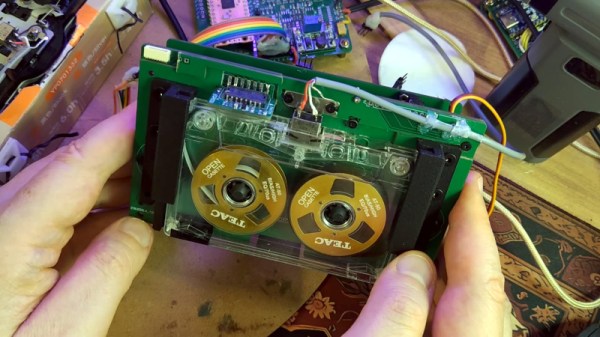
In the world of cassette tape enthusiasts, it’s an oft-repeated factoid that there is only one tape deck mechanism still being manufactured. The truth may be a tiny bit murky on that front, but it’s certain that cassettes are no longer a mainstream medium. So we’re bowled over by [Svofski], who’s creating his own cassette mechanism from scratch.

The mechanism takes the form of a chassis made from PCBs, and with each spindle powered by a separate brushless motor. There doesn’t appear to be a capstan — instead it uses an optical mouse sensor to sense tape speed and thus provide input for motor control. As we understand it, this thing is designed to have more in common with a data backup tape drive than an audio player.

Thus before any cassette fans become too excited it’s worth tempering that enthusiasm. The project in hand is to make a data tape drive rather than a linear cassette player, so while it is a cassette mechanism, it isn’t as it stands one you’d use for audio. And as he explains at length in his GitHub repository and a set of videos, it’s not there yet. But the mere fact of its existence is deeply impressive, and we think you’ll agree. The most recent video of the series is below.

Continue reading “Can’t Get The Right Cassette Mechanism? Have A Go At Making Your Own!” →

Follow The Grid With An Arduino Uno

We all know the frequency of our AC grid. 60Hz for Americans, or 50Hz for Europeans, for example.  But the real story has some complexity. In a plural but interconnected grid such as Europe’s, that frequency can drift around a nominal center value. To keep track of this, [Jeroen Brinkman] has created a grid monitor that can show long-term trends as well as instantaneous frequencies.

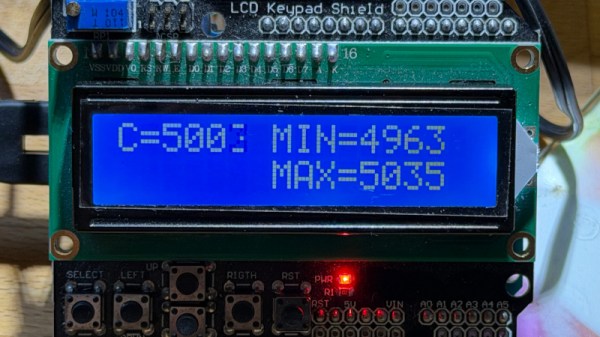
Hardware-wise, it’s somewhat old-school, with an Arduino Uno and a ubiquitous 2×16 character LCD, but the interest here lies not in the microcontroller. Sensing mains frequency is fraught with spicy high-voltage danger if done directly, so [Jeroen] is performing the task using an optocoupler that toggles an interrupt pin on the Arduino. The monitor stores long-term data by the week, using only four bytes per week. That means the monitor can hold up to 240 weeks, or about 4.6 years, on a Nano R3 and over 2,000 weeks, or around 39 years on a Nano R4. The data can be retrieved via serial transfer over the Arduino’s USB port.

The subject of grid monitoring is a fascinating one, as geopolitical events can show up in it. Back in 2018, we covered the moment when Europe lost six seconds as a result.

It’s A NAS, For Sony Mavica Disks

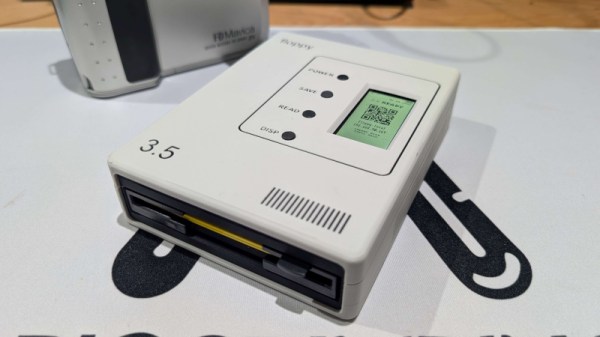
At the dawn of the consumer digital camera age, manufacturers tested this new market with a wide array of interesting and unorthodox designs. This era only lasted a few years before they moved toward making models that resembled the 35mm cameras the consumers were used to. Sony’s Mavica offerings were particularly unusual, because they eschewed Flash storage for the then-ubiquitous 3.5″ floppy disk. Where there are files, there might be a need to share them, so [Bigcrimping] has created floppy3.5. It’s a NAS for digital Mavica disks.

Continue reading “It’s A NAS, For Sony Mavica Disks” →