Super Mario Bros. 35 Lives Again With A Fan-Made Server

If you liked playing Super Mario Bros. 35, the unique multiplayer battle royale Mario game that Nintendo released last year on the Switch to celebrate 35 years since the original NES version of Super Mario Bros, then it’s likely that you have been disappointed since April. The gaming giant ended support and removed the game’s servers once their 35 year celebrations were over, leaving the game’s players hanging. Happily there’s a solution, because [Kinnay] has presented a reverse-engineered Nintendo game server replacement along with a game patch, that should keep gamers in multi-Mario fun forever.

While it’s a boon for fans of this particular game, the real value here is in introducing us to the reverse engineering work on those Nintendo servers. We learn about their various foibles over several generations of console, and perhaps most importantly we learn something of their inner workings.

Usually when a game server is turned off it’s because the platform it supports is so ancient as to have hardly any users. This time-limited game on an up-to-date platform is unusual then, but since it was made available to subscribers to Nintendo’s online service for free it’s less of a surprise. Certainly not in the same class as the loss of servers for an entire platform.

Thanks [Digiaap] for the tip.

Header image: Elvis untot, CC BY-SA 4.0.
3D Print An Entire PC Case

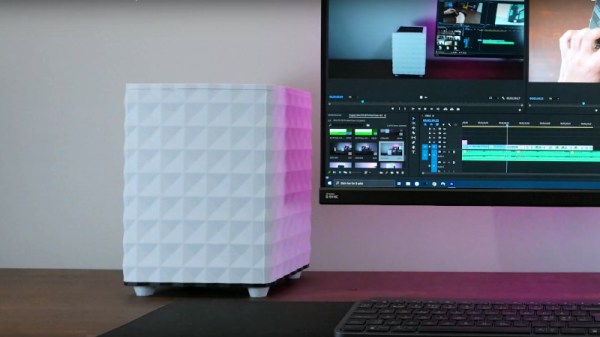
With laptops having become a commodity item and single-board computers having conquered the lower end for our community, building a PC for yourself is no longer the rite of passage that it once was; except perhaps if you are a gamer. But there is still plenty of fun to be had in selecting and assembling PC hardware, especially if as [makerunit] did, you design and 3D-print your own case.

This is no motherboard in an old pizza box, but instead a highly compact and well-designed receptacle for a reasonable-performance gaming machine with an ITX motherboard. The chassis holding all the parts sits inside a slide-on textured sleeve, and particular attention has been paid to air flow and cooling. The GPU card is a little limited by the size of the case and there’s no room at all for a conventional hard drive, so a PCIe SSD board takes that role.

We’d hazard the opinion that were this case cranked out by the likes of Apple it would be hailed as some kind of design masterpiece, such is its quality. It certainly shows that there’s so much more to building your own PC than the normal rectangular tower case.

Over the decades we’ve brought you so many PC cases, a recent-ish one that’s worth a look is this Lego Minecraft one for an Intel NUC motherboard.

Continue reading “3D Print An Entire PC Case”

Hacking The Lidl Home Gateway

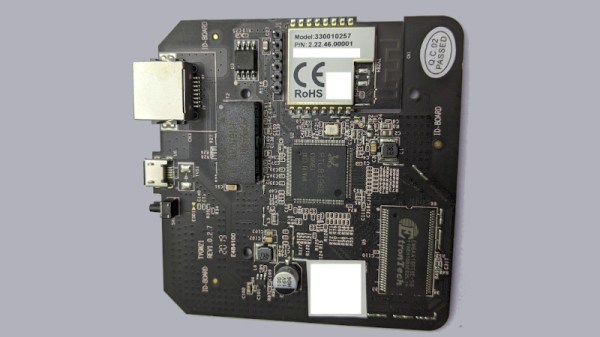
For years, Europeans have been browsing the central aisles of the German Aldi and Lidl supermarket chains, attracted by the surprising variety of transitory non-grocery bargains to be found there. There are plenty of temptations for hackers, and alongside the barbecues and Parkside tools at Lidl last year was a range of Zigbee home automation products. Every ZigBee network requires some form of hub, and for Lidl this comes in the form of a £20 (about $28) Silvercrest Home Gateway appliance. It’s a small embedded Linux computer at heart, and [Paul Banks] has published details of how it can be hacked and bent to the user’s will.

Under the hood is a Realtek RTL8196E MIPS SoC with 16Mb of Flash and 32 Mb of memory. Gaining control of it follows the well trodden path of finding the bootloader, dumping the firmware, and re-uploading it with a known password file. If you’ve done much hacking of routers and the like you’ll recognise that this quantity of memory and Flash isn’t the most powerful combination so perhaps you won’t be turning it into a supercomputer, but it’s still capable enough to be integrated with Home Assistant rather than the cloud-based services with which it shipped.

There was a time when repurposing routers as embedded Linux machines was extremely popular, but it’s something that has fallen from favour as boards such as the Raspberry Pi have provided an easier path. So it’s good to see a bit of old-fashioned fun can still be had with an inexpensive device.

If you fancy a bit more German budget supermarket goodness, feast your eyes on an Aldi stick welder!

What Is Ultra Wideband?

If you’ve been following the world of mobile phone technology of late, you may be aware that Apple’s latest IPhones and AirTag locator tags bring something new to that platform. Ultra wideband radios are the new hotness when it comes to cellphones, so just what are they and what’s in it for those of us who experiment with these things?

An Apple AirTag being paired with an iPhone. Swisshashtag, CC BY-SA 4.0.

Ultra wideband in this context refers to radio signals with a very high bandwidth of over 500 MHz, and a very low overall power density spread over that  spectrum. Transmissions are encoded not by modulation of discrete-frequency carriers as they would be in a conventional radio system, but by the emission of wideband pulses of RF energy across that bandwidth.  It can exist across the same unlicensed spectrum as narrower bandwidth channelised services, and that huge bandwidth gives it an extremely high short-range data transfer bandwidth capability. The chipsets used by consumer devices use a range of UWB channels between about 3.5 and 6.5 GHz, which in radio terms is an immense quantity of spectrum. Continue reading “What Is Ultra Wideband?”

Tractors And The Right To Repair: It’s Going Global

For more than a few years now, we’ve been covering the saga of tractors from the larger manufacturers on which all components are locked down by software to the extent that they can only be replaced by officially sanctioned dealers. We’re thus pleased to see a couple of moments when the story has broken out of the field of a few farmers and right-to-repair geeks and into the mainstream. First up:  a segment on the subject from NPR is worth a listen, as the US public radio station interviews a Montana farmer hit by a $5k fuel sensor on his John Deere as a hook form which to examine the issue. Then there is a blog post from the National Farmers Union, the body representing UK farmers, in which they too lay out the situation and also highlight the data-grabbing aspects of these machines.

Continue reading “Tractors And The Right To Repair: It’s Going Global”

An ALU As A Desktop Calculator Has Stunning Style From Days Gone By

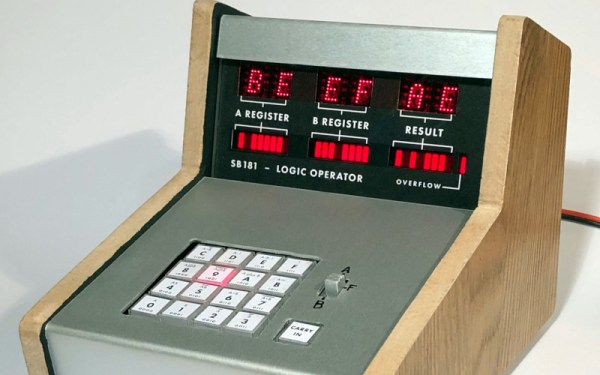
Those of you with an interest in microcomputer history will know that there is a strong crossover between the path of electronic calculator evolution and the genesis of the integrated CPU. Intel’s 4000 was famously designed for a calculator, and for a while in the 1970s these mathematical helpers were seen as the wonder of the age. [Simon Boak]’s calculator is a curious throwback to that era, as it’s not a decimal calculator as we’d know it but a hexadecimal device that simply computes using the functions of the famous 74181 ALU chip.

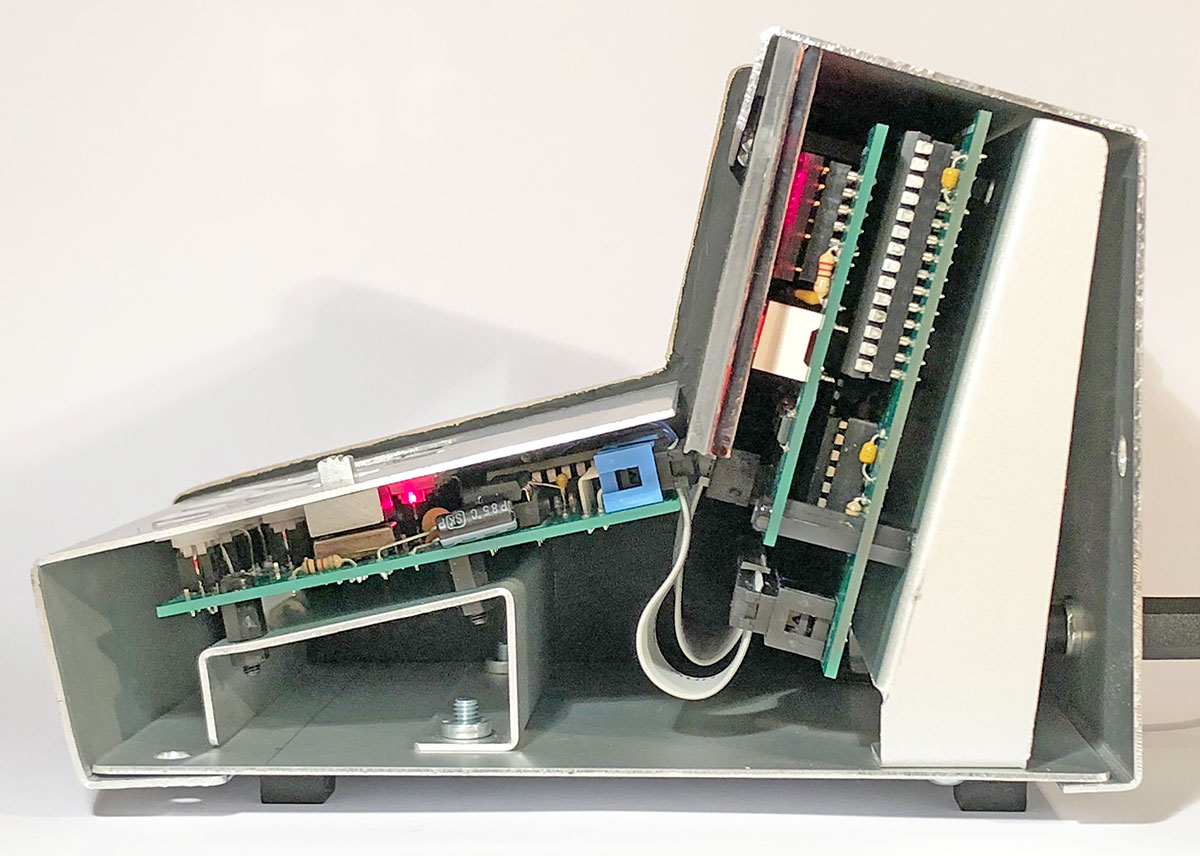
An ALU, or to give it its full name an Arithmetic Logic Unit, is a component of a CPU with two inputs and one output that can perform any of a range of binary functions upon the two inputs and return the result on the output. This calculator has two of them for eight bits of raw adding power, with a hexadecimal keypad for setting the inputs and a set of 7-segment displays for showing the results. It’s housed in an achingly retro folded sheet metal console case with wooden end pieces that would have graced any engineer’s desk with pride back in about 1975. We may not need one, but we really want one!

If the 74181 is a mystery to you then fear not, because chip master [Ken Shirriff] has produced some handy explanation work on its operation.

Thanks [Ted Yapo] for the tip.

Ryobi Power Packs As Ebike Batteries

By now, the process of creating custom lithium-ion battery packs is well-known enough to be within the reach of most makers. But it’s not a path without hazard, and mistakes with battery protection and management can be costly. Happily for those who are apprehensive on the battery front there’s a solution courtesy of a group of engineering students from the University of Pittsburgh. Their project was to convert a pedal bicycle to electric assisted power, and in doing so they didn’t make their own pack but instead used off-the-shelf 40V Ryobi power tool packs.

The bike conversion is relatively conventional with the crank replaced by a crank and motor assembly, and a pair of the Ryobi packs in 3D-printed holders on the frame. The value in this is in its reminder that these packs have evolved to the point at which they make a viable alternative to a much more expensive bike-specific pack, and that their inclusion of all the balancing and protection circuitry make them also a much safer option than building your own pack. The benefits of this are immense as they bring a good-quality conversion within reach of many more bicycle owners, with all parts being only a simple online order away. Take a look at the video below the break for more details.

Those Ryobi cells certainly seem to have carved themselves a niche in our community!

Continue reading “Ryobi Power Packs As Ebike Batteries”