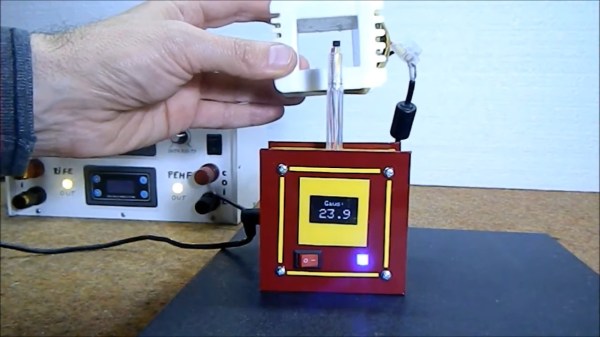
We’re used to Hall effect devices as proximity sensors in mechanical systems, used to provide detection of something that has a magnet attached to it. However it’s easy to forget that the devices that provide a magnet-or-not digital output are only part of the story, and linear Hall effect devices provide a handy way to measure a static magnetic field. It’s something [mircemk] demonstrates, with an Arduino-powered magnetic field strength meter that uses a UGN 3503U Hall effect device.
The circuit is extremely simple, comprising the sensor, an Arduino Nano, and an OLED display. This device is handy because its voltage output has a known relationship to the gauss level the sensor is experiencing, so while the accuracy of its calibration isn’t verified it can at least give a believable reading derived from the Arduino’s ADC.
The whole is wrapped up in an attractive case that looks as though it has been made from PCB material, with the sensor protruding on what seems to be the shell of a plastic ballpoint pen. It makes a handy instrument that provides a useful function for not a lot of money, so what’s not to like! Take a look at the video below the break for the full story.
The pandemic may have taken away many of our real-world events, but as they’ve gone online their badge teams have often carried on regardless. One of these comes from Carolinacon, and it’s decided to eschew the bleeding edge of electronic wizardry and instead push slightly at the boundaries of PCB art. It contains a hidden message in a copper layer behind a band of white silkscreen, which is revealed by a set of LEDs on the reverse of the board shining through the translucent FR4.
Electronics-wise it’s a pretty simple design, sporting only an ATtiny microcontroller and a photoresistor alongside the LEDs, and with the secret message being triggered when the badge is placed in the dark. The conference’s pig logo is eye-catching, but it has no pretences towards being a dev board or similar. The technique of LEDs behind copper and silkscreen is an interesting one though, and something that we think could bear more investigation in future designs. It’s pleasing to see that there are still new avenues to be taken in the world of PCB-based art.
Many of will have marveled at the feats of reverse engineering achieved by decapping integrated circuits and decoding their secrets by examining the raw silicon die. Few of us will have a go for ourselves, but that doesn’t stop the process being a fascinating one. Fortunately [Ryan Cornateanu] is on hand with a step-by-step description of his journey into the art of decapping, as he takes on what might seem an unlikely subject in the form of the CH340 USB to serial chip you’ll find on an Arduino Nano board.
Starting with hot sulphuric acid is probably not everyone’s idea of a day at the bench, but having used it to strip the epoxy from the CH340, he’s able to take a look under the microscope. This is no ordinary microscope but a metallurgists instrument designed to light the top of the sample from one side with polarised light. This allows him to identify an area of mask ROM and zoom in on the transistors that make each individual bit.
At this point the chemistry moves into the downright scary as he reaches for the hydrofluoric acid and has to use a PTFE container because HF is notorious for its voracious reactivity. This allows him to take away the interconnects and look at the transistor layer. He can then with a bit of computer vision processing help extract a bit layer map, which with some experimentation and guesswork can be manipulated into a firmware dump. Even then it’s not done, because he takes us into the world of disassembly of what is an unknown architecture. Definitely worth a read for the armchair chip enthusiast.
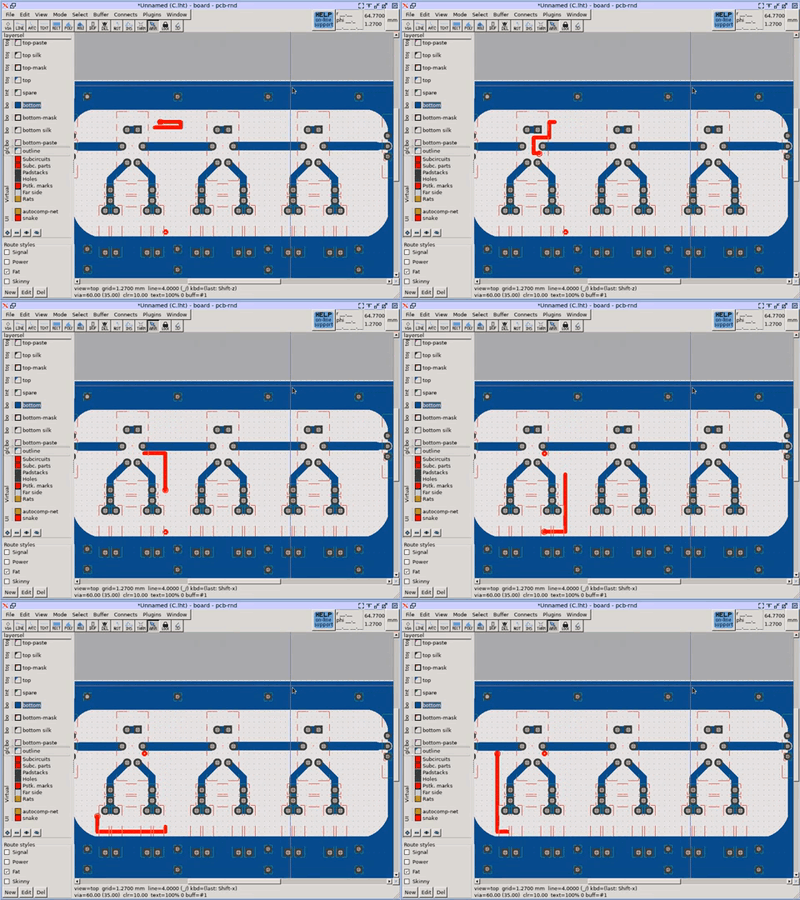
When conversation turns to the older Nokia mobile phones, it’s unlikely to be the long battery life or ability to conjure a signal out of thin air that tickles people’s memory, instead it’s the Snake game built into the stock firmware. Snake was an addictive yet extremely simple game in which a line of pixels — the snake in question — was navigated around the screen to eat the fruit without crashing into walls or itself. As the game progressed the snake grew in length, making it a surprisingly difficult challenge. If you hanker for Snake, as [VK5HSE ] writes, you can now play it in a PCB layout.
The software in question is PCB-RND, a cross-platform open-source PCB CAD tool, and the game is achieved through the magic of user scripting. Simply download the script, run it in your favourite circuit board, and away you go!
We can’t imagine a productive use for this piece of software, but it wouldn’t surprise us to see a snake slithering into a few boards we feature. It does provide a handy reminder though of the power in your PCB CAD tool’s scripting features, something it’s likely not many of us use to their full potential.
Here at Hackaday, we’re always working as hard as we can to bring you the latest and most exciting technologies, and like so many people we’ve become convinced that the possibilities offered by the rise of the Blockchain present unrivaled opportunities for humanity to reinvent itself unfettered by the stifling regulations of a dying system. This is why today we’ve decided to join in with the digital cognoscenti and celebrities embracing Non-Fungible Tokens, or NFTs, as a new promise of non-corporeal digital investment cryptoasset that’s taking the world by storm.
Crypto Non-Fungible Investment Gains!
Imagine for a minute, yourself owning a very expensive car. Skievl, CC BY-SA 4.0.
An NFT is a digital token representing something in the real world, and coupled to a unique ID held in a secure entry in the Blockchain. It’s non-fungible, which means that it’s unique and not interchangeable in the manner of a traditional old-style cryptoasset such as Bitcoin. As it allows a real-world object to be tokenised in digital form it represents a way to own something that provides an irrefutable connection to it as as a digital cryptoasset.
It’s a complex system that’s maybe too difficult to explain fully in a single article, but think of an NFT as a way to invest in a cryptoasset in digital form with its uniqueness guaranteed by Blockchain security, without having the inconvenience of physically owning it. Instead your NFT is safely held on a server on the Internet, and can’t be physically stolen as it would from a bank vault because it has the Blockchain cryptosecurity baked in.
Non Fungible Blockchain Cryptoassets!
You don’t own this. Yet.
NFTs have so far found a space in the creative markets, where they have provided a revolutionary opportunity for artists to expand their sales in the digital realm by selling NFTs of their work. A struggling artist can now access buyers all over the world, who can in turn now invest with confidence in creative talent to which they would never otherwise be exposed. It’s a win-win situation in which both cryptoinvestor and artist benefit from The Power of the Blockchain.
Hackaday is excited to offer a once-in-a-lifetime chance to acquire a Blockchain-cryptosecured NFT representing one of our own articles; our first ever NFT is the only officially sanctioned digital copy of a Hackaday article presenting a novel method of handling toilet paper shortages. The original article will continue to exist on Hackaday.com with all rights reserved, but we will not make any other NFTs of it. We may also decide to update the original article to let everyone know you are the lucky owner of the only digital copy of this piece of greatness. That’s right, this NFT will let you prove you own a screenshot!
Having today sold you on the incredible cryptoinvestment opportunity offered by NFTs, we’ll be back on another date with a more sober and in-depth technical examination of the technology behind them. Meanwhile should our brief foray into NFTs garner any interest (and we really hope it does not), we will donate proceeds to the excellent Girls Who Code, a truly solid investment with a tangible bright future.
Thanks [Micah Scott] for some NFT consultancy during the making of this piece.
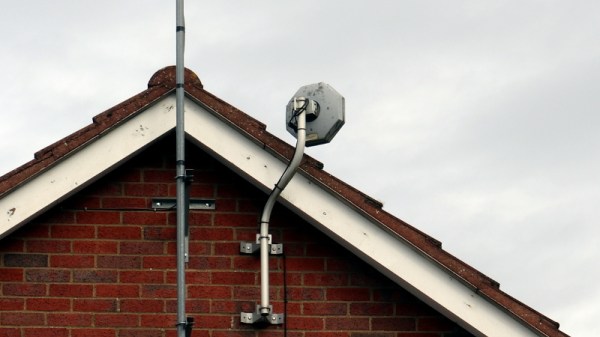
A dingy and cold early February in a small British town during a pandemic lockdown is not the nicest time and place to take your exercise, but for me it has revived a forgotten memory and an interesting tale of a technology that promised a lot but delivered little. Walking through an early-1990s housing development that sprawled across the side of a hill, I noticed a couple of houses with odd antennas. Alongside the usual UHF Yagis for TV reception were small encapsulated microwave arrays about the size of a biscuit tin. Any unusual antenna piques my interest but in this case, though they are certainly unusual, I knew immediately what they were. What’s more, a much younger me really wanted one, and only didn’t sign up because their service wasn’t available where I lived.
All The Promise…
The TV advert looked promising in 1998.
Ionica was a product of Cambridge University’s enterprise incubator, formed at the start of the 1990s with the aim of being the first to provide an effective alternative to the monopolistic British Telecom in the local loop. Which is to say that in the UK at the time the only way to get a home telephone line was to go through BT because they owned all the telephone wires, and it was Ionica’s plan to change all that by supplying home telephone services via microwave links.
Their offering would be cheaper than BT’s at the socket because no cable infrastructure would be required, and they would aim to beat the monopoly on call costs too. For a few years in the mid 1990s they were the darling of the UK tech investment world, with a cutting edge prestige office building just outside Cambridge, and TV adverts to garner interest in their product. The service launched in a few British towns and cities, and then almost overnight they found themselves in financial trouble and were gone. After their demise at the end of 1998 the service was continued for a short while, but by the end of the decade it was all over. Just what exactly happened?
Those of us who work on the road have a constant dread of being stuck somewhere without power, facing a race between a publication deadline and a fast-failing laptop battery. We’re extremely fortunate then to live in an age in which a cheap, lightweight, and efficient solid-state switch-mode inverter can give us mains power from a car cigarette lighter socket and save the day. Before these inverters came much heavier devices whose transistors switched at the 50Hz line speed, and before them came electromechanical devices such as the rotary converter or the vibrating reed inverter. It’s this last type that [Robert Murray-Smith] has taken a look at, making what he positions as the simplest inverter that it’s possible.
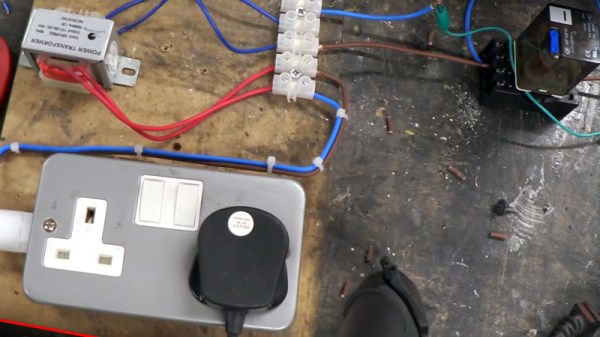
If you’ve ever played with relays, you’ll probably be aware that a relay can be wired as a buzzer, and it’s this property that a vibrating reed inverter harnesses. He takes an octal relay and wires it up with a small mains transformer for an immediate and very cheap inverter. It’s not perfect, as he points out the frequency isn’t right. The relay will eventually wear out unless the arcing problem is improved with the addition of a capacitor. But it does make a rough and ready inverter if you find yourself in a MacGyver-style tight spot with only your junk box for salvation.




 The software in question is