How Did They Get Sampled Sounds From An SN76489 8-bit Sound Chip?

If you were lucky and had well-off parents in the early 1980s, your home computer had a sound chip on board and could make music. There were a variety of chips on the market that combined in some form the tone generators and noise sources of a synthesiser, but without the digital-to-analogue converters of later sound chips designed for sampled audio. They gave birth to chiptune music, but that was all they were made to do. The essence of a hack lies in making something perform in a way it was never intended to, and some game developers for the Acorn BBC Micro had its SN76489 producing sampled audio when it should never have been possible. How did they do it? It’s a topic [Chris Evans] has investigated thoroughly, and his write-up makes for a fascinating explanation.

So, how can a set of audio tone generators be turned into a sampled audio player, and how can it be done when the CPU is a relatively puny 6502? There’s no processor bandwidth for clever Fourier transform tricks, and 1980s tech isn’t set up for high data bandwidths. The answer lies in making best use of the controls the chip does offer, namely frequency and volume of a tone. A single cycle of a tone can be given a volume, and thus can be treated as a single sample of an unintended DAC. By using a tone frequency well above the audio range a suitable sample frequency can be found, and thus an audio stream can be played. The write-up has links to some examples in an emulator, and while they’re hardly hi-fi they’re better than you might expect for the hardware involved. Still, even at that they don’t approach this amazing 48kHz playback on a Commodore 64.

Header: SN76489, on a Colecovision console motherboard. Evan-Amos / Public domain.

When A Bike Sharing Startup Goes Away, What Do You Do With The Bikes?

Part of the detritus of many cities over the last few years has been the ubiquitous bicycles and scooters of the various companies that offer them for hourly hire via a smartphone app. They’re annoying when left randomly on pavements by their users, and they sometimes appear to outnumber riders many times over. In 2018 for many cities outside China they became a little less numerous, as the Chinese bike sharing service Ofo contracted its operations and pulled its distinctive yellow machines from the streets. A couple of years later those Ofo bikes that were sold off or simply abandoned by the company and never recovered are still with us. They can be used if their lock is dismantled, but to do that is to ignore the potential of the lock. [Aladds] has written a firmware for Ofo locks that allows them to be unlocked by a code entered upon its buttons.

Onboard the lock are an nRF51822, 4G radio, and of course the lock mechanism itself. The battery is likely to be flat by now, and though he doesn’t tell us what it is it’s worth our pointing out that similar designs sometimes use hazardous LiSOCl2 chemistry which any hacker should be very cautious with. He gives us full instructions for finding the programming connections for the chip, which can either have its stock firmware downloaded for examination, or be wiped for insertion of the new version. To show the code in action there is also a short YouTube video that we’ve put below the break. Meanwhile we’ve peered inside an Ofo lock before, back in 2018.

Continue reading “When A Bike Sharing Startup Goes Away, What Do You Do With The Bikes?”

Surviving The Pandemic As A Hacker: Peering Behind The Mask

We’re now several months into the global response to the COVID-19 pandemic, with most parts of the world falling somewhere on the lockdown/social distancing/opening up path.

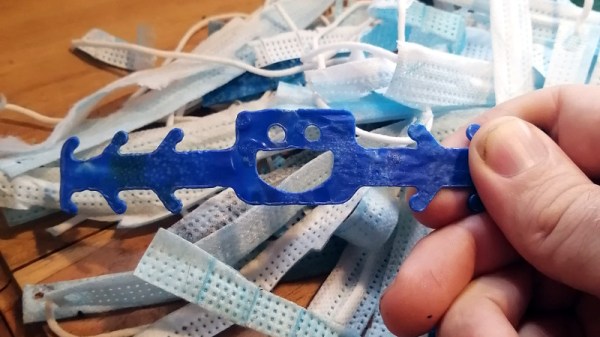
It’s fair to say now that while the medical emergency has not passed, the level of knowledge about it has changed significantly. When communities were fighting to slow the initial spead, the focus was on solving the problem of medical protection gear and other equipment shortages at all costs with some interesting yet possibly hazardous solutions. Now the focus has moved towards protecting the general public when they do need to venture out, and as society learns to get life moving again with safety measures in place.

So, we all need masks of some sort. What type to do you need? Is one type better than another? And how do we all get them when everyone suddenly needs what was once a somewhat niche item?

Continue reading “Surviving The Pandemic As A Hacker: Peering Behind The Mask”

Social Distancing Headgear For The Futuristically Inclined

Those of you with an eye to classic cinema will remember 1985’s Back To The Future, and particularly its scientist character Dr. Emmett Brown. When the protagonist Marty McFly finds himself in 1955, on his first meeting with they younger Dr. Brown the latter is wearing an experimental helmet designed to read thoughts. It doesn’t work, but it’s an aesthetic we’re reminded of in [Håkan Lidbo]’s Corona Hat, a social distancing tool that incorporates distance sensors into a piece of headgear.

The device is simple enough, half of a globe fitted with a set of car reversing sensors and the battery from an autonomous vacuum cleaner. It’s sprayed a bright orange, and worn on the head as he walks around town in the video below the break. It beeps any time something or somebody gets too close, and as far as we can see it’s effective in what it does. We are not so sure about the look though, to us as well as Emmett Brown it’s a little too reminiscent of the character Sheev in the 2005 Dukes of Hazzard movie who wore an armadillo’s armour as a hat. Perhaps more conventional headgear as a basis might gain it a few fewer askance looks.

This isn’t the first ultrasonic social distancing sensor we’ve seen. Probably the most noteworthy project in this arena though has to be the one with the high voltage that scares more with its bark than its bite.

Continue reading “Social Distancing Headgear For The Futuristically Inclined”

Why Does Solder Smoke Always Find Your Face?

For some of us the smell of rosin soldering flux vaporizing from the tip of an iron as a project takes shape is as evocative as the scent of a rose on a summer’s day. We’ve certainly breathed enough of it over the years, as it invariably goes from the piece of work directly into the face of the person doing the soldering. This is something that has evidently troubled [AlphaPhoenix], who has gone to extravagant lengths to research the problem using planar laser illumination and a home-made (and possibly hazardous) smoke generator.

He starts with a variety of hypotheses with everything from a human-heat-driven air vortex to the Coandă effect, but draws a blank with each one as he models them using cardboard cut-outs and boxes as well as himself. Finally he has the light bulb moment and discovers that the key to the mystery lies in his arms coming across the bench to hold both iron and solder. They close off an area of lower-pressure dead space which draws the air current containing the smoke towards it, and straight into his face.  It’s something that can be combated with a small fan or perhaps a fume extractor, as despite some video trickery we have yet to master soldering iron telekinesis.

Continue reading “Why Does Solder Smoke Always Find Your Face?”

A Home Made Dumper You’d Swear Came From A Factory

When it comes to YouTube videos, there’s little we like more than some good quality workshop action, watching someone in command of their tools craft a machine from raw materials with an amazing result. It’s something [Workshop From Scratch] delivers with his homemade mini dumper, in which he makes a small dump-truck from scratch with a result that looks as though he’d bought it factory-made from his agricultural supplier.

At its heart is a substantial chassis made from welded together double box section tube, to which he’s bolted a second-hand hydraulic transmission of the type you would find on larger walk-behind groundskeeping machinery. At the back is a front steering axle from a mobility scooter, that pivots on a bearing and wheel hub from a Ford Mondeo to ensure stability on rough ground. There is a platform for the operator to stand on as the little Honda 4-stroke engine moves it around. The bucket is plasma cut and welded, and it’s safe to say that his welding ability exceeds ours.

The result is a machine that looks to be very useful, and dare we admit it, one we wouldn’t mind having a go on. It may not be as powerful as this electric home-built dump truck, but we like it.

Continue reading “A Home Made Dumper You’d Swear Came From A Factory”

Pulling Data From News Feed Telemetry

We are used to seeing shots from TV news helicopters every day, they are part of the backdrop to life in the 21st century. But so often we hear them overlaid with studio commentary, so it’s interesting to hear that their raw audio contains telemetry. It caught the attention of [proto17], who took some audio pulled from a news helicopter video and subjected it to a thorough investigation to retrieve the data.

The write-up is at a very in-depth level, and while there’s an admission that some of the steps could have been performed more easily with ready-made tools, its point is to go through all steps at a low level. So the action largely takes place in GNU Radio, in which we see the process of identifying the signal and shifting it downwards in frequency before deducing its baud rate to retrieve its contents. The story’s not over though, because we then delve into some ASCII tricks to identify the packet frames, before finally retrieving the data itself. It still doesn’t tell you what the data contains, but it’s a fascinating process getting there nonetheless.

It’s easy to forget that GNU Radio has signal processing capabilities far beyond radio, but it was the subject of a fascinating Superconference talk. We even jumped on the bandwagon in the non-foolish part of our April Fool this year.