The Red Dwarf Talkie Toaster Made Real

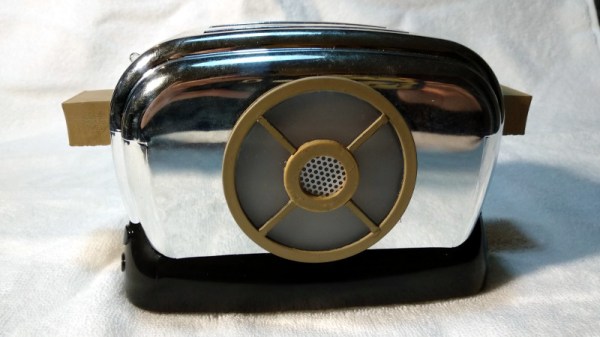
It’s cold outside, there’s no kind of atmosphere, you’re all alone, more or less. More or less meaning that you share the gigantic mining ship that is your home on the other side of the galaxy with an ineffectual android, a humanoid descended from your cat, a holographic representation of your dead colleague who’s a complete smeghead, and a really annoying sentient toaster that’s obsessed with bread products. If all this rings a bell, then maybe you’re familiar with the cult BBC TV series, Red Dwarf.  It’s a show that evidently [Bill Dudley] has spent too much time watching, because he’s created a really convincing replica of that talking toaster.

The base toaster is a toy appliance with a little clockwork ejector for toy toast, that comes with plenty of space inside and is easy to accessories for the classic Talkie Toaster look. Inside is an off-the-shelf MP3 player board and a home-made PCB which drives a set of LEDs behind the speaker grille in time with the audio. The result won’t make any toast, waffles, or even crumpets, but it will delight any Red Dwarf fans who might be passing, whether someone has smoked them a kipper or not.

Surprisingly this is not the first Talkie Toaster build we’ve seen. If they met, would they have a harmonious conversation about bagels?
Ultra-Rare Nintendo Play Station Prototype Hits Auction Block

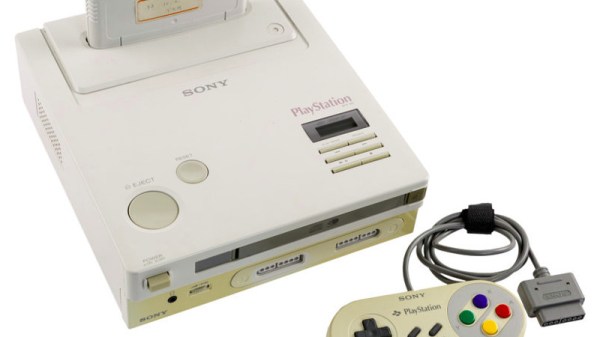
If you are interested in such things, you can buy a 1990s Sony Play Station via Heritage Auctions. We’re sure this will have caught your interest, after all it’s not every day you get the chance to catch such a machine. But before you call us out for seemingly reporting the news of an unremarkable sale featuring the runaway success story of 1990s gaming, take a look at the first sentence again. This is not a PlayStation, the ubiquitous grey console of the 1990s, but a Play Station, said as two words rather than one. This ill-fated collaboration between Sony and Nintendo was intended to be an SNES with a CD-ROM drive, but the project faltered and all that remained was the almost mythical tale of a few prototype consoles.

So far there has only been one of these devices that has surfaced, and this is the machine in the auction. So what seemed as though it might be a mundane console turns out to be one of the rarest machines ever created, a true Holy Grail of console collecting.

This machine has a known provenance, and has appeared on these pages before. In 2016 Ben Heck did a teardown to reveal the combination of Sony CD drive and SNES motherboard, and by 2017 he had it working with some homebrew games. There was no official software produced for this console, so it seems the lucky purchaser may have only homebrew games with which to try their console.

At the time of writing the auction is standing at $57,600, and we’d expect this to increase significantly. So you may not have the chance to own the Play Station, but with such a rare machine it’s always worth noting its appearances. It’s also worth remembering that there was more than one of them produced, in fact when your scribe was working in the same industry in the 1990s a senior colleague talked about having been shown one during dealings with Nintendo UK a few years earlier. The machine on sale today may be the only one we know to have survived, but it’s a fair possibility that there are others still gathering dust in long-forgotten archive boxes or collections of gaming hardware junk. Keep an eye out, you might just find your own rarest console ever produced!

Star Wars Themed Laser Badge: All That Is Missing Is The Pew Pew Sound Effect

In the quest to advance the art of the electronic badge, the boundaries of what is possible to manufacture in small quantities are continually tested. Full-colour PCBs, injection moulding, custom keyboards, and other wow factor techniques have all been tried, leading to some extremely impressive creations. With all this innovation then it’s sometimes easy to forget that clever design and a really good idea can produce an exceptional badge with far more mundane materials.

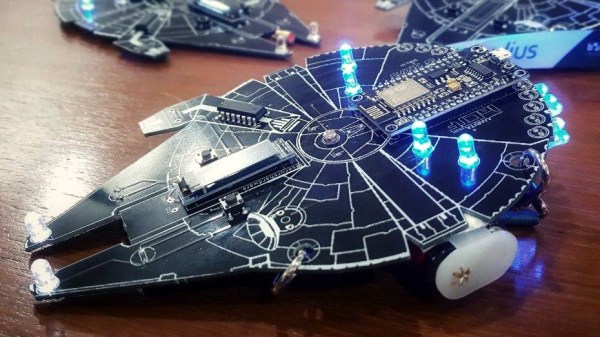
The 10th InCTF cybersecurity contest held at Amrita, Kerala, India, had a Star Wars themed badge designed by Team bi0s for the event. It takes the form of a Millennium Falcon-shaped PCB, with a NodeMCU ESP8266 board mounted on it, a shift register, small OLED display, and the usual array of buttons and LEDs. The fun doesn’t stop there though, because it also packs a light-dependent resistor and a laser pointer diode that forms part of one of its games. Power for this ensemble comes courtesy of a set of AA cells on its underside.

They took a novel approach to the badge’s firmware, with a range of different firmwares for different functions instead of all functions contained in one. These could be loaded through means of a web-based OTA updater. Aside from a firmware for serial exploits there was an Asteroids game, a Conway’s Game Of Life, and for us the star of the show: a Millennium Cannon laser-tag game using that laser. With this, attendees could “shoot” others’ LDRs, with three “hits” putting their opponent’s badge out of action for a couple of minutes.

Unusually this badge is a through-hole design as a soldering teaching aid, but its aesthetics do not suffer for that. We like its design and we especially like the laser game, we look forward to whatever next Team bi0s produce in the way of badges.

This isn’t the first badge packing a laser we’ve seen, at last year’s Def Con there was a laser synth badge. No laser tag battles though.

HackIt: Why Aren’t We Hacking On The LED Printer?

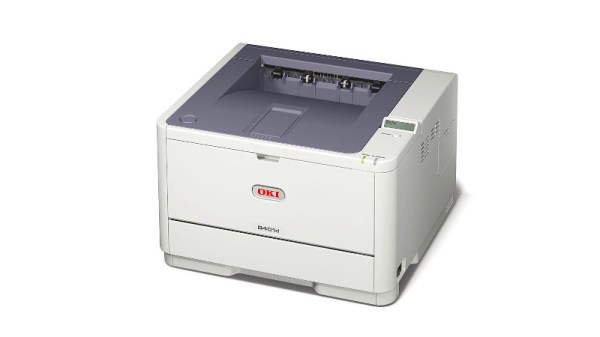
Strings of LEDs are a staple of the type of project we see here at Hackaday, with addressable devices such as the WS2812 in particular having changed beyond recognition what is possible on a reasonable budget. They’ve appeared in all kinds of projects, but are perhaps most memorable when used in imaging projects such as screen-like arrays or persistence-of-vision systems. There’s another addressable LED product that we haven’t seen here, which is quite a surprise considering that it can be found with relative ease in junk piles and has been on the market for decades. We’re talking about the LED printer, and the addressable LED product in question is a very high density array of LEDs the width of a page, designed to place an image of the page to be printed on the toner transfer drum.

Continue reading “HackIt: Why Aren’t We Hacking On The LED Printer?”

C#, The Language For All Platforms – Now Including Windows 3.11 And DOS

The Microsoft .NET framework has been with us in one form or another since the millennium, and though it has remained largely the preserve of the Microsoft universe, it has found its way since then through a variety of implementations to other platforms including MacOS and GNU/Linux. In Microsoft terms though its history goes back only as far as Windows 98, earlier MS operating systems remain off-limits.

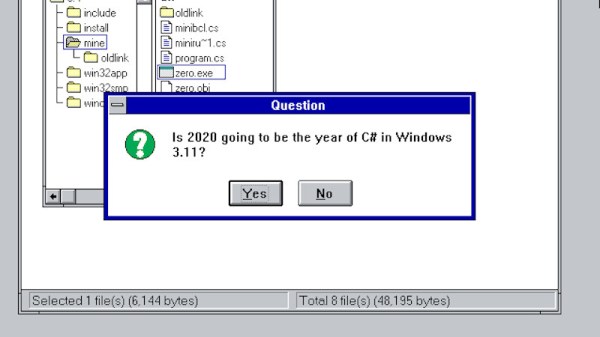
Just a glimmer of .NET in DOS and Windows 3.11 comes courtesy of [Michal Strehovský], who has successfully compiled .net C# code for both Windows 3.11 and DOS. An in-depth explanation comes courtesy of [Scott Hanselman], and it involves some tricks spanning the decades since the early 1990s. The .NET Core compiler’s object files can be fed into the linker that shipped with an ancient version of Microsoft’s C++ compiler, which when used with Microsoft’s Win32s compatibility layer that brought some of Windos NT’s APIs to the 16-bit OS, allows C# from 2020 to run as though it were 1992 again. Meanwhile the DOS version uses .NET Core’s ability to produce self-contained executables along with some very significant tricks to pare down the size of the finished program from many megabytes to an eventual DOS-suitable 27k. Remember the apocryphal Bill Gates quote, that “640k should be enough for anyone“, that refers to the maximum memory available to DOS without extra memory-extending tricks.

Neither piece of software is especially useful, and we can’t see a rush of C# coders to these new platforms. But we applaud him for his ingenuity, and getting old hardware to do new tricks is right up our alley. It’s certainly dredged up a few memories from back in the day for us. Meanwhile we’ve featured .NET in a few projects over the years, most recently on an FPGA.

Rental Home Thermostat Gets Smart Upgrade Without Modifying The Dumb Controller

A problem facing those who live in rental properties comes with two prongs: that such properties rarely have up-to-date facilities such as heating controllers, and that landlords tend to take a dim view of tenants installing their own alternatives. [Andy] wanted to upgrade the heating controller in his home and was in this situation, so he came up with a smart controller add-on for the existing mechanical timer that does not irreversibly modify anything and is easily removable when he moves on.

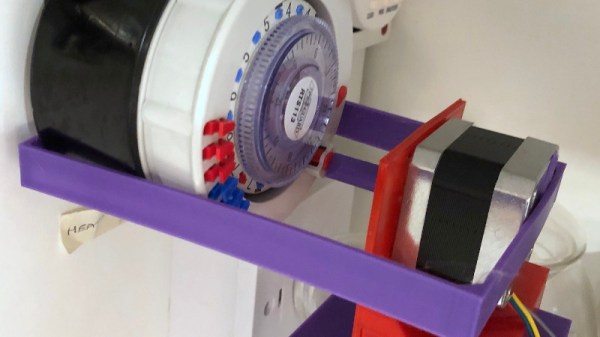
This sounds like an impossible task, but it’s one he’s done very well by mounting a stepper motor on a 3D-printed frame over the timer switch. It’s the type with a motorised ring onto which plastic fingers can be placed to flip a switch on or off; he’s simply removed the plastic fingers and designed a shaft extension for the motor that simulates their passing the switch. He can now turn his heating on and off at will from an ESP8266, in this case on an Adafruit Feather Huzzah.

Behind it all lies Adafruit IO with a custom dashboard — Hackaday’s [Sean Boyce] took this service for a trial run if you’d like his take on it’s features. For this project, Adafruit IO delivered exactly what [Andy] was after but still left a few teething troubles. The stepper needed to be told not to try to hold its position, and moving a stepper very slowly generated wait periods long enough to trigger the ESP’s watchdog timers. Adding in IFTTT gave him the ability to schedule, as well as Alexa control. All in all he’s replicated some commercial offerings with a lot less cost and all without annoying his landlord. You can see it in action in the video below the break.

Continue reading “Rental Home Thermostat Gets Smart Upgrade Without Modifying The Dumb Controller”

See In The Dark, The Simple Way

Night vision googles used to be the exclusive preserve of the military, and then of the well-heeled. Image intensifier tubes were very expensive, and needed high-voltage power supplies to keep them going. Now that we have solid-state infra-red cameras the task of seeing in the dark had become much simpler, and [Alex Zidros] is here to show us just how easy that can be. His night vision goggles take a selection of off-the-shelf parts and a little bit of 3D printing to produce a complete set-up for a fraction of the cost of those night-vision goggles of old.

At its heart is a little NTSC/PAL LCD display in a 3D printed bracket. These used to be a small display of choice, but we see them rarely now because standalone displays and the microcontrollers to drive them have become so much more useful. Driving the display is a video camera with its IR filter removed, and providing illumination is an IR flashlight. In effect it’s a classic analogue CCTV system in miniature, but the most important thing is that it works.

We might have expected a Raspberry Pi Zero and NoIR camera, but it’s difficult to argue with a functioning night vision system. If you want to look at a project with an image intensifier tube though, we’ve covered one of those in the past.