Car Alternators Make Great Electric Motors; Here’s How

The humble automotive alternator hides an interesting secret. Known as the part that converts power from internal combustion into the electricity needed to run everything else, they can also themselves be used as an electric motor.
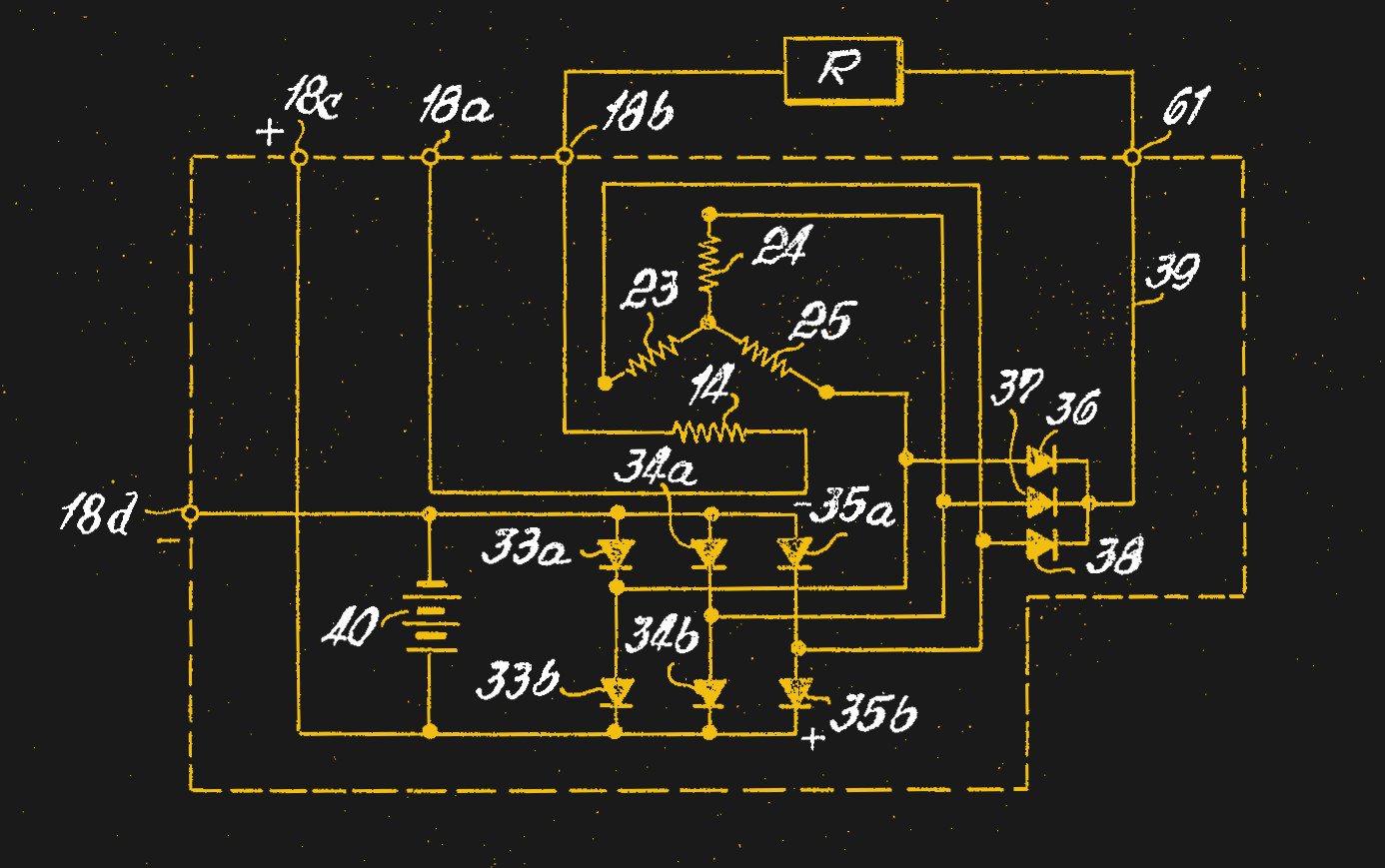
The schematic of a simple automotive alternator, from US patent 3329841A filed in 1963 for Robert Bosch GmbH .
The schematic of a simple automotive alternator, from US patent 3329841A filed in 1963 for Robert Bosch GmbH.

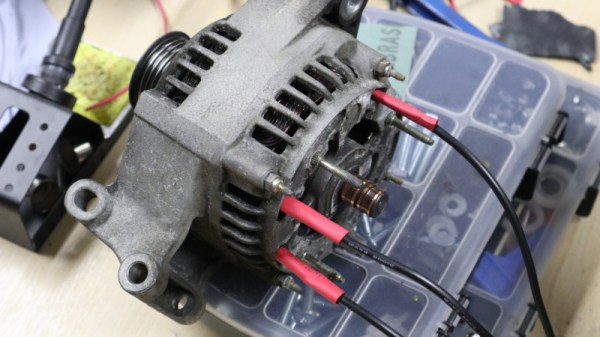
These devices almost always take the form of a 3-phase alternator with the magnetic component supplied by an electromagnet on the rotor, and come with a rectifier and regulator pack to convert the higher AC voltage to 12V for the car electrical systems. Internally they have three connections to the stator coils which appear to be universally wired in a delta configuration, and a pair of connections to a set of brushes supplying the rotor coils through a set of slip rings. They have a surprisingly high capacity, and estimates put their capabilities as motors in the several horsepower. Best of all they are readily available second-hand and also surprisingly cheap, the Ford Focus unit shown here came from an eBay car breaker and cost only £15 (about $20).

We already hear you shouting “Why?!” at your magical internet device as you read this. Let’s jump into that.

Continue reading “Car Alternators Make Great Electric Motors; Here’s How”

One ESP8266, One Battery, One Year… And Counting.

There are times when a sensor is required that does its job without the need for human attention over a long period, and for those applications a minimal power drain is a must. [Dave Davenport] had an EPS8266-based moisture sensor, and became disappointed in having to replace its AA batteries every few months. With an 18650 Li-ion cell and a bunch of power-saving tricks that time has been extended so far to over a year and still going, so he’s written a blog post detailing how he did it.

Some of his techniques such as turning off the sensor or using a better LDO regulator than the stock Wemos one are straightforward. Others though are unexpected, such as using the memory associated with the on-board RTC to store the WiFi connection info and channel number during sleep. The normal ESP8266 connection sequence involves a network scan, by hanging onto what it found last time the extra time and thus power expended by it can be avoided. Similarly switching from a DHCP lease to a fixed IP address cuts the time the device waits for a lease and thus the time it has to stay awake.

We might not all have ESP8266 moisture sensors to build, but we’re many of us on a quest to sip less power in our projects. Let us help you with a previous sojourn into that arena.

ESP8266 image: connorgoodwolf [CC BY-SA 4.0].

A Vintage Phone In 2020

When we make a telephone call in 2020 it is most likely to be made using a smartphone over a cellular or IP-based connection rather than a traditional instrument on a pair of copper wires to an exchange. As we move inexorably towards a wireless world in which the telephone line serves only as a vehicle for broadband Internet, it’s easy to forget the last hundred years or more of telephone technology that led up to the present.

The iconic British telephone of the 1960s and 1970s, the GPO model 746. Mine is from 1971.
The iconic British telephone of the 1960s and 1970s, the GPO model 746. Mine is from 1971. (That isn’t my phone number)

In a manner of speaking though, your telephone wall socket hasn’t forgotten. If you like old phones, you can still have one, and picture yourself in a 1950s movie as you twirl the handset cord round your finger while you speak. Continue reading “A Vintage Phone In 2020”

Awakening A Dragon From Its Slumber

For all the retrocomputing fun and games we encounter in our community, there are a few classic microcomputers that rarely receive any attention. Usually this is because they didn’t sell well and not many have survived, or were simply underwhelming machines that haven’t gathered a huge following today. One that arguably falls within both camps is the Dragon 32, a machine best known in those pre-Raspberry Pi days for being the only home computer manufactured in Wales, and for being nearly compatible with the Tandy Color Computer due to both machines’ designs coming from the same Motorola data sheet. Repeat restorer of retrocomputers, [Drygol], has given a Dragon 32 the full restoration and upgrade treatment, offering us a rare chance to take a look at this computer.

The Dragon arrived with a pile of contemporary books and software, but no power supply. A significant modification was made to the internal PSU board then to allow it to work with an Amiga unit, and the black-on-green Dragon text came up on the TV screen. Recapping and a replacement for a faulty op-amp fixed poor video quality, then it was time for a 64K memory upgrade with some neatly done bodge-wiring. Finally there’s a repair to the very period-looking analogue joystick, and a home-made interface for the more common Atari/Amiga style sticks.

The Dragon may be only a footnote in the history of 8-bit home computing, but with its good expandability and decent quality keyboard it perhaps deserved to reach more homes than it did. This appears to be the first time a Dragon has featured here, though its Tandy CoCo cousin has made it into a few stories.

A Supercapacitor Might Just Light Your Way One Day

Sometimes the simplest hacks are the most useful ones, and they don’t come much simpler than the little supercapacitor LED flashlight from serial maker of cool stuff [Jeremy S. Cook]. Little more than an LED, a supercapacitor, USB plug, and couple of resistors, it makes a neat little flashlight that charges from any USB A power socket and delivers usable light for over half an hour.

It’s neat, but on its own there’s not much to detain the reader until it is revealed as a “Hello World” supercapacitor project from an article in which he delves into the possibilities of these still rather exotic components. Its point is to explore their different properties when compared to a battery, for example a linear voltage drop in contrast to the sharp drop-off of a chemical cell. In the video below the break we see him try a little boost regulator to deliver a constant voltage, with consequent severe loss of lighting time for the LED. It’s by this type of experimentation that we learn our way around a component unfamiliar to us, and the article and video are certainly worth a look if you’ve never used a supercapacitor before.

Continue reading “A Supercapacitor Might Just Light Your Way One Day”

Living At The Close Of The Multiway Era

After over a decade of laptop use, I made the move a couple of months ago back to a desktop computer. An ex-corporate compact PC and a large widescreen monitor on a stand, and alongside them a proper mouse and my trusty IBM Model M that has served me for decades. At a stroke, the ergonomics of my workspace changed for the better, as I no longer have to bend slightly to see the screen.

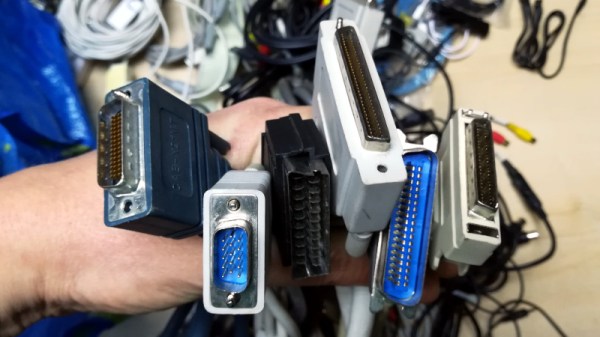
The previous desktop PC was from an earlier time. I think it had whatever the AMD competitor to a Pentium 4 was, and if I recall correctly, its 512 MB of memory was considered to be quite something. On the back it had an entirely different set of sockets to my new one, a brace of serial ports, a SCSI port, and a parallel printer port. Inside the case, its various drives were served by a set of ribbon cables. It even boasted a floppy drive. By contrast the cabling on its successor is a lot lighter, with much less bulky connectors. A few USB plugs and a network cable, and SATA for its disk drive. The days of bulky multiway interconnects are behind us, and probably most of us are heaving a sigh of relief. Continue reading “Living At The Close Of The Multiway Era”

DMCA-Locked Tractors Make Decades-Old Machines The New Hotness

It’s fair to say that the hearts and minds of Hackaday readers lie closer to the technology centres of Shenzhen or Silicon Valley than they do to the soybean fields of Minnesota. The common link is the desire to actually own the hardware we buy. Among those working the soil there has been a surge in demand (and consequently a huge price rise) in 40-year-old tractors.

Second-hand farm machinery prices have made their way to the pages of Hackaday due to an ongoing battle between farmers and agricultural machinery manufacturers over who has the right to repair and maintain their tractors. The industry giant John Deere in particular uses the DMCA and end-user licensing agreements to keep all maintenance in the hands of their very expensive agents. It’s a battle we’ve reported on before, and continues to play out across the farmland of America, this time on the secondary market. Older models continue to deliver the freedom for owners to make repairs themselves, and the relative simplicity of the machines tends to make those repairs less costly overall.

Tractors built in the 1970s and 80s continue to be reliable and have the added perk of predating the digital shackles of the modern era. Aged-but-maintainable machinery is now the sweetheart of farm sales. It confirms a trend I’ve heard of anecdotally for a few years now, that relatively new tractors can be worth less than their older DMCA-free stablemates, and it’s something that I hope will also be noticed in the boardrooms. Perhaps this consumer rebellion can succeed against the DMCA where decades of activism and lobbying have evidently failed.

They just don’t build ’em like they used to.


[Image Source: John Deere 2850 by Raf24 CC-BY-SA 3.0]

[Via Hacker News]