Turning A Sony Into A Leica Through Extreme Camera Modding

The quality of a photograph is a subjective measure depending upon a multitude of factors of which the calibre of the camera is only one. Yet a high quality camera remains an object of desire for many photographers as it says something about you and not just about the photos you take. [Neutral Gray] didn’t have a Leica handheld camera, but did have a Sony. What’s a hacker to do, save up to buy the more expensive brand? Instead he chose to remodel the Sony into a very passable imitation.

This is a Chinese language page but well worth reading. We can’t get a Google Translate link to work, but in Chrome browser, right clicking and selecting “translate” works. If you have a workaround for mobile and other browsers please leave a comment below.

The Sony A7R is hardly a cheap camera in the first place, well into the four-figure range, so it’s a brave person who embarks on its conversion to match the Leica’s flat-top aesthetic. The Sony was first completely dismantled and it was found that the electronic viewfinder could be removed without compromising the camera. In a bold move, its alloy housing was ground away, and replaced with a polished plate bearing a fake Leica branding.


Extensive remodelling of the hand grip with a custom carbon fibre part followed, with significantly intricate work to achieve an exceptionally high quality result. Careful choice of paint finish results in a camera that a non-expert would have difficulty knowing was anything but a genuine Leica, given that it is fitted with a retro-styled lens system.

We’re not so sure we’d like to brace Leica’s lawyers on this side of the world, but we can’t help admiring this camera. If you’re after a digital Leica though, you can of course have a go at the real thing.

Thanks [fvollmer] for the tip.

Safety Systems For Stopping An Uncontrolled Drone Crash

We spend a lot of time here at Hackaday talking about drone incidents and today we’re looking into the hazard of operating in areas where people are present. Accidents happen, and a whether it’s a catastrophic failure or just a dead battery pack, the chance of a multi-rotor aircraft crashing down onto people below is a real and persistent hazard. For amateur fliers, operating over crowds of people is simply banned, but there are cases where professionally-piloted dones are flying near crowds of people and other safety measures need to be considered.

We saw a skier narrowly missed by a falling camera drone in 2015, and a couple weeks back there was news of a postal drone trial in Switzerland being halted after a parachute system failed. When a multirotor somehow fails while in flight it represents a multi-kilogram flying weapon widow-maker equipped with spinning blades, how does it make it to the ground in as safe a manner as possible? Does it fall in uncontrolled flight, or does it activate a failsafe technology and retain some form of control as it descends?

Continue reading “Safety Systems For Stopping An Uncontrolled Drone Crash”

What Happens To Tesla When The Sleeping Auto Giants Awake?

The history of automotive production is littered with the fallen badges of car companies that shone brightly but fell by the wayside in the face of competition from the industry’s giants. Whether you pine for an AMC, a Studebaker, or a Saab, it’s a Ford or a Honda you’ll be driving in 2019.

In the world of electric cars it has been a slightly different story. Though the big names have dipped a toe in the water they have been usurped by a genuinely disruptive contender. If you drive an electric car in 2019 it won’t be that Ford or Honda, it could be a Nissan, but by far the dominant name in EV right now is Tesla.

Motor vehicles are standing at the brink of a generational shift from internal combustion to electric drive. Will Tesla become the giant it hopes, or will history repeat itself?

Continue reading “What Happens To Tesla When The Sleeping Auto Giants Awake?”

An MSX With A Nintendo Controller

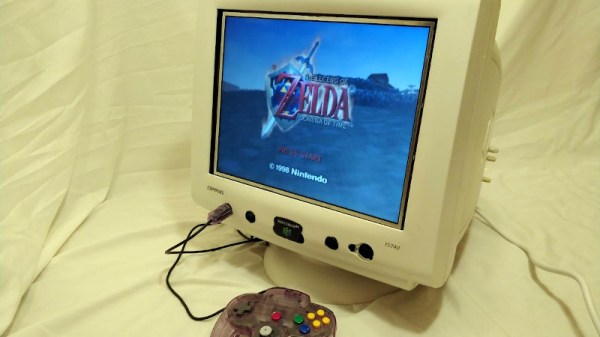
Console owners inhabit their own individual tribes depending upon their manufacturer of choice, and so often never the twain shall meet. But sometimes there are those what-if moments, could Mario have saved the princess more quickly through PlayStation buttons, or how would Sonic the Hedgehog have been with a Nintendo controller? [Danjovic] is finding the answer to one of those questions, with an interface between Nintendo 64 controllers and MSX hardware including the earlier Sega consoles.

In hardware terms, it’s a pretty simple device in the manner of many such projects, an Arduino Nano, a resistor, and a couple of sockets. The clever part lies not in its choice of microcontroller, but in the way it uses the Nano-s timing to ensure the minimum delay between button press and game action. The detail is in the write-up, but in short it makes use of the MSX’s need to attend to video lines to buy extra time for any conversion steps.

The MSX computers have had their share of controller upgrade courtesy of Nintendo hardware in the past, we’ve seen a Wii nunchuck controller talk to them before, as well as a SNES one.

Header image: [mboverload] (Public-domain).

Fitness Trackers Don’t Have To Be Proprietary

Fitness trackers have become a popular piece of consumer electronic equipment, with a range of models from a variety of manufacturers. Many of these commercial offerings, however, leave the consumer with the prospect of their data being drawn off to a cloud server and sold to the highest bidder, trading convenience for a loss of privacy. If only there were a fitness tracker offering complete control!

The OpenHAK is an open-source fitness tracker in a 3D printed wristwatch case that measures your heart rate and counts your steps, offering the resultant data for you to collect via Bluetooth. At its heart is a Sparkfun Simblee module, with heart rate sensing through a Maxim MAX30101 and step counting .by a Bocsh BMI160. It’s designed for expandability from the start with a header bringing out useful interface lines. In the prototype, they’ve used this to support a small OLED display. The result is a fitness tracker watch that may not match some of the well-known proprietary devices, but which remains completely open and probably costs a lot less too.

We’ve seen quite a few fitness tracker apps over the years, including a conversion to an EEG, and custom firmware for some commercial trackers.

In The Fast Moving World Of CNC, This Restored Router Is An Antique

Large machine tools are often built to last a very long time, so it is not uncommon to find a lathe made in the 19th century still providing faithful service. The fundamental job of a lathe has not changed significantly in the intervening years, even though a modern lathe will have more features than its hundred-year-old equivalent.

This is not the case for CNC machine tools. When computer numerical control was wedded with old iron machine tools, the control hardware was doomed to quickly become antique or vintage. From the user interfaces to the control circuitry, in the world of electronics new features quickly become obsolete. [Evan] has a ShopBot CNC wood router from the mid 1990s that he describes as an antique, and his tale of its restoration is both a fascinating look at the changes in small-scale CNC control over two decades as well as something of a primer for anyone considering a similar upgrade.

The controller is a pair of beige-box PC cases that scream “I love the 90’s!”. One contains a socket-7 PC running Windows 95, and the other houses the ShopBot controller; an 80c32 dev board with ShopBot firmware, coupled to a set of motor controller boards, which unlike today’s controllers expect raw quadrature inputs. His aim was to replace the vintage hardware with a modern alternative. An Arduino Mega running grbl to talks to the ShopBot controllers by way of a small piece of electronics to condition quadrature data from the step and direction lines it provided. The result may not be as good as a router from 2019, but it did save this aging tool from retirement.

A Keyboard Interface For Your SInclair ZX

The SInclair ZX 8-bit computers of the early 1980s were masterpieces of economy, getting the most out of minimal hardware. The cassette tape interface was a one-bit port, the video was (on the first two models anyway) created by the processor itself rather than a CRT controller, and the keyboard? No fancy keyboard controllers here, just a key matrix and some diodes between a set of address lines and some data lines. The ZX80 and ZX81 were not very fast as a result of their processors being tied up with all this work, but it ensured that their retail price could break the magic £100 barrier in the British market, something of a feat in 1980.

A host of hackers still devote their time to these machines, and among them [Danjovic] has updated that ZX keyboard by producing an interface between that matrix and a PS/2 keyboard. As you might expect it uses a modern microcontroller board, in this case an Arduino Nano but it doesn’t stretch the imagination to think that a USB equipped board might perform the same task. It sits upon the relevant lines, and performs the necessary logical connection between them depending upon the serial input from an attached PS/2 keyboard. The project goes into some detail on PS/2 to ZX mappings, but perhaps of most interest is its explanation of the bus timings involved. The Arduino makes use of the ZX WAIT line to hold the Z80 and ensure that there is enough time for it to perform its task, it would be interesting to note whether or not this has a visible impact on BASIC program timing.

We are more used to seeing ZX keyboards being attached to PCs, rather than this way round.

ZX Spectrum image: Bill Bertram [CC BY-SA 2.5].