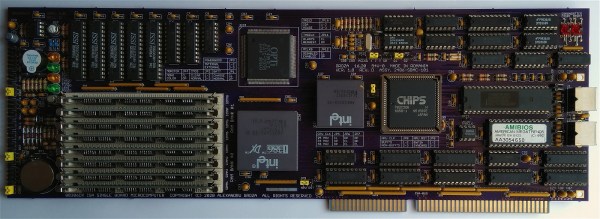
Version 1.8 of the 80386 ISA SBC in its assembled glory. (Credit: Alexandru Groza)

Building Your Own 80386DX ISA Single Board Microcomputer

Having grown up with 386-level systems during the early 90s like so many of us, [Alexandru Groza] experienced an intense longing to experience the nostalgia of these computer systems from an interesting angle: by building his own 80386DX-based single board computer. Courtesy of the 16-bit ISA form factor, the entire system fits into a 16-bit ISA backplane which then provides power and expansion slots for further functionality beyond what is integrated on the SBMC card.

Having started the project in 2019, it is now in the home stretch towards completion. Featuring an 80386DX and 80387DX FPU alongside 128 kB of cache and a grand total of 32 MB of RAM, an OPTi chipset was used to connect with the rest of the system alongside the standard 8042-class PS/2 keyboard and mouse controller. A large part of the fun of assembling such a system is that while the parts themselves are easy enough to obtain, finding datasheets is hard to impossible for some components.

Undeterred, some reverse-engineering of signaling on functional mainboards was sufficient to fill in the missing details. Helpfully, [Alexandru] provides the full schematics and BOM of the resulting board and takes us along with bootstrapping the system after obtaining the PCBs and components. After an initial facepalm moment due to an incorrectly inserted (and subsequently very dead) CPU and boot issues, ultimately [Alexandru] gave up on the v1.6 revision of the board

Fortunately the v1.8 revision with a logic analyzer led to a number of discoveries that has led to the system mostly working, minus what appears to be DMA-related issues. Even so, it is a remarkable achievement that demonstrates the complexity of these old systems.

ESP32 composite library with LVGL demo. (Credit: aquaticus)

Generating Composite Video On ESP32 With LVGL GUI

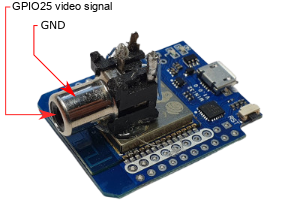
RCA connector mounted to ESP32 board. (Credit: aquaticus)

Just because a microcontroller doesn’t have a dedicated video peripheral doesn’t mean it cannot output a video signal. This is demonstrated once again, this time on the ESP32 by [aquaticus] with a library that generates PAL/SECAM and NTSC composite signals. As a finishing touch on the hardware side, [aqaticus] added an RCA jack is an optional extra. The composite signal itself is generated on GPIO 25, with the selection from a wide number of PAL and NTSC resolutions.

In addition, LVGL support is integrated: this is an open-source library that provides a cross-platform way to provide graphical UIs for embedded platforms. Using this combination any ESP32 can generate a fully graphical UI on a monochrome or color display to add some extra flair and functionality to an ESP32 project.

Currently, this library does not support color output, but hopefully this will be added in the future. Even so, together with simple VGA output using a DAC, this library provides yet another way to add analog video output to ubiquitous MCUs like the ESP32. Even if these MCUs are not going to be decoding any video formats at a reasonable speed, adding a UI that’s more user-friendly than an HD44780-based display and a few buttons can really elevate the user experience.

Cranes made by Origami (Orizuru). The height is 35mm.

Bringing The Art Of Origami And Kirigami To Robotics And Medical Technology

Traditionally, when it comes to high-tech self-assembling microscopic structures for use in medicine delivery, and refined, delicate grippers for robotics, there’s been a dearth of effective, economical options. While some options exist, they are rarely as effective as desired, with microscopic medicine delivery mechanisms, for example, not having the optimal porosity. Similarly, in so-called soft robotics, many compromises had to be made.

A promising technology here involves the manipulation of flat structures in a way that enables them to either auto-assemble into 3D structures, or to non-destructively transform into 3D structures with specific features such as grippers that might be useful in both micro- and macroscopic applications, including robotics.

Perhaps the most interesting part is how much of these technologies borrow from the Japanese art of origami, and the related kirigami.

Continue reading “Bringing The Art Of Origami And Kirigami To Robotics And Medical Technology”

Grid Batteries On Wheels: The Complicated Logistics Of Vehicle-Grid Integration

At its core, the concept of vehicle-grid integration (VGI) – also called Vehicle To Grid (V2G) – seems a simple one. Instead of a unidirectional charger for battery-electric vehicles (BEVs), a bidirectional charger would be used. This way, whenever the BEV is connected to such a charger, power could be withdrawn from the car’s battery for use on the local electrical grid whenever there’s demand.

Many of the complications with VGI have already been discussed, including the increased wear that this puts on a BEV’s battery, the need for an inherently mobile machine to be plugged into a charger, and the risk of needing one’s BEV and finding its battery to be nearly depleted. Here the cheerful marketing from Nissan and that from commercial initiatives such as Vehicle to Grid Britain makes it sound like it’s a no-brainer once those pesky details can be worked out.

In parallel with the world of glossy marketing leaflets, researchers have been investigating VGI as a potential option for grid-level energy storage. These studies produce a far less optimistic picture that puts the entire concept of VGI into question.

Continue reading “Grid Batteries On Wheels: The Complicated Logistics Of Vehicle-Grid Integration”

Greedy Receivers: FCC Considers Regulating Receivers After Altimeter Showdown

Recently, the media was filled with articles about how turning on 5G transmissions in the C-band could make US planes fall out of the sky. While the matter was ultimately resolved without too much fuss, this conflict may have some long-term consequences, with the FCC looking to potentially address and regulate the root of the problem, as reported by Ars Technica.

At the heart of the whole issue is that while transmitters are regulated in terms of their power and which part of the spectrum they broadcast on, receivers are much less regulated. This means that in the case of the altimeters in airplanes for example, which use the 4.2 GHz – 4.4 GHz spectrum, some of their receivers may be sensitive to a part of the 5G C-band (3.7 GHz -3.98 GHz), despite the standard 200 MHz guard band (upped to 400 MHz in the US) between said C-band and the spectrum used by altimeters.

What the FCC is currently doing is to solicit ways in which it could regulate the performance and standards for receivers. This would then presumably not just pertain to 5G and altimeters, but also to other receivers outside of avionics. Since the FCC already did something similar back in 2003 with an inquiry, but closed it back in 2007 without any action taken, it remains to be seen whether this time will be different. One solid reason would be the wasted spectrum: a 400 MHz guard band is a very large chunk.

Thanks to [Chris Muncy] for the tip.

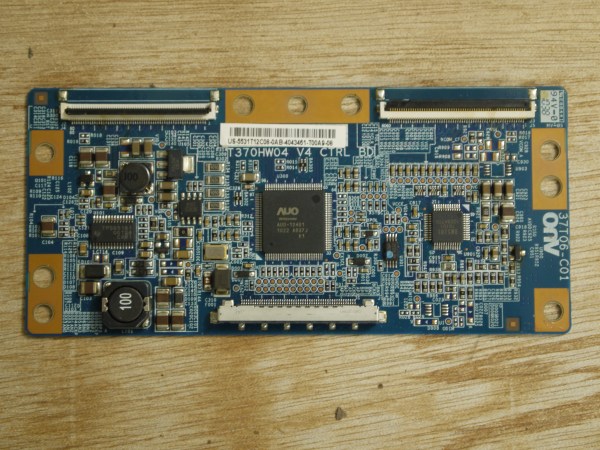
The AUO-manufactured controller board of an LG-branded TV. (Credit: Andrew Menadue)

What To Do With A Broken Television When You Can’t Fix It

Who can say ‘no’ to a free TV, even if it’s broken? This was the situation [Andrew Menadue] ended up in last year when he was offered an LG 39LE4900 LCD TV. As [Andrew] describes in the blog post along with videos (see first part embedded after the break), this particular television had been taken to a television repair shop previously after the HDMI inputs stopped working, but due to a lack of replacement parts the owner had to make due with the analog inputs still working. That is, until those stopped working as well.

The nice thing about these TVs is that they are very modular inside, as [Andrew] also discovered to his delight. In addition to the LG controller board, an inverter board and the power supply board, this TV also contained a TCON PCB. After some initial unsuccessful swapping of the parts with EBay replacements, nothing was (surprisingly) working, but it did turn out that the TCON and inverter boards are made and sold by AUO (major Taiwanese display manufacturer), along with the display itself.

In the end it turned out that the AUO boards and screen were fine, and after sourcing a board to convert VGA input to the LVDS signal accepted by the TCON board, the whole display worked. Naturally using a board with HDMI inputs would be nice, but it does show how a ‘broken’ TV can be turned into a really nice, big monitor without all too much effort if it’s just the controller board that went on the fritz.

Continue reading “What To Do With A Broken Television When You Can’t Fix It”

Ray Tracing On A Modern TI Graphing Calculator

Something being impractical isn’t any reason not to do it, which is why just about anything with a CPU in it can run Doom by now. For the same reason there obviously is a way to do ray tracing of 3D scenes on a modern-day TI-84 Plus CE graphical calculator. This is excellent news for anyone who has one of these calculators, along with a lot of time, perhaps during boring classes, to spare.

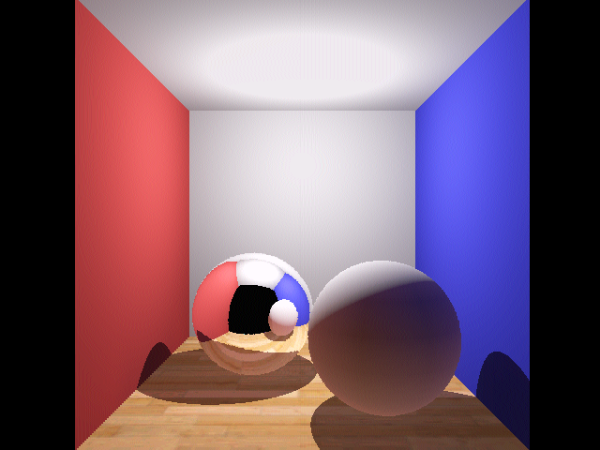
As [TheScienceElf] demonstrates in a video, also embedded after the break, it’s not quite the real-time experience one would expect from an NVidia RTX 30-series GPU. Although the eZ80-based CPU in the calculator is significantly more efficient than a Z80 as found in many 1980s home computers, the demo scene at standard resolution takes about 12 minutes to render, as also noted on the GitHub project page.

Perhaps the most interesting part about this project is its use of the Clang-based C & C++ toolchain for the TI-84 Plus CE which gives easy access to the calculator’s hardware and related, including graphics, file I/O, fonts, keypad input and more. Even if using a TI-84 Plus CE to render the next Pixar-level movie isn’t the most productive use imaginable for these devices, this project and the CE toolchain make it all too easy to tinker with these $150 devices.

It would also offer a nice change of pace from writing Snake in TiBASIC, a BASIC dialect in which [TheScienceElf] incidentally has also written a ray tracer.

(Thanks to [poiuyt] for the tip)

Continue reading “Ray Tracing On A Modern TI Graphing Calculator”