Another World On The Apple II

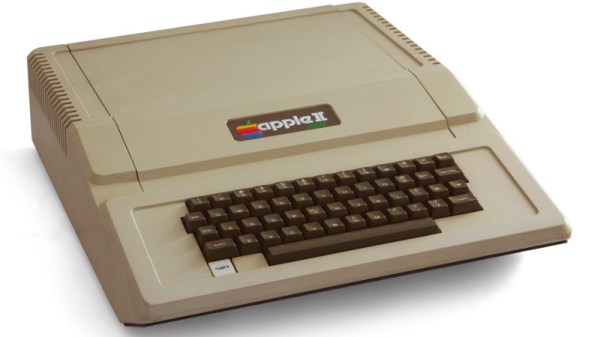
What’s more fun than porting an old game released for an old system such as the Apple IIgs to its 10-year-older predecessor, the Apple II from 1977? Cue [Deater]’s port of the classic video game ‘Another World‘ to the original Apple II. As was fairly obvious from the onset, the main challenges were with the amount of RAM, as well as with the offered graphics resolutions.

Whereas the Apple II could address up to 48 kB of RAM, the 16-bit Apple IIgs with 65C816 processor could be upgraded to a maximum of 8 MB. The graphics modes offered by the latter also allowed ‘Another World’ to run at a highly playable 320×200, whereas the ported version is currently limited to the ‘low resolution’ mode at 40×48 pixels.

The game itself still needs a lot of work to add missing parts and fix bugs, but considering that it has been implemented in 6502 assembler from scratch, using just the gameplay of the IIgs version as reference, it’s most definitely an achievement which would have earned [Deater] a lot of respect back in the late ’80s as well.

Feel free to check out the Github page for this project, grab a floppy disk image from the project page and get playing. Don’t forget to check out the gameplay video linked after the break as well.
Continue reading “Another World On The Apple II”

Inventor And Detective Create Range Of Snack-Hiding Devices

Anyone who has had to deal with siblings, their friends, flatmates or parents who are overly fond of snacks may know this issue: you bought some snacks for your own consumption, but before you can get to them they have vanished. Naturally, nobody knows what happened to said snacks and obviously outraged that anyone would dare to do such a dastardly thing like eating someone else’s snacks.

This is the premise behind British inventor [Colin Furze]’s new series of YouTube videos (embedded after the break). Teaming up with former Scotland Yard detective [Peter Bleksley], their goal is to find ways to hide snacks around the house where curious and peckish individuals will not find them. Though a snack-company sponsored series (Walkers) and featuring snack names that will ring no bells for anyone outside of the UK, it nevertheless shows some innovative ways to hide snacks.

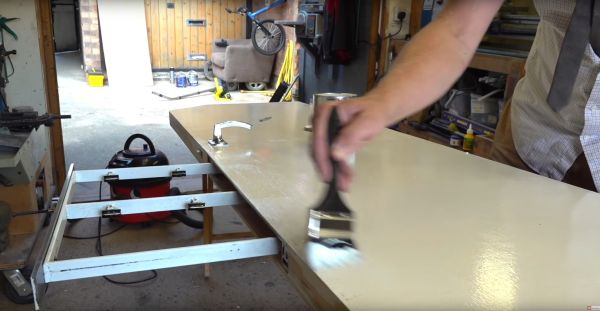
The first episode shows how one can hide snacks (or something else, naturally) inside a door. The second tweaks a standing lamp to add some hidden drawers, and the third episode creates a hidden compartment behind a television. Perhaps the most intriguing part of these episodes is the way it highlights how easy it is to not just hide snacks around the house, but also devices for automation and monitoring. Just think how one could use these tricks for IoT projects and the like.

Continue reading “Inventor And Detective Create Range Of Snack-Hiding Devices”

A Colorful Way To Play Chess On An ATmega328

We’ve all seen those chess computers that consist out of a physical playing field, and a built-in computer that would indicate where you should put its pieces while inputting the position of your pieces in some way. These systems are usually found in a dusty cardboard box in a back room’s closet, as playing like this is fairly cumbersome, and a lot depends on the built-in chess computer.

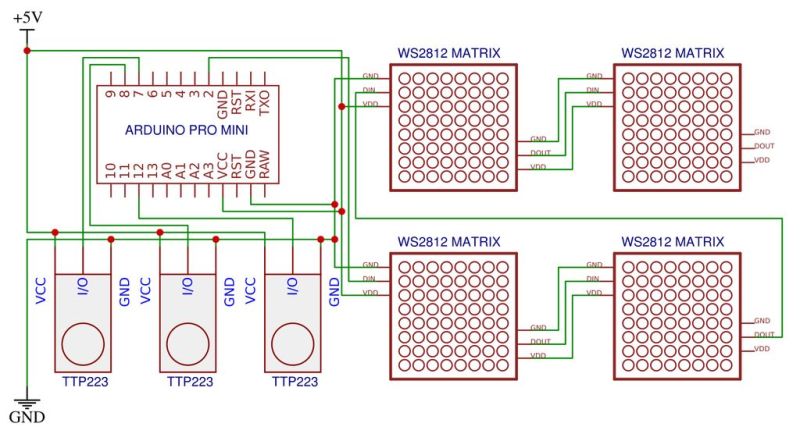
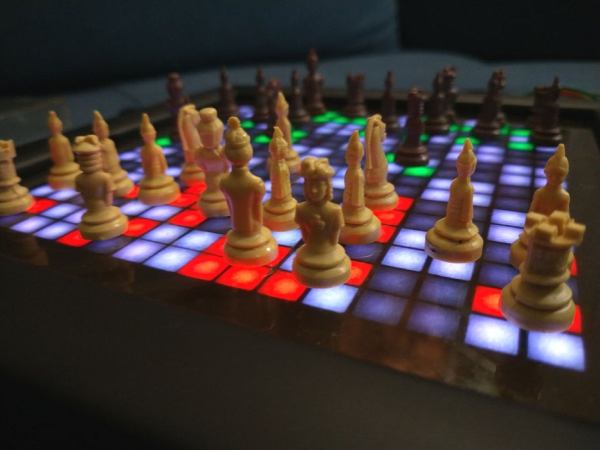
This take by [andrei.erdei] on this decades-old concept involves an ATmega328p-based Arduino Pro Mini board, a nice wooden frame, and 4 WS2812-based 65×65 mm RGB 8×8 LED matrices, as well as some TTP223 touch sensors that allow one to control the on-board cursor. This is the sole form of input: using the UP and RIGHT buttons to select the piece to move, confirm with OK, then move to the new position. The chess program will then calculate its next position and indicate it on the LED matrix.

Using physical chess pieces isn’t required either: each 4×4 grid uses a special pattern that indicates the piece that occupies it.  This makes it highly portable, but perhaps not as fun as using physical pieces. It also kills the sheer joy of building up that collection of enemy pieces when you’ve hit that winning streak. You can look at the embedded gameplay video after the break and judge for yourself.

Continue reading “A Colorful Way To Play Chess On An ATmega328”

ORNL's Summit supercomputer, fastest until 2020 (Credit: ORNL)

Joining The RISC-V Ranks: IBM’s Power ISA To Become Free

IBM’s Power processor architecture is probably best known today as those humongous chips that power everything from massive mainframes and supercomputers to slightly less massive mainframes and servers. Originally developed in the 1980s, Power CPUs have been a reliable presence in the market for decades, forming the backbone of systems like IBM’s RS/6000 and AS/400 and later line of Power series.

Now IBM is making the Power ISA free to use after first opening up access to the ISA with the OpenPower Foundation. Amidst the fully free and open RISC-V ISA making headway into the computing market, and ARM feeling pressured to loosen up its licensing, it seems they figured that it’s best to join the party early. Without much of a threat to its existing business customers who are unlikely to whip up their own Power CPUs in a back office and not get IBM’s support that’s part of the business deal, it seems mostly aimed at increasing Power’s and with it IBM’s foothold in the overall market.

The Power ISA started out as the POWER ISA, before it evolved into the PowerPC ISA, co-developed with Motorola  and Apple and made famous by Apple’s use of the G3 through G5 series of PowerPC CPUs. The PowerPC ISA eventually got turned into today’s Power ISA. As a result it shares many commonalities with both POWER and PowerPC, being its de facto successor.

In addition, IBM is also opening its OpenCAPI accelerator and OpenCAPI Memory Interface variant that will be part of the upcoming Power9′ CPU. These technologies are aimed at reducing the number of interconnections required to link CPUs together, ranging from NVLink, to Infinity Fabric and countless more, not to mention memory, where OMI memory could offer interesting possibilities.

Would you use Power in your projects? Let us know in the comments.

Looking Around Corners With F-K Migration

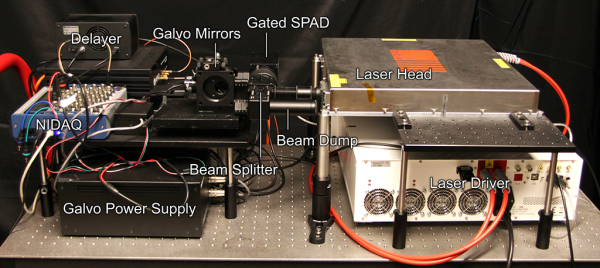
The concept behind non-line-of-sight (NLOS) imaging seems fairly easy to grasp: a laser bounces photons off a surface that illuminate objects that are within in sight of that surface, but not of the imaging equipment. The photons that are then reflected or refracted by the hidden object make their way back to the laser’s location, where they are captured and processed to form an image. Essentially this allows one to use any surface as a mirror to look around corners.

Main disadvantage with this method has been the low resolution and high susceptibility to noise. This led a team at Stanford University to experiment with ways to improve this. As detailed in an interview by Tech Briefs with graduate student [David Lindell], a major improvement came from an ultra-fast shutter solution that blocks out most of the photons that return from the wall that is being illuminated, preventing the photons reflected by the object from getting drowned out by this noise.

The key to getting the imaging quality desired, including with glossy and otherwise hard to image objects, was this f-k migration algorithm. As explained in the video that is embedded after the break, they took a look at what methods are used in the field of seismology, where vibrations are used to image what is inside the Earth’s crust, as well as synthetic aperture radar and similar. The resulting algorithm uses a sequence of Fourier transformation, spectrum resampling and interpolation, and the inverse Fourier transform to process the received data into a usable image.

This is not a new topic; we covered a simple implementation of this all the way back in 2011, as well as a project by UK researchers in 2015. This new research shows obvious improvements, making this kind of technology ever more viable for practical applications.

Continue reading “Looking Around Corners With F-K Migration”

Returning Digital Watches To The Analog Age: Enter The Charliewatch

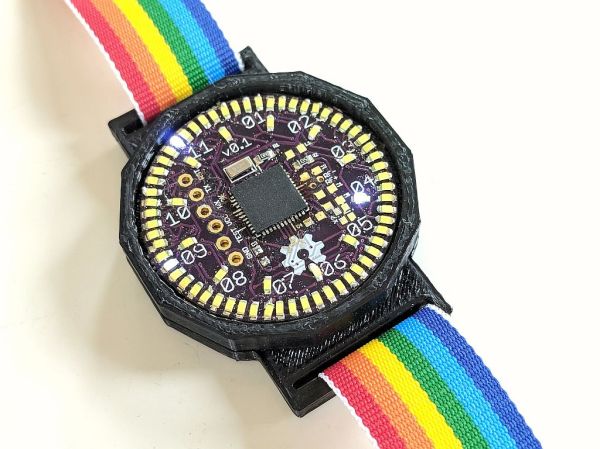
The Charliewatch by [Trammell Hudson] is one of those projects which is beautiful in both design and simplicity. After seeing [Travis Goodspeed]’s GoodWatch21 digital watch project based around a Texas Instruments MSP430-based SoC, [Trammell] decided that it’d be neat if it was more analog. This is accomplished using the CC430F5137IRGZR (a simpler member of the MSP430 family) and a whole bunch of 0603 SMD LEDs which are driven using Charlieplexing.

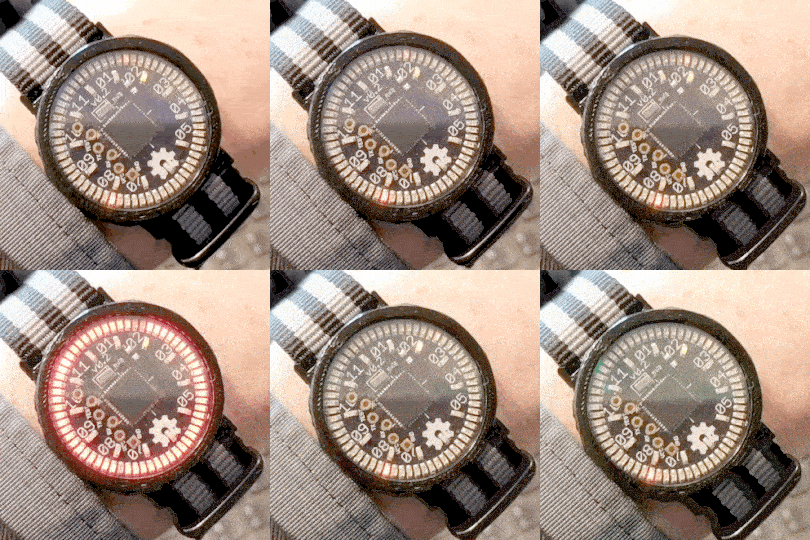
This time-honored method of using very few I/O pins to control many LEDs makes it possible to control 72 LEDs without dedicating 72 pins. The density makes animations look stunning and the digital nature melts away leaving a distinct analog charm.

A traditional sapphire crystal was sourced from a watchmaker for around 14€ as was the watch band itself. The rest is original work, with multiple iterations of the 3D printed case settling in on a perfect fit of the crystal, PCB, and CR2032 coin cell stackup. The watch band itself hold the components securely in the housing, and timekeeping is handled by a 32.768 kHz clock crystal and the microcontroller’s RTC peripheral.

The LEDs can be seen in both daylight and darkness. The nature of Charlieplexing means that only a few of the LEDs are ever illuminated at the same time, which does wonders for battery life. [Trammell] tells us that it can run for around six months before the coin cell needs replacing.

It’s completely open source, with project files available on the project’s Github page. We hope to see an army of these watches making appearances at all upcoming electronics-oriented events. Just make sure you lay off the caffeine as the process of hand-placing all those LEDs looks daunting.

Apollo’s PLSS And The Science Of Keeping Humans Alive In Space

Ever since humans came up with the bright idea to explore parts of the Earth which were significantly less hospitable to human life than the plains of Africa where humankind evolved, there’s been a constant pressure to better protect ourselves against the elements to keep our bodies comfortable. Those first tests of a new frontier required little more than a warm set of clothes. Over the course of millennia, challenging those frontiers became more and more difficult. In the modern age we set our sights on altitude and space, where a warm set of clothes won’t do much to protect you.

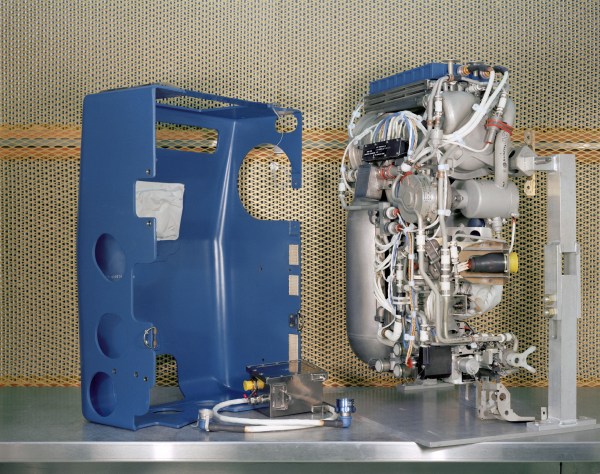
With the launch of Sputnik in 1957 and the heating up of the space race between the US and USSR, many firsts had to be accomplished with minimal time for testing and refinement. From developing 1945’s then state-of-the-art V-2 sounding rockets into something capable of launching people to the moon and beyond, to finding out what would be required to keep people alive in Earth orbit and on the Moon. Let’s take a look at what was required to make this technological marvel happen, and develop the Portable Life Support System — an essential component of those space suits that kept astronauts so comfortable they were able to crack jokes while standing on the surface of the Moon.

Continue reading “Apollo’s PLSS And The Science Of Keeping Humans Alive In Space”