Haunted Dollhouse Microcontroller Networking For World Maker Faire

master-slave-networks

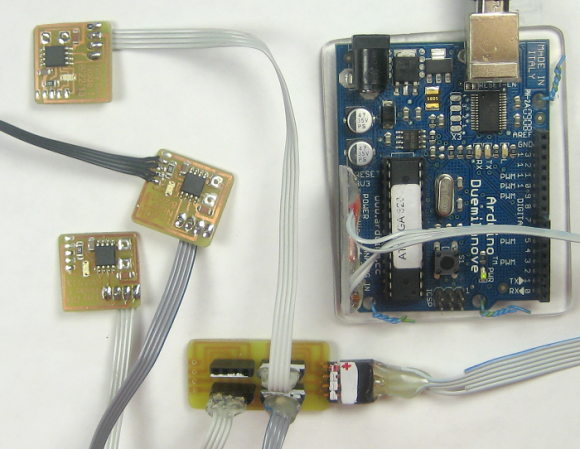
It’s pretty awesome to get see the number of projects presented at World Maker Faire. But we still love digging into the gritty details that only an in-depth build post can deliver. Here we get both. You can see the circuits pictured above in the Circuit Castle exhibit at WMF this weekend, and you can read about how the microcontroller network was built in [Jim’s] article.

As the title states, this is a network built for a dollhouse. Each slave device performs a different task; adding color, sound, motion, and interactivity using some sensors.  The post discusses the i2c (or TWI to get around licensing issues as [Jim] mentions) communications used to talk to the ATtiny85 chips on the slave boards. Because the eight-pin package leaves few I/O pins to work with an ATtiny84 was also added. It brings 14-pins to the party, including multiple ADC inputs for reading sensors.

If this ends up being too much of a read for you jog to the “Update 9/17/13” to get the general overview of progress. Like any project on a timeline, not everything works quite as well as they would have liked it to. But it’s the journey that makes something like this so fun — a fully working project would signal an end to the enjoyment, right?

[via Workshop 88]

Getting Your Feedback And A Staff Update

had-staff-update-9-2013

Please join me in welcoming four new members to our crew. I published a post calling for applications almost two weeks ago. I wouldn’t say we were overwhelmed with applications. But I would say we were overwhelmed with qualified applicants. Hackaday writers need to be Jacks of all Trades in order to recognize and feature the best hacks from a wide range of disciplines. To this end we chose writers who have interests in areas what will complement those already represented by the team. I couldn’t be happier with the new contributors. Please join me in welcoming [James Hobson], [Todd Harrison], [Phillip Ryals], and [Adam Fabio]. They’ve already been hard at work dishing up fresh hacks, but you can learn more about their backgrounds by reading the biographies on our Staff Page.

You may have noticed a change this week. Although we’re an English language blog based in the United States, our statistics show readers throughout the world (in fact, almost a third of our writing team aren’t Americans). For this reason we changed our post scheduling earlier this week to a 24-hour cycle. This means more time between posts, and of course new posts being published in the middle of the night. Keep reading for a few more tidbits and a chance to give us your feedback.

Continue reading “Getting Your Feedback And A Staff Update”

Fail Of The Week: Smoking Pulse Sensor And BLE Disappointment

fotw-ble-and-pulse-sensor

We think [Thomas Brittain] is onto something. We often post to our personal blogs so that we have a reference to how we did something. But he also keeps a long post that documents his abandoned projects. It ends up serving as a quick start if he ever decides to pick up the torch once again. Lucky for us he’s included his failures in the write up. This Fail of the Week features the top two posts on his Incomplete Works page. The first is an attempt to make his own pulse sensor. The second is a miserable experience with a cheap Bluetooth Low Energy module.

Continue reading “Fail Of The Week: Smoking Pulse Sensor And BLE Disappointment”

$25 Coupon Code For Texas Instruments Store

ti-25-buck-coupon

If you’ve been coveting a piece of Texas Instruments hardware you should put in an order before September 30th. A coupon code for $25 off a purchase was posted to the Stellaris ARM Community forums and it should work until that date. Above is the overview of an order placed yesterday for two Tiva Launchpads (apparently TI has rebranded the Stellaris chips as Tiva for some odd reason). After applying the coupon code “National-1yr” the total price of [BravoV’s] order is just under one dollar (including shipping). The coupon code can be entered into a box on the right hand column of step #3 (payment) when placing an order.

UPDATE: There are now multiple comments reporting that the coupon code no longer works.

We’re pretty sure you can use this coupon code on anything in the TI store. But if you don’t have a Stellaris/Tiva Launchpad yet we highly recommend getting one. We picked ours up about a year ago. It’s a great way to try your hand at ARM programming. We have had some issues with how the breakout headers are organized — there’s some gotchas with multiple pins being connected (read the last five paragraphs of the project write up linked in this post for more). But for the price and ease of programming this will get you up and coding in no time. If you need some ideas of what to do with the board look at our posts tagged as “Stellaris”.

[Thanks Vlad]

Hackaday Links: September 15, 2013

hackaday-links-chain

First a quick announcement. We changed our “Kickstarter” category to “Crowd Funding“. We get a huge number of tips about crowd funding projects. We’re always interested in details. If you’re trying to get your crowd funding campaign on our front page make sure you’ve shared as many gritty project details (development process, problems/successes along the way, etc.) as possible . We usually prefer if this is done in a separate blog post from the campaign page itself.

Here’s a peephole hack that purportedly cost four grand. It uses a full on DSLR for the peephole hardware. Add a motion sensor and maybe you’ll be able to learn the faces of the neighbors who live on your floor. [via Gizmodo]

[Matthias] tells us that support for Rigol DS1052E oscilloscopes has been included in the 3.11 version of the Linux Kernel. Prior to this, getting the hardware to work on Linux was a hack, and a buggy one at that. For what it’s worth, here’s confirmation that support was added.

A post about reverse engineering the FitBit Aria Wi-Fi scale was sent in by [Christopher]. This makes us wonder if you could patch into a digital scale, using your own electronics to spoof the FitBit version?

We always keep our paperboard six-pack carriers so that we have a way to transport our homebrew beer. But rolling into a party with this laser-cut beer caddy which [Daniel] designed looks a lot cooler.

Texas Instruments has an MSP430 Selection Guide (PDF) which we found interesting. The first nine pages or so are pretty much just marketing, but several pages of parametric tables found after that make for a great collection of data on the hardware families. [via Dangerous Prototypes]

[Antoine] spared no expense building a coffee table that showcases his old motherboards. The illuminated glass and wood art piece rang in at around $400 in materials. We’re a little more minimalist with our home decor. We still want something along the lines of this LED matrix version.

Speaking of LED matrices, [Mario] dropped off a link to his LED Space Invaders game in the comments of last week’s Game of Light post. What we can’t figure out is why so many people hesitate to send in a tip about their awesome projects?

Fail Of The Week: Laser Cutter That Makes Jagged Edges

This Fail of the Week is really only a failure because of the standards to which [eLabz] holds himself. The rig pictured above is a laser cutter built out of DVD drive parts. It goes above and beyond most of the optical drive CNC projects we see around here — it actually makes cuts! But [eLabz] looks on it as a failure because the steps of the driver motors are visible as jagged edges in those cuts. We see this more as a pausing point in the development process before the next refinement is made.

Continue reading “Fail Of The Week: Laser Cutter That Makes Jagged Edges”

PCB Agitator From A Broken CD-ROM Drive

pcb-agitator

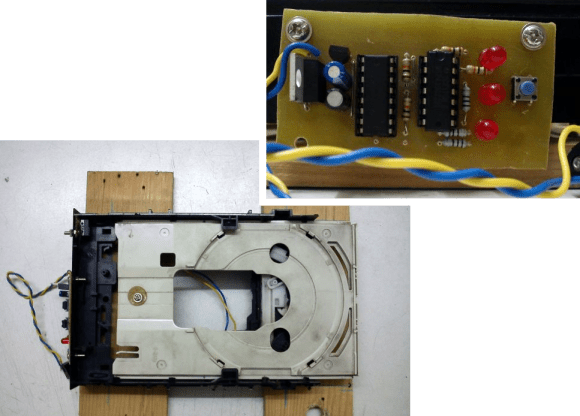
Etching PCBs goes a lot better if you agitate the solution in order to carry away the dissolved copper and get fresh etchant to the area. With that in mind [Rohit Gupta] designed a mechanism in Sketch Up before realizing he was going about it the hard way. He ended up basing his agitator on a broken CD-ROM drive instead of starting from scratch.

He uses the CD sled from the drive, ditching the lens and its support structure. To get direct access to the motor that drives the tray he uses an L293D H-bridge chip. This is controlled by an MSP430G2231 microcontroller. The driver board seen in the upper right includes a voltage regulator, three status LEDs, and one user input switch. Once triggered, the sled will move back and forth, contacting an old mouse microswitch which acts as the limiting switch. We find it entertaining that [Rohit] prototyped the circuit on a breadboard, then used that success to etch the final circuit board (shown in the video below).

If you’ve been following the hacker creed and never getting rid of any junk you’ll have no problem finding a donor drive to make one of your own. But just in case you can’t get a hold of this hardware a similar agitator can be built using a hobby servo.

Continue reading “PCB Agitator From A Broken CD-ROM Drive”