Color NTSC Video Directly From An AVR Chip

color-ntsc-from-avr-chip

We’ve seen composite video out from AVR chips many times before. But we can’t remember coming across one that managed to produce a color signal. This project does just that, producing a color video signal from an ATmega168 without using external integrated circuits.

[CNLohr] is seen here showing off his accomplishment. You’ll remember him from the glass-slide PCB server project he’s been working on recently. This time around it’s a small piece of gaming hardware which he’s working on. But using four pins from the microcontroller, connected via resistors in parallel, he is able to generate a color NTSC signal without using a chip like the AD723.

After the break you can see the two minute demo in which he shows the game running for just an moment, then gives a general overview of how the signals are being built. There isn’t a ton of explanation, but he did post his code as well as a resource for you to teach yourself more about the NTSC standard. Maybe you can make a color version of that AVR tetris game?

Continue reading “Color NTSC Video Directly From An AVR Chip”
Making A 12V Bulb Work In A 6V Socket

12v-led-in-6v-socket

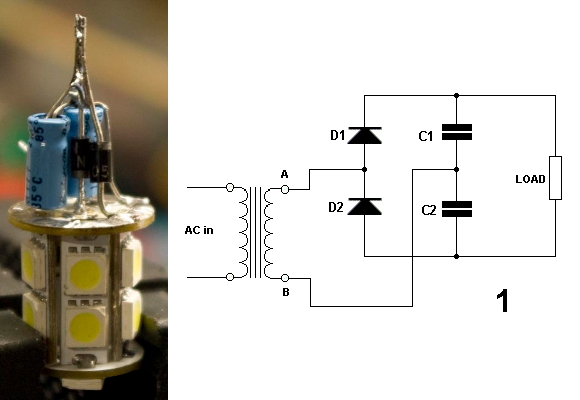
This is something of a square peg in a round hole type of problem. [Kiel Lydestad] has been riding a vintage Moped around. You know, a motorcycle that can be pedaled like a bike. He of course wants to keep the thing looking stock, but also needs it to be fully functional. Enter this light bulb replacement project. His brake light needed a new bulb, and he managed to make this 12V LED bulb work in the 6V socket.

An LED is a really great choice for this application since the Motobécane Moped uses a magneto generator to power the lights. It won’t pull much current, but it did need modification to run from half as much voltage. [Kiel] mentions that it may have been possible to crack open the LED tower and adjust the current limiting circuit inside, but he felt it was easier to just add this voltage doubling circuit. He assembled the components in a way that still allows them to fit in the metal base of the bulb.

Robot Steals Soda From The Vending Machine

robot-steals-soda

It’s very hard to tell from this photo because of the super bright blue LEDs, but this soda machine is being robbed by a robot.

We don’t condone theft, but neither does the creator of the project. [Ioduremetallique] is really just problem solving; doing something because he can. And we’d bet this type of thing will end up landing him a high-paying job some day (we’re assuming he’s currently in school).

The project is shown off in the video after the break. The gist of it is that a compact robot arm is put into the drop area of a vending machine. After the flap is closed the wired remote control is used to raise up the telescoping arm, and grip the soda can with the grippers. It’s brilliant and devious all at the same time. The entire video is in French, but the YouTube captions translator actually worked quite well with this video. To turn it one, use the ‘CC’ icon on the bottom of the video. We had to select the French captions before it would allow us to chose English from the translated captions list. About four minutes in we get a great look at the hardware itself… a super hack!

Continue reading “Robot Steals Soda From The Vending Machine”

Rate Gyroscope Circuitry Explained

rate-gyroscope-driver

Hackaday alum [Adam Munich] shot a tutorial video on using a rate gyroscope.

Here he’s showing off the really fancy piece of ancient (technologically speaking) hardware. It would have set you back about fifteen grand in the 1960’s (inflation adjusted) but can be had these days for around $30. What a deal! These are not small, or power efficient when compared to the components that go into smart phones or gaming controllers, but they’re a heck of a lot more accurate than the ubiquitous modern parts. That’s because a rate gyroscope — which is the gold cylinder on the left — actually incorporates a spinning motor and a way to monitor how it is affected by changes in gravity. The driver/interface circuitry for this gets hairy relatively fast, but [Adam] does a solid job of breaking down the concept into smaller parts that are easy to manage.

Wondering what is different about this compared to a MEMS accelerometer? We know they’re really not the same thing at all, but wanted a chance to mention [The Engineer Guy’s] video on how those parts are made.

Continue reading “Rate Gyroscope Circuitry Explained”

Playing Meat Boy On An FPGA

We usually look at these FPGA University projects and think how much fun it must have been to get credit for the work. But in this case we can’t image the grind it must have been to implement the game mechanics of Meat Boy in an FPGA. See how well it came out in the clip after the break.

Remember that with an FPGA you’re basically building hardware devices by using code. The Reddit discussion of the project sheds some light on where to start (and even shares the source code). The Altera DE2 is pushing the game to a monitor using SXGA at 60Hz. The map is laid out as a collection of 32×32 tiles, each represented by 2 bits in memory. [SkipToThe3nd] does go into detail about how the physics work but we can’t even begin to paraphrase that part of the discussion.

The game being cloned here is Meat Boy, the Flash game predecessor to Super Meat Boy. If you’ve never heard of the title we’d suggest watching Indie Game: The Moviea documentary which follows several independent game developers as they try to get their titles to market.

Continue reading “Playing Meat Boy On An FPGA”

Rigol WFM Viewer Ported For Non-Windows Users

rigol-wfm-parser-for-linux

[Matthias Blaicher] may think this isn’t a big deal when it comes to the amount of work he put into the hack. But for us, anything that extends the functionality of the versatile yet affordable Rigol DS1052E is a win. In this case he’s taken a previous hack and made it work for more people by extending the functionality of the WFM file format viewer.

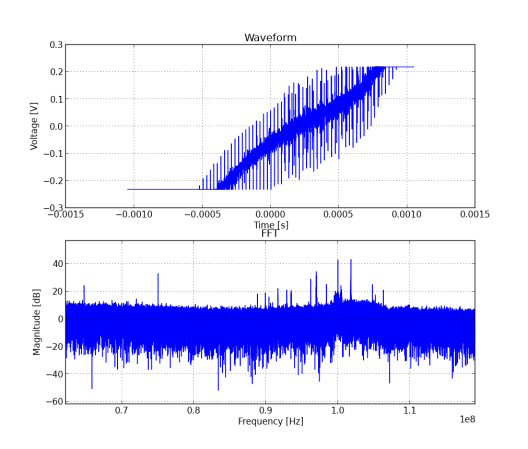
[Dexter2048] pulled off the original hack which allows this oscilloscope to be used as a spectrum analyzer. [Matthias] didn’t want the tool to be limited to running only on Windows systems so he got to work. This isn’t quite as easy as sounds because the only part of the original code that was released is the parser itself. [Matthias] had to build everything up from that starting point. His software uses standard Python to parse the WFM file and reformat the data. The features included in the current version allow you to export data as a CSV file and even plot the waveform and FFT as seen above.

Installing GLaDOS In The Ceiling Of Your House

glados-ceiling-light

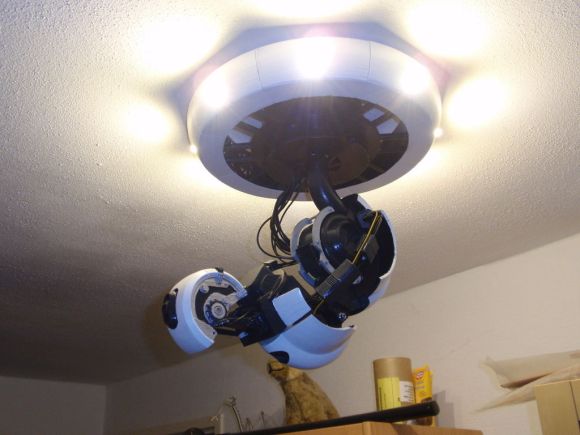
Install this light fixture in your bedroom and you might kiss your nights of peaceful sleep goodbye. Fans of the Portal game franchise will recognize it as a smaller version of the megalomaniacal artificial intelligence character from the game. This particular rendition is how she looked in the second installment of the series. The lamp is the creation of [Dragonator]. It was entirely 3D printed before being outfitted with LEDs to actually function as a light.

Our first thought is that this project is all about 3D design to get the final product t0 look so fantastic. But if you dig a little deeper you’ll see that it’s so much more than that. To get pieces that look this fantastic you must have a well tuned printer and be willing to let it run for 40-60 hours as it burns through 2 kg of filament. At that point you’re still far from the finish line as the [Dragonator] then set to work sanding and painting all of the pieces. From there he lovingly assembled everything, including gears and motors to give it motion.

In the end the electronics did not work as he envisioned. But maybe after a bit of time off from all that work he’ll revisit the project and make a bit more progress. For us, the aesthetic already makes the hack. Making it move and sound like the character would be over the top.

If you liked this you can’t miss the GLaDOS potato.