Binary Clock Using Logic Chips And Mains Frequency

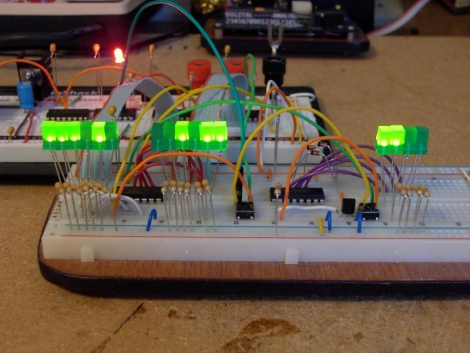
[Osgeld] built himself a binary clock. He didn’t take the time to explain his project, but he did post beautifully hand-drawn schematics and pictures of the circuit (PDF) as he was building it. We’ve seen clock projects that use mains frequency as the clock source and that’s the route that [Osgeld] chose for his build. He started with a 9-12V AC wall wort as a power input. From there it’s just a matter of using a bridge rectifier to convert to DC, then a 7805 linear regulator to establish a steady 5V rail. A resistor and a couple of diodes allow him to pull the 60 Hz frequency off of the incoming AC, and then use a combination of 4000 and 7400 logic chips to count the pulses and keep track of the time.
Improving A Hexapod Design

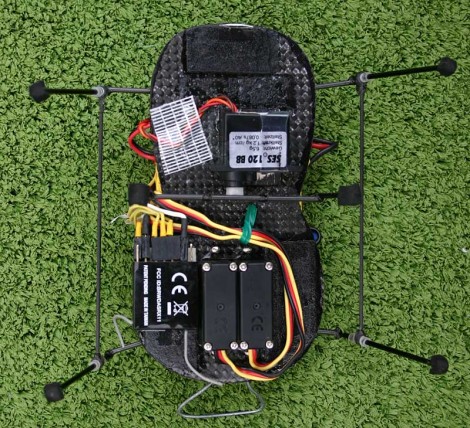
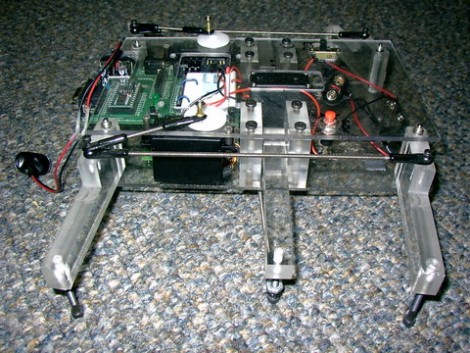
[JC] built himself a hexapod based on a project he found on the Internet. It worked fairly well, but was mechanically weak and prone to breakage. He set out to improve the design and came up with the unit seen above. It uses three servo motors to control the six legs, and walks quite well as seen in the quick clip after the break. It’s not quite as agile as the little acrobatic six-legger we saw yesterday, but the movement is quite pleasing and it’s capable of moving forward, backward, and turning. [JC’s] post is four pages in all so don’t forget to seek out his links for the construction, linkage, and servo control pages to find concept drawings, cad designs, and his thoughts on the process.

Continue reading “Improving A Hexapod Design”

Two Generations Of Ocean-going ROV

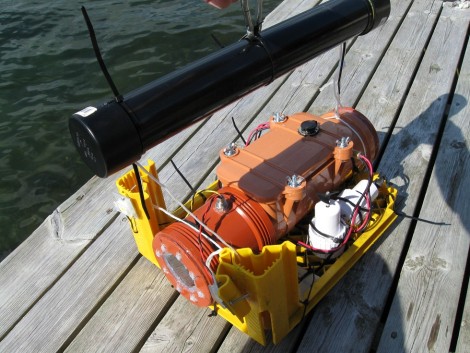
[Eirik] wants to help inspire others to take on big projects to he sent in a link to his ROV project. He started it about one year ago and the image above shows the first generation. After the break you can see the video that the ROV captured during a couple of it’s initial voyages. They’re pretty clear and right off the bat you’ll see the little guy following a jellyfish. Like a lot of homebrew ROV’s [Eirik] is still searching for the right way to pass wires through the housing without leaks. He does okay so far, and has designed a nice cable spool for the topside tether, but some water does get in. He’s almost finished the second generation which re-designs the camera mount to aim downward so that what’s in frame is more interesting.

Continue reading “Two Generations Of Ocean-going ROV”

R2D2 Wannabe Lacks Lightsaber Launcher, Autonomy

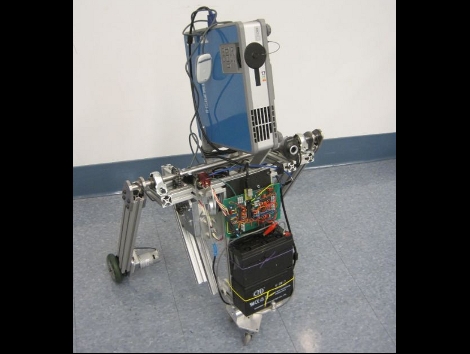
Is this what the lovable Star Wars droid would look like without its protective skin? This R2D2 inspired robot is another Olin College of Engineering (where that CNC cake decorator came from) build developed by [Nathaniel Ting] and his classmates. Alas, it lacks autonomy, relying on an operator for guidance. But we enjoy it for the build quality. Two motorcycle batteries supply DC motors on the two rear legs of the trike. It can be driven with a wireless Xbox controller or through a Python interface that also randomly plays droid audio clips from the movie. That’s a tilting projector on top, which would be used to show Princess Leia’s pleas for assistance. That is, after the operator plugs in an extension cord to power it up. Oh well, it’s still a lot of fun to watch. See for yourself after the break.

Continue reading “R2D2 Wannabe Lacks Lightsaber Launcher, Autonomy”

ArduSpider Entertains Children And Exercises Pets

There are so many good things about [Jose Julio’s] robotic spider. It’s design is dainty yet robust, and the behaviors encoded in the firmware are nothing short of spectacular.

The body is built from a piece of balsa wood in between sheets of carbon fiber. The legs are carbon rods, using two servo motors for left and right leg movement, and a third servo which can move the intermediary legs like the roll axis of a plane. An IR sensor rides on the front for obstacle avoidance, with system control courtesy of an Arduino. For more hardware info check out his build log.

Don’t miss the video after the break. You’ll see that the little bot can be manually controlled, or allowed to roam free. As we said before, the behavior is fantastic. Not only has [Jose] programmed interesting characteristics like the spider getting tired and sitting down for a while, but when it is awakened it leaps into the air. The movements are fun to watch for human and feline alike; if only your house cat could be so lucky.

Continue reading “ArduSpider Entertains Children And Exercises Pets”

Atomic Pinball Clock

[Mark Gibson] sent us a load of details on his build, a WWVB atomic clock using a pinball machine marquee (PDF). This is the upright portion of an old machine that used electromechanical displays instead of digital electronics. It’s big, noisy, and seeing it running might make you a bit giddy. Luckily he included video that shows it working on both the outside and the inside.

It took a bit of probing to discover the connections for relays that control the display. From there he used optoisolation to drive them with an Arduino. With this hurdle behind him, [Mark] set out to add atomic clock accuracy. He picked up a WWVB module and added it to the mix.

Check out his build log in PDF form linked above. He went out of his way to explain how the original parts work, and the processes he used during prototyping. For more of those juicy details we’ve added a photo gallery and his video after the break.

Didn’t get enough pinball goodness from this project? Check out the this digital gas plasma display pulled and reused from a much more modern pinball machine. Oh, and there’s always Bill Paxton Pinball.

Continue reading “Atomic Pinball Clock”

Theory Behind Evanescent Wave Coupling, Aka Wireless Power

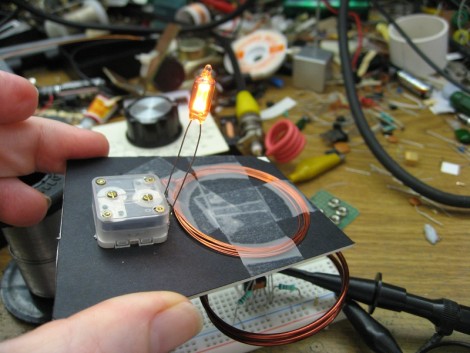
[Alan Yates] is building a persistence of vision display and needs a way to transfer power from the stationary base to the spinning circuitry. He’s decided to go with wireless energy transfer and he’s sharing all of his research and experiment data from the development process. It comes in two forms, the written version we just linked to, and a 37 minute video which is embedded after the break. If you liked some of the inductive energy transmission devices we’ve featured in the past, [Alan’s] video will fill you in on the why’s and how’s by using a combination of illustrative schematic examples and measurements on test coils that he built.

Continue reading “Theory Behind Evanescent Wave Coupling, Aka Wireless Power”