Better 3D Scans Through A Slowed Down Turntable

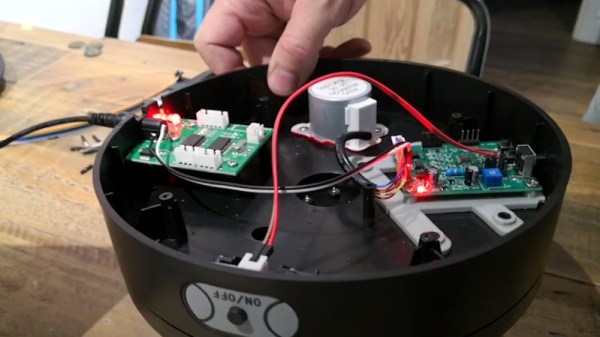
3D scanners aren’t cheap, and the last thing you want to see after purchasing one is bad data. But that’s what [Dave Does] and others were getting from their Revopoint POP scanners until some communal brainstorming uncovered the reason: the motorized turntable that came with the Kickstarter edition of the product was spinning too fast for the software to accurately keep track of the object. So he decided to replace the stepper motor controller in his turntable and document the process for anyone else who’s scanner might be struggling.
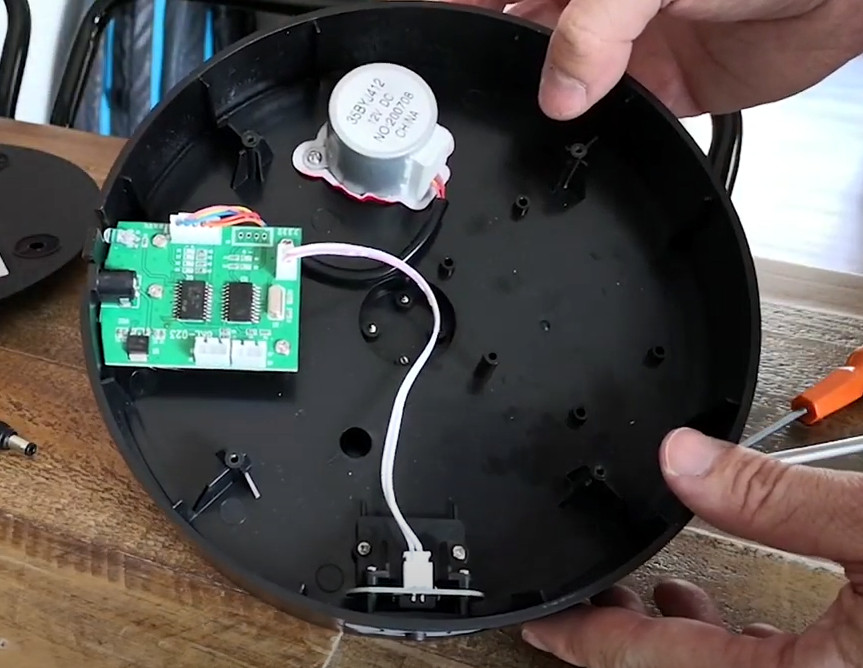
Plenty of room for expansion.

In the video below, [Dave] pops open the plastic case of the turntable and reveals a pretty sparse interior. There’s an incredible amount of empty space inside, and even some mounting studs to screw down new components, should you want to get into some hardcore upgrades. But for his purposes, a generic stepper motor controller that featured a potentiometer to adjust the speed was enough. He found a suitable board online for around $5 USD, and got to designing a 3D printed bracket that mates up to the existing screw holes on the turntable.

But it’s not exactly a drop-in replacement. For one thing, you’ve got to pop a hole in the side of the enclosure for the potentiometer knob to stick out of. You’ve also got to solder wires coming from the original DC jack and power switch to the new board to get it hooked up, but at least the motor plugs right in. In the video below, you can see [Dave] demonstrate the impressively deep throttle capability of the new driver.

If you’d rather build than buy, we’ve covered some impressive DIY turntables in the past that could fit the bill nicely, from automatic models that handle camera control to fully 3D printed versions that you’ve got to crank yourself.

Continue reading “Better 3D Scans Through A Slowed Down Turntable”
Impromptu Metal Detector Built From The Junk Bin

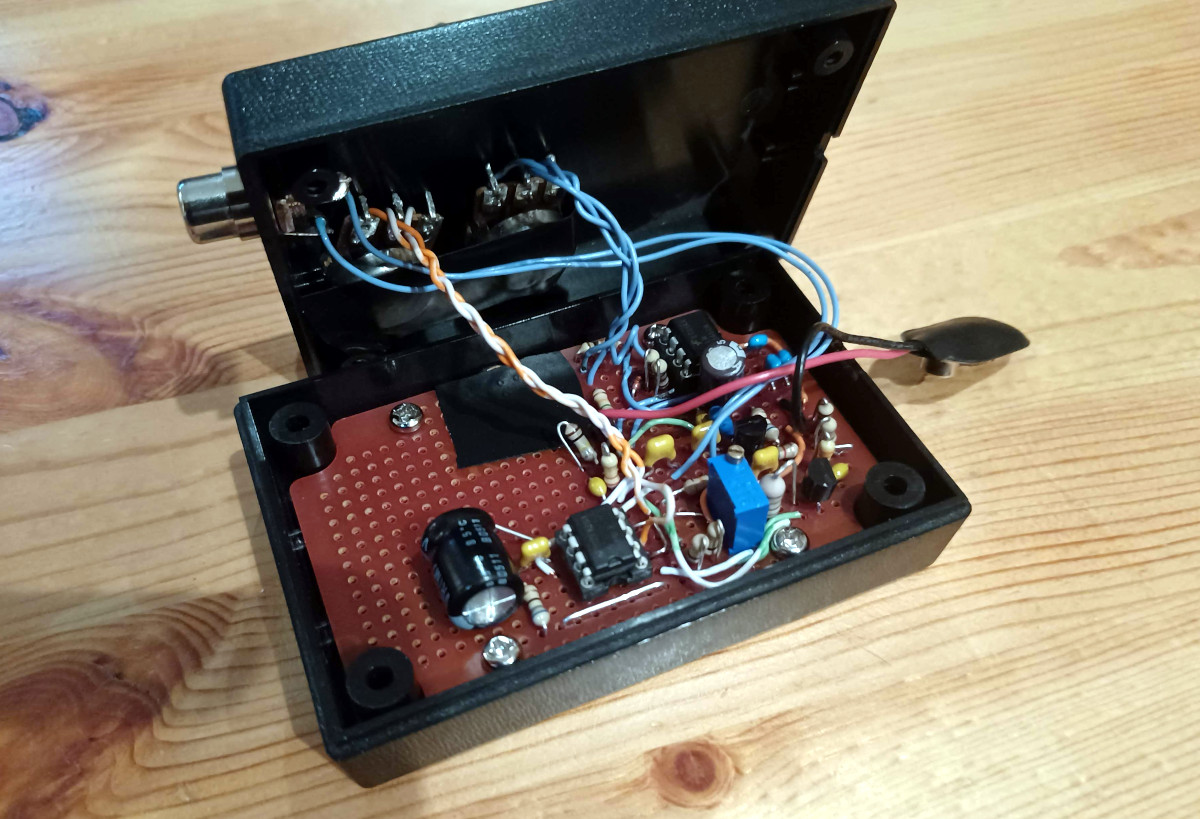
Have you ever found yourself suddenly in need of finding a small metal object hidden in the woods? No? Well, neither have we. But we can’t say the same thing for [zaphod], who’s family was hoping to settle a dispute by finding the surveyor stakes that marked the corners of their property. It was a perfect job for a metal detector, but since they didn’t own one, a serviceable unit had to be assembled from literal garbage.

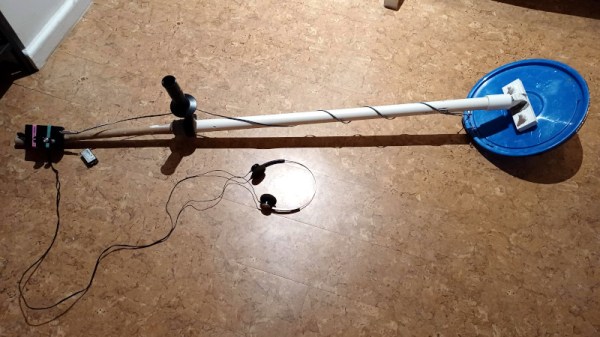
To start with, [zaphod] had to research how a metal detector actually works. After reviewing the pros and cons of various approaches, the decision was made to go with a beat frequency oscillator (BFO) circuit. It’s not the greatest design, it might even be the worst, but it could be built with the parts on hand and sometimes that’s all that matters. After packing a 2N3904 transistor, an LM386 amplifier, and every Hackaday reader’s favorite chip the 555 timer into an enclosure along with some of their closest friends, it was time to build the rest of the metal detector.

Look ma, no MCU!

The sensor coil was made by salvaging the wire from an old fluorescent lamp ballast and winding it around the lid of a bucket 27 times. This was mounted to the end of a broom handle with some angle pieces made from PVC sheet material, being careful not to use any metal fasteners that would throw off the detector. With the handle of an old drill in the middle to hold onto, the metal detector was complete and actually looked the part.

So did [zaphod] save the day by finding the surveyor stakes and reconnoitering the family’s plot? Unfortunately, no. It wasn’t a technical failure though; the metal detector did appear to work, although it took a pretty sizable object to set it off. The real problem was that, after looking more closely into it, the surveyors only put down one stake unless they are specifically instructed otherwise. Since they already knew where that one was…

If your homemade metal detector can’t find something that was never there, did it really fail? Just a little something to meditate on. In any event, when even the cheapest smart bulb is packing a microcontroller powerful enough to emulate early home computers, we’re always happy to see somebody keep the old ways alive with a handful of ICs.

Raspberry Pi And ESP32-S2 Team Up For MutantC_V4

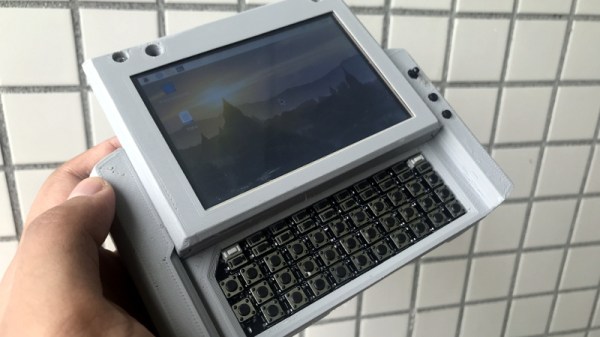
Back in 2019 we first came across the mutantC, an open source 3D printable Raspberry Pi handheld created by [rahmanshaber] that took more than a little inspiration from Sony’s VAIO ultra-mobile PCs (UMPCs) from the early 2000s. It was an impressive first effort, but it clearly had a long way to go before it could really be a practical mobile device.

Well after two years of development and three iterative versions of this Linux powered QWERTY slider, [rahmanshaber] is ready to show off the new and improved mutantC_v4. Outwardly it looks quite similar to the original version, with the notable addition of a tiny thumbstick and a pair of programmable buttons on the right side that can be used for input in addition to the touch screen. But inside it’s a whole other story, with so many changes and improvements that we hardly even know where to start.

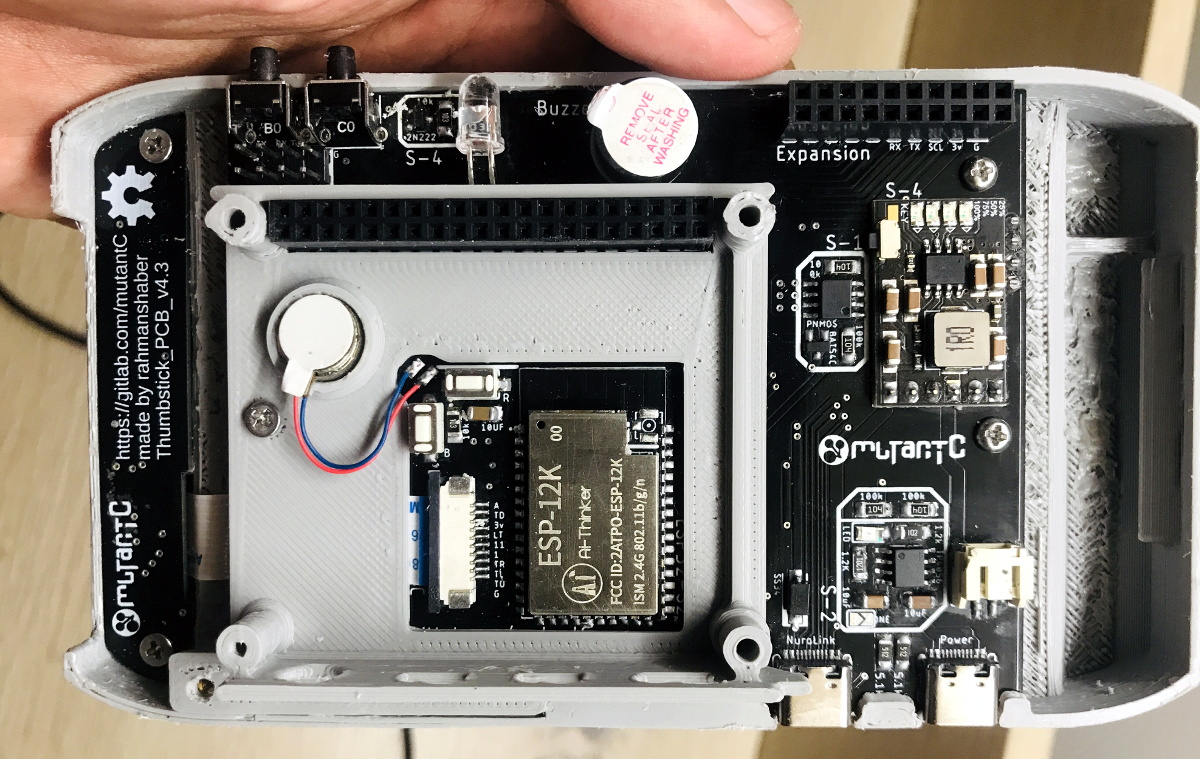
Inside the mutantC_v4, showing off the ESP32-S2

Probably the most notable improvement is the addition of an ESP32-S2, specifically a bare ESP-12K module, to the main PCB. Previous versions of the hardware used an Arduino Pro Micro to interface with all the hardware, but the added horsepower of the ESP32 should come in handy with the array of sensors, controls, and NeoPixels that [rahmanshaber] has tasked the chip with. There’s even a buzzer and a coin-style vibration motor in there to provide some feedback to the user. While the board has changed significantly, it still retains compatibility with the Pi Zero, 2, 3, and 4.

Another notable addition is the expansion connector on the bottom of the handheld that has pins for I2C, UART, and 3.3 V. In the video below, [rahmanshaber] mentions that this feature was previously implemented with a standard 2×6 female header block, but is now using a far slimmer female USB-C port. We do wonder if it’s not a bit confusing to have this faux-USB port right next to the real one that’s actually used to charge the system, but with such cramped quarters occasionally you’ve got to make some tough decisions like that.

It’s quite inspiring to see how [rahmanshaber] has honed his skills since releasing the first version of the mutantC. The 3D printed parts and PCBs have matured considerably over the last two years, showing how quickly a dedicated hobbyist can advance their abilities. The most recent version has been entered in the 2021 Hackaday Prize. But the show isn’t over yet, as we hear v5 of this impressive handheld may tackle the Raspberry Pi 4 Compute Module.

Continue reading “Raspberry Pi And ESP32-S2 Team Up For MutantC_V4”

Nokia LCD Goes Transparent For Hands-Free Reminders

These days everyone’s excited about transparent OLED panels, but where’s the love for the classic Nokia 5110 LCD? As the prolific [Nick Bild] demonstrates in his latest creation, all you’ve got to do is peel the backing off the the late 90s era display, and you’ve got yourself a see-through cyberpunk screen for a couple bucks.

View through the modified LCD.

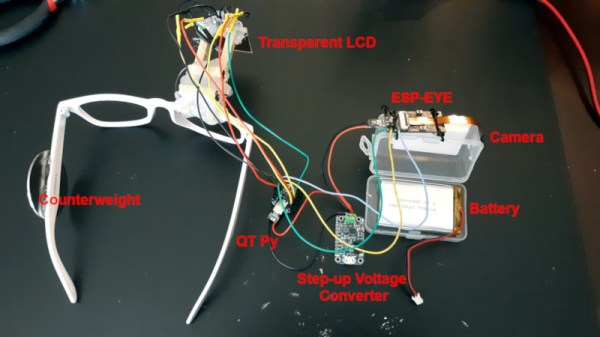
In this case, [Nick] has attached the modified display to a pair of frames, and used an Adafruit QT Py microcontroller to connect it to the ESP32 powered ESP-EYE development board and OV2640 camera module. This lets him detect QR codes within the wearer’s field of vision and run a TensorFlow Lite neural network right on the hardware. Power is provided by a 2000 mAh LiPo battery running through an Adafruit PowerBoost 500.

The project, intended to provide augmented reality reminders for medical professionals, uses the QR codes to look up patient and medication information. Right now the neural network is being used to detect when the wearer has washed their hands, but obviously the training model could be switched out for something different as needed. By combining these information sources, the wearable can do things like warn the physician if a patient is allergic to the medication they’re currently looking at.

Relevant information and warnings are displayed on the Nokia LCD, which has been placed far enough away from the eye that the user can actually read the text; an important design consideration that [Zach Freedman] demonstrated with his (intentionally) illegible wearable display a few weeks back. That does make the design a bit…ungainly, but at least you don’t have to worry about hand-cutting your optics

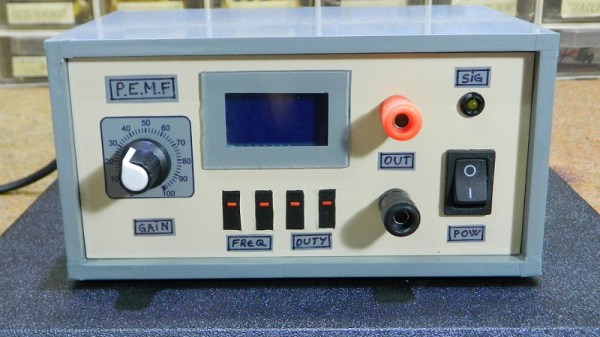
DIY Machine Enables PEMF Therapy On A Budget

We’re certainly not qualified to say whether or not pulsed electromagnetic field (PEMF) therapy will actually reduce your stress or improve your circulation, but there seems to be enough legitimate research going on out there that it might be worth a shot. After all, unless you’ve got a pacemaker or other medical implant, it seems pretty unlikely a magnetic field is going to make anything worse. Unfortunately commercial PEMF machines can cost thousands of dollars, making it a fairly expensive gamble.

But what if you could build one for as little as $10 USD? That’s the idea behind the simple DIY PEMF machine [mircemk] has been working on, and judging by its ability to launch bits of metal in the video below, we’re pretty confident it’s indeed producing a fairly powerful electromagnetic field. Even if it doesn’t cure what ails you, it should make an interesting conversation piece around the hackerspace.

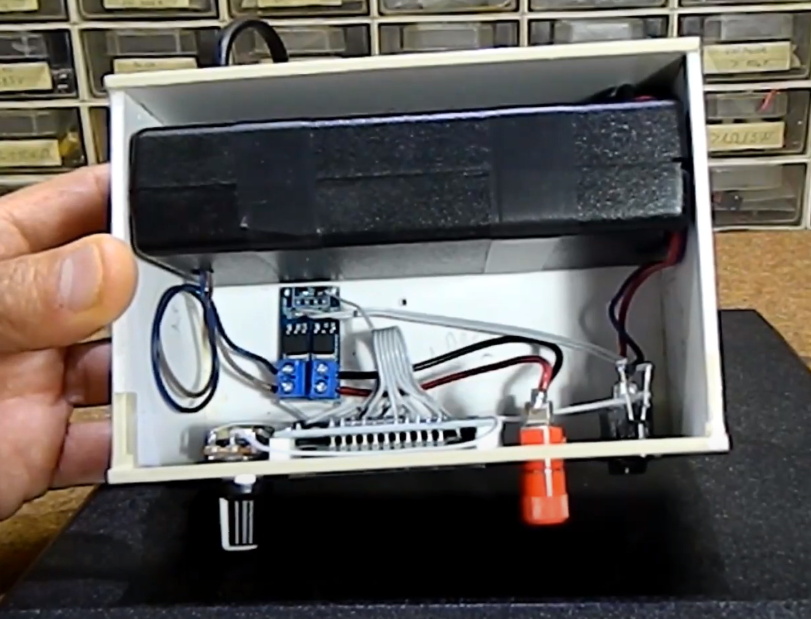
While the outside of the machine might look a bit imposing, the internals really are exceptionally straightforward. There’s an old laptop power supply providing 19 VDC, a dual-MOSFET board, a potentiometer, and a simple signal generator. The pulses from the signal generator trip the MOSFET, which in turn dumps the output of the laptop power supply into a user-wound coil. [mircemk] has a 17 cm (6.7 inch) open air version wrapped with 200 turns of copper wire used for treating wide areas, and an 8 cm (3 inch) diameter version with 300 windings for when you need more targeted energy.

Some skepticism is always in order with these sort of medicinal claims, but commercial PEMF machines do get prescribed to users to help promote bone growth and healing, so the concept itself is perhaps not as outlandish as it might seem.

Continue reading “DIY Machine Enables PEMF Therapy On A Budget”

Custom Soldering Fume Fan Doesn’t Skimp On Features

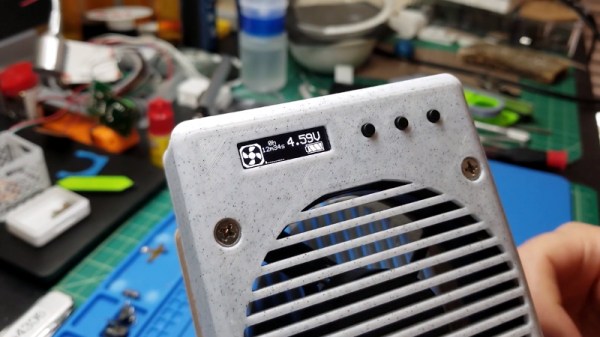
Prolific maker [sjm4306] tells us the first iteration of his soldering fan was little more than some cardboard, electrical tape, and a hacked up USB cable. But as we all know, these little projects have a way of evolving over time. Fast forward to today, and his custom fan is a well-polished piece of kit that anyone with a soldering iron would be proud to have on their workbench.

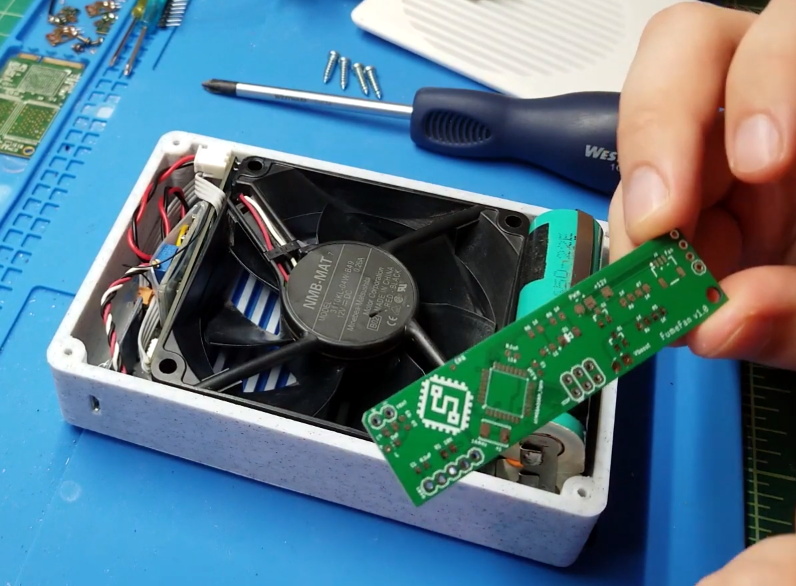
Cardboard has given way to a 3D printed enclosure that holds the fan, electronics, a pair of 18650 cells, and a easily replaceable filter. Between the marbled filament, debossed logo, properly countersunk screw holes, and rounded corners, it’s really hard to overstate how good this case looks. We’ve shamefully produced enough boxy 3D printed enclosures to know that adding all those little details takes time, but the end result really speaks for itself.

Fan internals, with a look at the custom PCB.

The user interface running on the OLED is also an exceptionally nice touch. Sure the fan doesn’t need a graphical display, and [sjm4306] could have saved a lot of time and effort by using a turn-key speed controller, but the push-button configuration complete with graphical indications of fan speed and battery life really give the final product a highly professional feel.

In the video below, [sjm4306] reveals that while the finished product might look great, there were a few bumps in the road. Issues with clearance inside the case made him rethink how things would be wired and mounted, leading to a far more cramped arrangement than he’d anticipated. Part of the problem was that he designed the case first and tried to integrate the electronics later, rather than the other way around; a common pitfall you’d be wise to watch out for.

It’s been proven that, without some external input, solder smoke is going to go right in your face. Whether or not you need to do something this complex is naturally up for debate, but if you want to keep all that nasty stuff out of your lungs, you’d do well to outfit your workbench with some kind of fan.

Continue reading “Custom Soldering Fume Fan Doesn’t Skimp On Features”

Wall of video games

Consoles, Consoles On The Wall, Can Alexa Help Me Play Them All?

If you’ve got a collection of classic game consoles, finding the space to set them all up can be a challenge. But the bigger problem is figuring out how to hook them all up to a TV that, at best, might only have two or three inputs. [odelot] recently wrote in to tell us how he solved both problems with his voice-controlled wall of gaming history.

To mount the systems to the wall, [odelot] designed and printed angled brackets that attach to specially shaped pieces of 3 mm MDF. They do a pretty good job of holding the systems at a visually interesting angle while making themselves scarce, with only the notoriously slick-bottomed Wii needing some extra clips on the front to keep it from sliding off. He also printed up a series of blocks and pipes, no doubt a reference to Mario Bros., to hold the power and video cables for each system.

Prototype version of electronics on breadboardAs to connecting them all up to his TV, [odelot] picked up an eight-device Extron VGA switch that features a serial port for remote control. After getting all the systems adapted over to the appropriate video standard, he then wired an ESP8266 to the switch and wrote some code that ties it into Amazon’s Alexa voice assistant.

By just saying the name of the system he wants to play, the microcontroller will flick the switch over to the appropriate input and turn on a ring of blue LEDs under the appropriate shelf to signify which console has been selected. There’s even an array of solid state relays that will eventually control the mains power going to each system, though [odelot] hasn’t fully implemented it yet. Currently the electronics for this project live on a fairly packed breadboard, but it looks like he’s in the early stages of designing a proper PCB to clean it all up.

Not content to simply control a commercial A/V switch? In the past we’ve seen truly dedicated console collectors design their own custom switches from the ground up, complete with a display to show the currently selected system’s logo.

Continue reading “Consoles, Consoles On The Wall, Can Alexa Help Me Play Them All?”