Books You Should Read: V-2 By Walter Dornberger

In an era where we can watch rockets land on their tails Buck Rogers-style live on YouTube, it’s difficult to imagine a time when even the most basic concepts of rocketry were hotly debated. At the time, many argued that the very concept of a liquid fueled rocket was impossible, and that any work towards designing practical rocket powered vehicles was a waste of time and money. Manned spacecraft, satellite communications, to say nothing of landing on other worlds; all considered nothing more than entertainment for children or particularly fanciful adults.

Walter Dornberger (Bundesarchiv, Bild 146-1980-009-33 / CC-BY-SA 3.0)

This is the world in which V-2, written by the head of the German rocket development program Walter Dornberger, takes place. The entire history of the A-4/V-2 rocket program is laid out in this book, from the very early days when Dornberger and his team were launching rockets with little more than matches, all the way up to Germany’s frantic attempts to mobilize the still incomplete V-2 rocket in face of increasingly certain defeat at the end of World War II.

For those fascinated with early space exploration and the development of the V-2 rocket like myself, this book is essentially unparalleled. It’s written completely in the first person, through Dornberger’s own eyes, and reads in most places like a personal tour of his rocket development site at the Peenemünde Army Research Center. Dornberger walks through the laboratories and factories of Peenemünde, describing the research being done and the engineers at work in a personal detail that you simply don’t get anywhere else.

But this book is not only a personal account of how the world’s first man-made object to reach space was created, it’s also a realistic case study of how engineers and the management that pays the bills often clash with disastrous results. Dornberger and his team wanted to create a vehicle to someday allow man to reach space, while the Nazi government had a much more nefarious and immediate goal. But this isn’t a book about the war — the only battles you’ll read about in V-2 take place in meeting rooms, where the engineers who understood the immense difficulty of their task tried in vain to explain why the timetables and production numbers the German military wanted simply couldn’t be met.

Continue reading “Books You Should Read: V-2 By Walter Dornberger”
Homebuilt Laser Engraver Using Salvaged Parts

Now that anyone can go online and get a fairly decent 3D printer for around $200, they’ve officially fallen out of the “Elite Hacker” arsenal and are now normal, if perhaps highly specialized, tools. That’s great for the 3D printing community as a whole, but what about those who want to be on the fringe of technology? Telling people you have a 3D printer at home doesn’t get that wide-eyed response like it used to. What’s a “l33t” hacker to do?

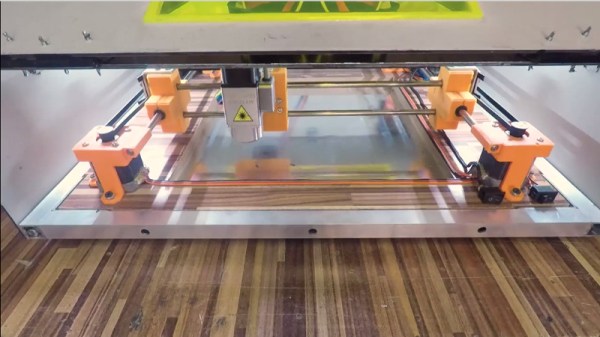
Enter the laser engraver/cutter: it’s like a 3D printer, but easier to build and has a higher capacity for bodily harm! While there are a couple good options for kits and turn-key setups out there, just like the early days of 3D printers, some of the best machines are still home built. In his latest video, YouTuber [MakerMan] takes us through his build which features an impressively low part count.

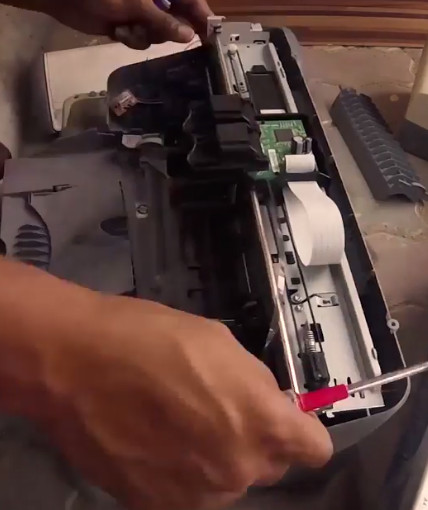
To start his build, [MakerMan] strips down four printers and salvages seven high quality 8 mm linear rods; a huge cost saving tip in itself. We’ll certainly be picking up any printers we see in the trash for the next couple months hoping to score some rods. With the addition of some cheap LM8UU bearings and 3D printed holders for them, [MakerMan] has a smooth 2D motion platform for just a couple bucks. The frame of the machine is built out of type of aluminum square tubing you can find at the hardware store, no expensive extrusion here.

For the laser itself, [MakerMan] is using a six watt PLH3D-6W-XF from Opt Lasers. This module features integrated driver and cooling, so all you need to do is provide it power and a stable means of moving it over the work piece. They even offer a magnetic “dock” which allows you to remove the laser from the mount without any tools for servicing or tool changes. [MakerMan] reports he’s been able to engrave stainless steel with this laser module, and cut thin wood.

This isn’t the first laser engraver we’ve seen built out of scrap parts, though if you want to save some work you could just upgrade a cheap commercial model.

Continue reading “Homebuilt Laser Engraver Using Salvaged Parts”

Scratchbuilt Cryptex Would Make Da Vinci Weep

Here’s a fun fact, the kind of thing that you might (but we definitely did not) find out when writing a blog post: Dan Brown actually made up the cryptex for his book, The Da Vinci Code. We therefore have Mr Brown, with a bit of help from the filmmakers over at Sony, to thank every time we see somebody make their own version. To follow that line of logic to its conclusion, we believe you’ll agree that the following is without question the greatest thing Dan Brown has ever done in his life.

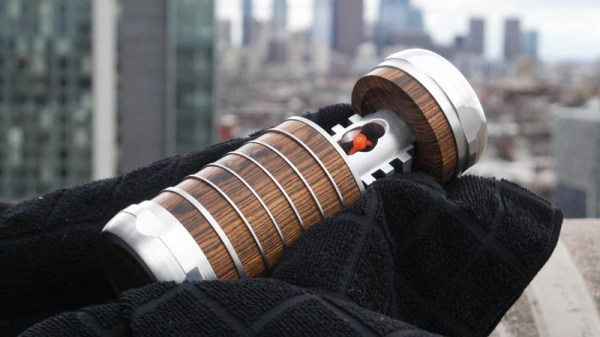
Created by [Stephen Peduto] as a ring box for an exceptionally lucky young lady, it required an estimated 127 hours to complete over the course of two months. From the incredible job [Stephen] did photographing and documenting the build, we don’t doubt it for a second. Expertly combing milled aluminum and lathe-turned bocote wood, this has got to be the most gorgeous ring “box” ever made.

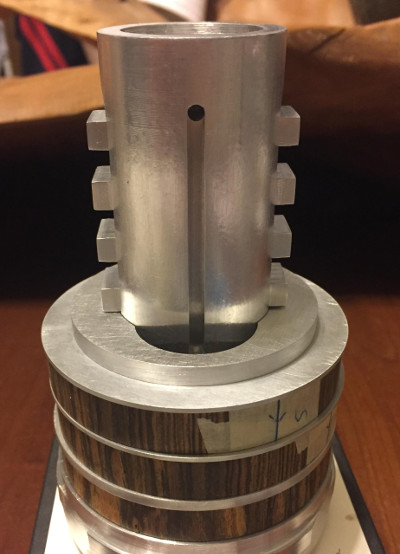
Frankly, it’s hard to do justice to what [Stephen] has created in so short a space, and you really should browse through the 140+ images in his gallery. But the short version is that after some furious white board sketching, [Stephen] moved over to AutoCAD and then SolidWorks to design all the parts which would eventually get machined out of aluminum. As a very clever touch, he wisely added 17° slop in the locking mechanism so that the recipient wouldn’t fumble too much at the big moment.

When the machining was all said and done, [Stephen] then switched over to the woodworking part of the project. Rather than numbers or letters for a combination, this cryptex uses the grain pattern in the turned piece of wood. This gives the final product a more organic feel, while at the same time avoiding the head-scratching problem of getting the characters printed or engraved into the wheels.

Towards the end of construction there was a worrying moment when the newly made wooding rings warped so badly that the aluminum inserts would no longer fit. As a last resort, the rings were placed in a box with a humidifier for a week and slowly worked back into shape. [Stephen] says he’s still surprised it worked.

Even if some may argue that a cryptex is nothing but a prettied-up bike lock, people sure do love them. We’re no stranger to high quality cryptex builds here, though even mere mortals can play along if they’ve got a well calibrated 3D printer.

PCB Tesla Coil Is Perfect Desk Toy

A Tesla coil easily makes it to the top spot on our list of “Mad Scientist” equipment we want for the lab, second only to maybe a Jacob’s Ladder. Even then, it’s kind of unfair advantage because you know people only want a Jacob’s Ladder for that awesome sound it makes. Sound effects not withstanding, it’s Tesla coil all the way, no question.

Unfortunately, winding your own Tesla coil is kind of a hassle. Even on relatively small builds, you’ll generally need to setup some kind of winding jig just to do the secondary coil, which can be a project in itself. So when [Daniel Eindhoven] sent his no-wind Tesla coil into the tip line, it immediately got our attention.

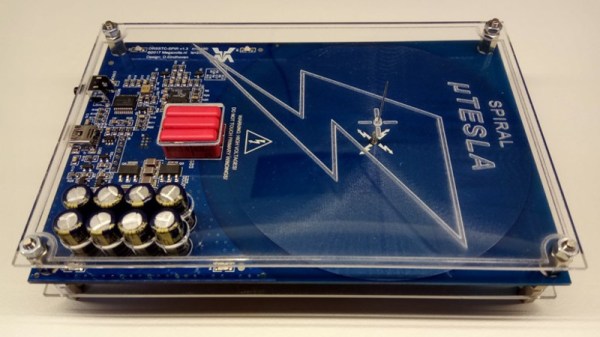
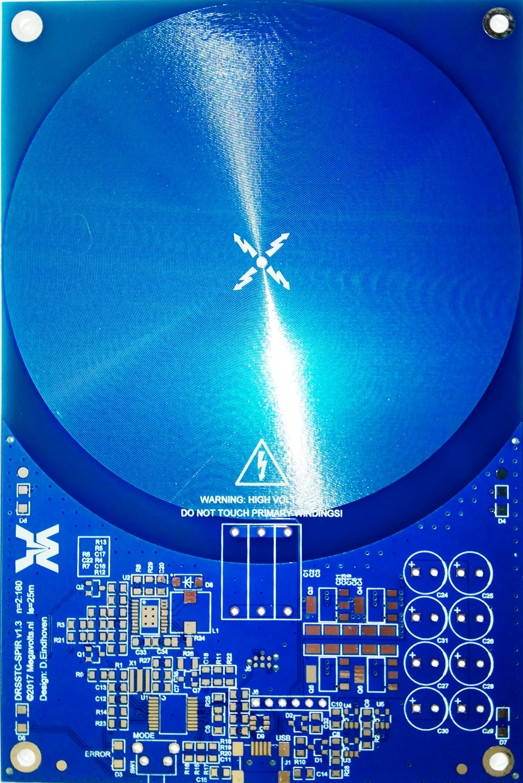
The genius in his design is that the coils are actually etched into the PCB, completely taking the human effort out of the equation. Made up of 6 mil traces with 6 mil separation, the PCB coil manages to pack a 25 meter long, 160 turn coil into an incredibly compact package. As you might expect, such a tiny Tesla coil isn’t exactly going to be a powerhouse, and in fact [Daniel] has managed to get the entirely thing running on the 500 mA output of your standard USB 2.0 port.

In such a low-power setup, [Daniel] was also able to replace the traditional spark gap pulse generator with a PIC18F14K50 microcontroller, further simplifying the design. An advantage of using a microcontroller for the pulse generator is that it’s very easy to adjust the coil’s operating frequency, allowing for neat tricks like making the coil “sing” by bringing its frequency into the audible range.

For those looking to build their own version, [Daniel] has put the PCB schematic and firmware available for download on his site. He also mentions that, in collaboration with Elektor magazine, he will be producing a kit in the near future. Definitely something we’ll be keeping an eye out for.

Incidentally, this isn’t the first time [Daniel] has demonstrated his mastery of high voltage. He scared impressed us all the way back in 2010 with his 11,344 Joule capacitor bank, perfect for that laptop-destroying rail gun you’ve been meaning to build.

Continue reading “PCB Tesla Coil Is Perfect Desk Toy”

Neural Network Really Ties The Room Together

If there’s one thing that Hollywood knows about hackers, it’s that they absolutely love data visualizations. Sometimes it’s projected on a big wall (Hackers, WarGames), other times it’s gibberish until the plot says otherwise (Sneakers, The Matrix). But no matter what, it has to look cool. No hacker worth his or her salt can possibly work unless they’ve got an evolving Venn diagram or spectral waterfall running somewhere in the background.

Inspired by Hollywood portrayals, specifically one featured in Avengers: Age of Ultron, [Zack Akil] decided it was time to secure his place in the pantheon of hacker wall visualizations. But not content to just show meaningless nonsense on his wall, he set out to create something that was at least showing actual data.

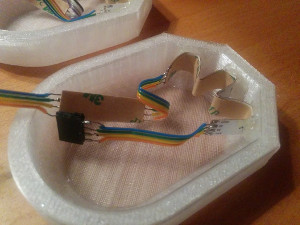
[Zack] created a neural network to work through multi-label classification data in Python using the scikit-learn machine learning suite. The code takes the values from the neutral network training algorithm and converts them to RGB colors by way of an Arduino. Each “node” in the neutral network is 3D printed in translucent filament, and fitted with an RGB LED module. These modules are then connected to each other via side-glow fiber optic tubes, so that the colors within the tubes are mixed depending on the colors of the nodes they are attached to. This allows for a very organic “growing” effect, as colors move through the network node-by-node.

In the end this particular visualization doesn’t really mean anything; the data it’s working on only exists for the purposes of the visualization itself. But [Zack] succeeded in creating a practical visualization of machine learning, and if you’re the kind of person who needs to keep tabs on learning algorithms, some variation of this design may be just what you’re looking for.

If AI isn’t your thing but you still want a wall of RGB LEDs, maybe you can use this phased array antenna visualizer instead. If you’re really hip, maybe you’ll go the analog route and put a big gauge on the wall.

Continue reading “Neural Network Really Ties The Room Together”

Raspberry Pi Media Streamer Is Combat Ready

We are truly living in the golden age of media streaming. From the Roku to the Chromecast, there is no shortage of cheap devices to fling your audio and video anywhere you please. Some services and devices may try to get you locked in a bit more than we’d like (Amazon, we’re looking at you), but on the whole if you’ve got media files on your network that you want to enjoy throughout the whole house, there’s a product out there to get it done.

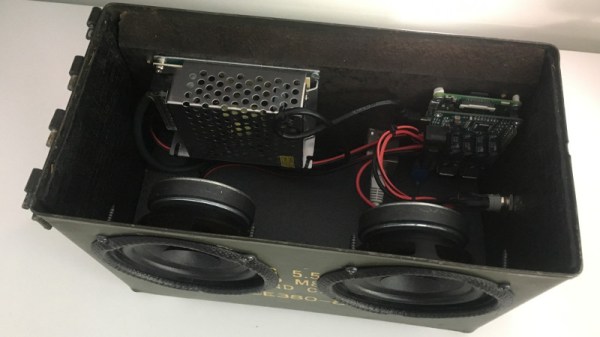
But why buy an easy to use and polished commercial product when you can hack together your own for twice the price and labor over it for hours? While you’re at it, why not build the whole thing into a surplus ammo can? This the line of logic that brought [Zwaffel] to his latest project, and it makes perfect sense to us.

It should come as no surprise that a military ammo can has quite a bit more space inside than is strictly required for the Raspberry Pi 3 [Zwaffel] based his project on. But it does make for a very comfortable wiring arrangement, and offers plenty of breathing room for the monstrous 60 watt power supply he has pumping into his HiFiBerry AMP+ and speakers.

On the software side the Pi is running Max2Play, a Linux distro designed specifically for streaming audio and video remotely. [Zwaffel] says that with this setup he is able to listen to music on his Squeezebox server as well as watch movies via Kodi.

While none are quite as battle-hardened as this, we have seen several other Raspberry Pi Squeezebox clients over the years if you’re looking for more inspiration.

Restoring A Tonka Truck With Science

The yellow Tonka Truck. Instantly recognizable by any child of decades past, that big metal beast would always make you popular around the sandbox. There were no blinking lights to dazzle, no noises to be heard (unless you count the hard plastic wheels rolling on concrete), even the dumping action is completely manual. But back then, it was a possession to be treasured indeed.

So it’s perhaps no surprise that there is a certain following for these classic trucks today, though like with most other collectibles, a specimen in good condition can be prohibitively expensive. The truck that [PoppaFixIt] found in the trash was certainly not one of those specimens, but with some patience and knowledge of basic chemistry, he was able to bring this vintage toy back to the present.

The first step was to disassemble the truck. Before they switched over to Chinese mass production, these trucks were built with actual rivets. After drilling them out and unfolding the little metal tabs that toy makers loved back in the day, he was able to separate the metal body of the truck from the plastic detail bits. The plastic parts just needed a fresh coat of paint, but the rusted metal body would need a bit more attention.

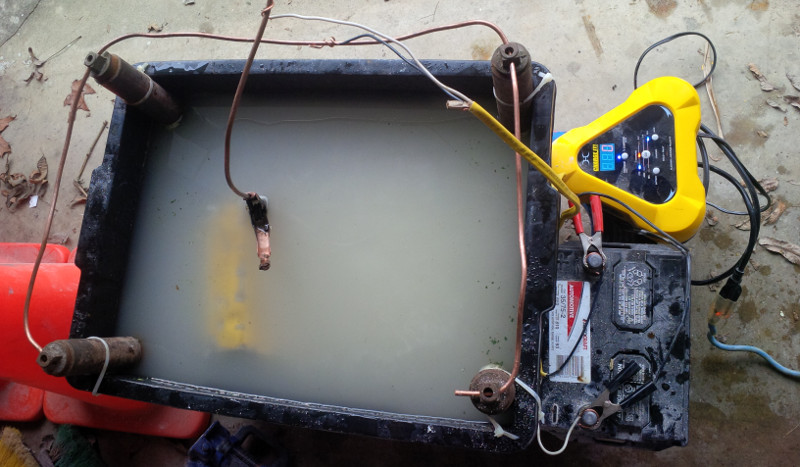
Remembering a tip he read online, [PoppaFixIt] decided to attempt electrolytic rust removal to get the metal parts back into serviceable condition. A big plastic bin, some washing soda, and old steel window weights for his sacrificial anodes was all the equipment he needed for the electrolysis tank. To power the chemical reaction he used a standard 12 volt car battery and charger wired in parallel; this step is important, as he notes most newer chargers are smart enough not to work unless they see a real battery connected.

After running the setup overnight, the collected rust and junk on the window weights was proof enough the process worked. From there, it was just a fresh coat of yellow paint, a new sticker kit from eBay, and his Tonka truck was ready to face another 30+ years of service.

If you’re looking to restore things larger than a child’s toy, you may be interested in the much larger electrolytic setup we’ve covered previously. Of course if you’re really pressed for time, you could try blasting the rust away with a laser.