A Brain Transplant For A Philips Smart Lamp

As the saying goes, modern problems require modern solutions. When the modern problem is that your smart light is being hijacked by the neighbors, [Wejn]’s modern solution is to reverse engineer and replace the mainboard.

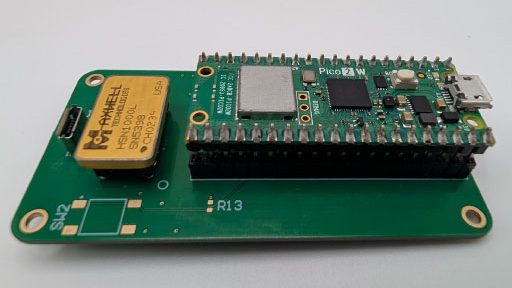
The light in question is a Phillips Hue Ambiance, and [Wejn]’s excellently-documented six part series takes us through the process of creating a replacement light driver. It’s a good read, including reverse-engineering the PWM functions to get the lights to dim exactly like stock, and a dive into the Zigbee protocol so his rebuild light could still talk to the Philips Hue hub. The firmware [Wejn] wrote for the ESP32C6 he chose to use for this project is on GitHub, with the PCB in a second repo.

We want to applaud [Wejn] for his excellent documentation and open-sourcing (the firmware and PCB are under GPL v3). Not only do we get enough information to replicate this project perfectly if we so choose, but by writing out his design process, [Wejn] gives everyone reading a good head start in doing something similar with other hardware. Even if you’re scratching your head wondering why a light switch isn’t good enough anjymore, you have to appreciate what [Wejn] is offering the community.

We’ve covered domestic brain transplants in the past — which is easier in this sort of light than the close confines of a smart bulb. If you’re still wondering why not just use a light switch, perhaps you’d rather hack the light to run doom instead.

Before you go, can we just take a moment to appreciate how bizarre the world has become that we have a DOOM-capable computer to run fancy light fixture? If you’re using what might have been a decent workstation in days of yore to perform a painfully mundane task, let us know on the tips line.

Print PLA In PLA With A Giant Molecular Model Kit

It isn’t too often we post a hack that’s just a pure 3D print with no other components, but for this Giant Molecular Model kit by [3D Printy], we’ll make an exception. After all, even if you print with PLA every day, how often do you get to play with its molecular bonds? (If you want to see that molecule, check out the video after the break.)

There are multiple sizes of bonds to represent bond lengths, and two styles: flexible and firm. Flexible bonds are great for multiple covalent bonds, like carbon-carbon bonds in organic molecules. The bonds clip to caps that screw in to the atoms; alternately a bond-cap can screw the atoms together directly. A plethora of atoms is available, in valence values from one to four. The two-bond atom has 180 and 120-degree variations for greater accuracy.  In terms of the chemistry this kit could represent, you’re only limited by your imagination and how long you are willing to spend printing atoms and bonds.

[3D Printy] was kind enough to release the whole lot as CC0 Public Domain, so we might be seeing these at craft fairs, as there’s nothing to keep you from selling the prints. Honestly, we can only hope; from an educational standpoint, this is a much better use of plastic than endless flexy dragons.

If you’d prefer your chemistry toys help you do chemistry, try this fidget spinner centrifuge. Perhaps you’d rather be teaching electronics instead?

Continue reading “Print PLA In PLA With A Giant Molecular Model Kit”

Exploring The RP2350’s UART-Bootloader

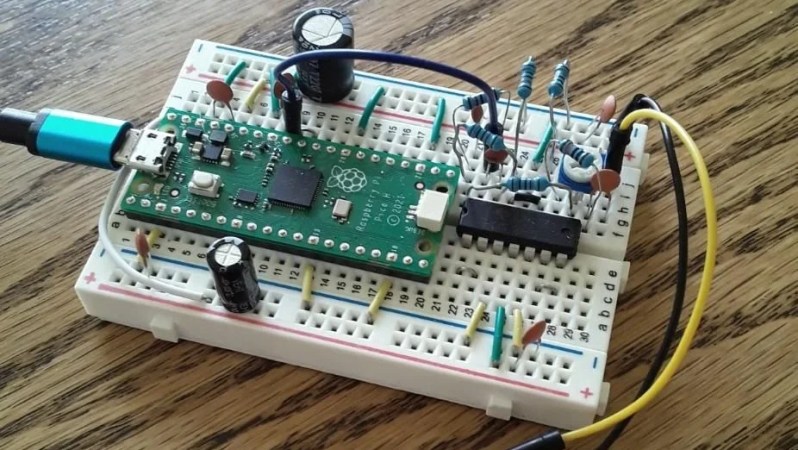
The RP2350 has a few advantages over its predecessor, one of which is the ability to load firmware remotely via UART, as [Thomas Pfister] has documented on his blog and in the video below.

[Thomas] had a project that needed more PWM than the RP2350 could provide, and hit upon the idea of using a second RP2350 as a port expander. Now, one could hard-code this, but dealing with two sets of firmware on one board can be annoying. That’s where the UART bootloader comes in: it will allow [Thomas] to program the port-expander RP2350 using the main microcontroller. Thus he only has to worry about one firmware, speeding up development.

Continue reading “Exploring The RP2350’s UART-Bootloader”

Move Over, Lithophane: 3D Printed 3D Photos With Gaussian Splats

If you had asked us yesterday “How do you 3D Print a Photo”, we would have said “well, that’s easy, do a lithophane”– but artist, hacker and man with a very relaxing voice [Wyatt Roy] has a much more impressive answer: Gaussian splats, rendered in resin.

Gaussian splats are a 3D scanning technique aimed at replicating a visual rather than geometry, like the mesh-based 3D-scanning we usually see on Hackaday. Using photogrammetry, a point cloud is generated with an associated 3D Gaussian function describing the colour at that point. Blend these together, and you can get some very impressive photorealistic 3D environments. Of course, printing a Gaussian smear of colour isn’t trivial, which is where the hacking comes in.

Continue reading “Move Over, Lithophane: 3D Printed 3D Photos With Gaussian Splats”

Antique Mill Satisfies Food Cravings

Everyone knows what its like to get a hankering for a specific food. In [Attoparsec]’s case, he wanted waffles. Not any waffles would do, though; he needed waffles in the form of a labyrinth. Those don’t exist, so he had to machine his own waffle maker.

Antique pantograph mill
When computers were the size of rooms, these stood in where we’d use CNC today.

Most of us would have run this off on a CNC, but [Attoparsec] isn’t into CNCing–manual machining is his hobby, and he’s not interested in getting into another one, no matter how much more productive he admits it might make him. We can respect that. After a bit of brain sweat thinking of different ways to cut out the labyrinth shape, he has the opportunity to pick up an antique Deckle pantograph mill.

These machines were what shops used to do CNC before the ‘computer numeric’ part was a thing. By tracing out a template (which [Attoparsec] 3D prints, so he’s obviously no Luddite) complex shapes can be milled with ease. Complex shapes like a labyrnthine wafflemaker. Check out the full video below; it’s full of all sorts of interesting details about the machining process and the tools involved.

If you don’t need to machine cast iron, but are interested in the techniques seen here, a wooden pantorouter might be more your speed than a one-tonne antique. If you have a hankering for waffles but would rather use CNC, check out these design tips to help you get started. If pancakes are more your style, why not print them?

Shoutout to [the gambler] for sending this into the tip line. We think he struck the jackpot on this one. If you have a tip, don’t be shy. Continue reading “Antique Mill Satisfies Food Cravings”

Let The Wookie Win With This DIY Holochess Table

If you have seen Star Wars, you know what is being referenced here. Holochess appeared as a diversion built into the Millennium Falcon in the very first movie, way back in 1977. While not quite as iconic a use of simulated holograms as tiny Princess Leia begging for hope, it evidently struck a chord with [Maker Mac70], given the impressive effort he’s evidently gone through to re-create the game table from the film.

The key component of this unit is a plate from Japanese firm ASKA3D that scatters light from displays inside the table in just such a way that the diverging rays are focused at a point above its surface, creating the illusion of an image hovering in space. Or in this case, hovering at the surface of a acrylic chessboard. Granted, this technique only works from one viewing angle, and so is not a perfect recreation of a sci-fi holoprojector. But from the right angle, it looks really good, as you can see in the video below.

There are actually six SPI displays, driven by an Arduino GIGA, positioned and angled to project each character in the game. Placing two of the displays on 3D printed gantries allows them to move, allowing two creatures to battle in the center of the table. As [Maker Mac70] admits, this is quite a bit simpler than the Holochess game seen in the film, but it’s quite impressive for real world hardware.

If this all seems a little bit familiar, we covered an earlier floating display by [Maker Mac70] last year. This works on similar principles, but uses more common components which makes the technique more accessible. If chess isn’t your forte, why not a volumetric display that plays DOOM? If you’re interested in real holograms, not Sci-Fi, our own [Maya Posch] did a deep dive you may find interesting. Continue reading “Let The Wookie Win With This DIY Holochess Table”

Flow Visualization With Schlieren Photography

The word “Schlieren” is German, and translates roughly to “streaks”. What is streaky photography, and why might you want to use it in a project? And where did this funny term come from?

Think of the heat shimmer you can see on a hot day. From the ideal gas law, we know that hot air is less dense than cold air. Because of that density difference, it has a slightly lower refractive index. A light ray passing through a density gradient faces a gradient of refractive index, so is bent, hence the shimmer. Continue reading “Flow Visualization With Schlieren Photography”