Google’s Periodic Table

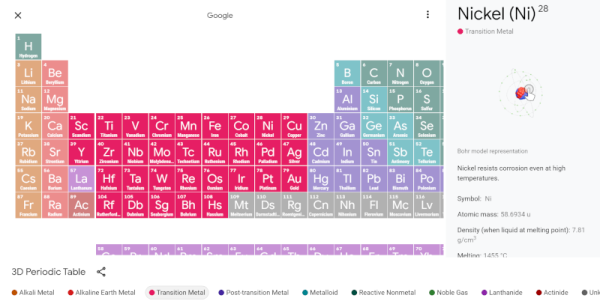
One of the nice things about the Internet is that you don’t need huge reference books anymore. You really don’t need big wall charts, either. A case in point: what science classroom didn’t have a periodic table of the elements? Now you can just look up an interactive one from Google. They say it is 3D and we suppose that’s the animations of the Bohr model for each atom. You can debate if it is a good idea to show people Bohr models or not, but it is what most of us learned, after all.

While the website is probably aimed more at students, it is a handy way to look up element properties and it is visually attractive, too. You probably remember, the columns are no accident in a periodic table, so the actual format doesn’t vary from one instance of it to another. However, we liked the col coding and the information panel that appears when you click on an element.
Continue reading “Google’s Periodic Table”

Audio Cassette Tape Data Retrospective

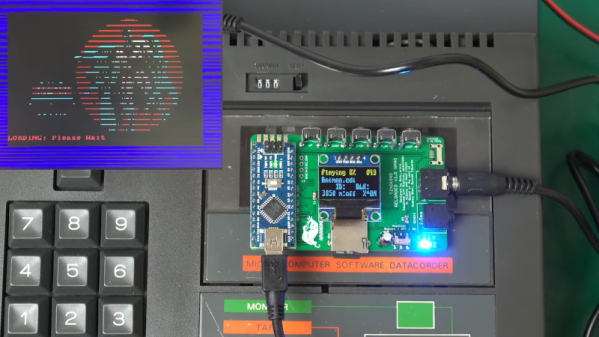
It has been a long time since we stored software and computer data on audiotape. But it used to be the de facto standard for hobby computers and [Noel] has a great video about the Amstrad’s system (embedded below) which was pretty typical and how the process could be sped up since today, you have perfect audio reproduction, especially compared to consumer-grade audiotape.

The cassette tapes suffered from several problems. The tape had an inherently low bandwidth, there was quite a bit of noise present from the analog circuitry and heads, and the transport speed wasn’t necessarily constant. However, you can easily digitally synthesize relatively noise-free sound at high fidelity and rock-solid frequency. So basically a microcontroller, like an Arduino, can look like an extremely high-quality tape drive.

Continue reading “Audio Cassette Tape Data Retrospective”

3D Prints Of Steel — Um — PLA, Rather

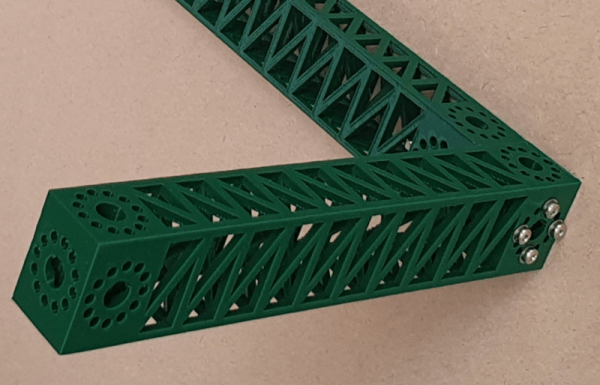
Need a steel beam? You can 3D print PLA beams that are as strong as a steel beam of equivalent weight according to [RepRap]. The Python code for FreeCAD generates a repeating structure especially well suited for belt printers that can print a beam of any length. Keep in mind, of course, given two things that weigh the same, if one is made of steel and the other PLA, the steel one will be physically smaller.

The beams are repeating tetrahedrons which are quite strong with a lot of material on the outer faces to resist bending. Each beam end has a neat block with a wiring hole and a ring of small holes that allow you to mount the beams to things or each other with 30 degree increments of rotation.

Continue reading “3D Prints Of Steel — Um — PLA, Rather”

Charles Lindbergh The Famous… Inventor?

Most people remember Charles Lindbergh for his non-stop solo flight across the Atlantic which made him an international celebrity. If you are a student of history, you might also know he was at the center of a very controversial trial surrounding the kidnapping of his child or even that he had a dance named after him. But did you know he was also the co-inventor of a very important medical device? Turns out, medicine can thank Lindbergh for the creation of the perfusion pump.

Continue reading “Charles Lindbergh The Famous… Inventor?”

Everything You Always Wanted To Know About Radioactive Lenses

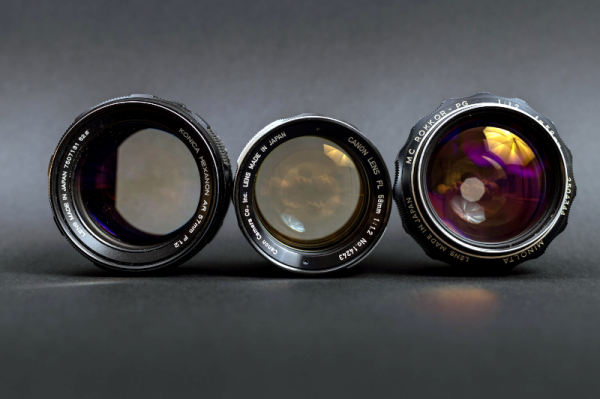
We think of radioactive material as something buried away in bunkers with bombs, power plants, and maybe some exotic medical equipment. But turns out, there are little bits of radiation in the water, our soil, bananas, granite countertops, smoke detectors, and even some camera lenses. Camera lenses? A few decades ago, camera companies added rare elements like thorium to their glass to change the optical properties in desirable ways. The downside? Well, it made the lenses somewhat radioactive.  A post by [lenslegend] explains it all.

Exotic elements such as Thorium, Lanthanum and Zirconium are added to glass mixtures to create the high refractive indexes necessary in sophisticated lens designs. Selection of premium quantities of glass from the large glass pots, stringent spectrophotometric tests after stress and strain checks provide the valuable raw glass for ultimate use in lens elements.
Konica Hexanon Lens Guide, Konica Camera Company, 1972

According to [lenslegend] the practice started in 1945 with Kodak. However, by the 1980s, consumer distaste for radioactive things and concern for factory workers ended the production of hot camera lenses.

Continue reading “Everything You Always Wanted To Know About Radioactive Lenses”

Pen Plotter Is About As Simple As It Can Get

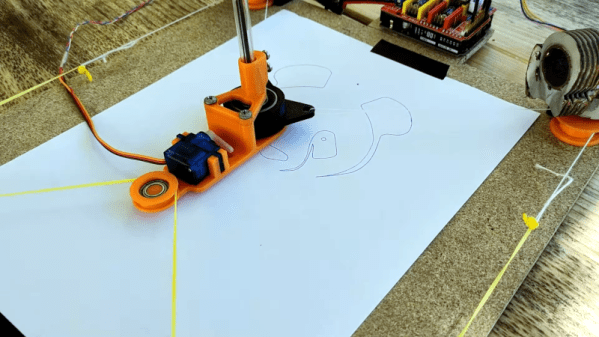
Sure, we see quite a few plotters and other motion machines, but the one from [DAZ Projects] has the virtual of looking dead simple. The Arduino and CNC shield are old hat, of course. But some 3D printed pulleys and a very simple-looking core XY arrangement looks like this could be a pretty quick build.

You might ask; if you have a 3D printer, why you wouldn’t just mount a pen on it and call it a day? Well, you could do that, of course, but what fun is that? Besides, that will tie up your printer, too. You can see a video of the project, below.

Continue reading “Pen Plotter Is About As Simple As It Can Get”

Linux Fu: The Windows X11 Connection

The life of a Linux user can be a bit difficult. Sometimes you have to — or want to — run Windows. Why Windows? Sometimes you have a work computer or a laptop that Linux doesn’t support well. Or it might be software. Although there are plenty of programs that can edit, say, Word documents, there’s always that one document that doesn’t quite translate correctly. Things like videoconferencing software sometimes works on Linux but might have fewer features.

So what do you do? You can dual boot, of course, but that’s not very handy. You can run Windows in a virtual machine if you have enough horsepower. There’s also Wine, but that often has its own set of problems with features and stability of complex programs. However, recent versions of Windows provide the Windows Subsystem for Linux (WSL).

With WSL, you can have most of what you like about Linux inside your Windows session. You just have to know how to set it up, and I’m going to show you one way that works for me with reasonably stable versions of Windows 10. Continue reading “Linux Fu: The Windows X11 Connection”