Optical Microscope Resolves Down To 40 Nanometers

Optical microscopes depend on light, of course, but they are also limited by that same light. Typically, anything under 200 nanometers just blurs together because of the wavelength of the light being used to observe it. However, engineers at the University of California San Diego have published their results using a hyperbolic metamaterial composed of silver and silica to drive optical microscopy down to below 40 nanometers. You can find the original paper online, also.

The technique also requires image processing. Light passing through the metamaterial breaks into speckles that produce low-resolution images that can combine to form high-resolution images. This so-called structured illumination technique isn’t exactly new, but previous techniques allowed about 100-nanometer resolution, much less than what the researchers were able to find using this material.

Continue reading “Optical Microscope Resolves Down To 40 Nanometers”

Anti-Gravity, Time Travel, And Teleportation: Dr. Hamming Gives Advice

You may not know the name [Richard Hamming], but you definitely use some of his work. While working for Bell Labs, he developed Hamming codes — the parent of a class of codes that detect, and sometimes correct, errors in everything from error-correcting memory to hard drives. He also worked on the Manhattan Project and was a lecturer at the Naval Postgraduate school.

Turns out [Hamming] has an entire class from the 1990s on YouTube and if you are interested in coding theory or several other topics, you could do worse than watch some of them. However, those videos aren’t what attracted me to the lectures. As the last lecture of his course, [Hamming] used to give a talk called “You and Your Research” and you can see one of the times he delivered it in the video below. You might think that it won’t apply to you because you aren’t a professional academic or researcher, but don’t be too quick to judge.

Turns out, [Hamming’s] advice — even by his own admission — is pretty general purpose for your career or even your life. His premise: As far as we know, you have one life to live, so why shouldn’t it be a worthwhile one by your definition of worthwhile.

Along the way, he has an odd combination of personal philosophy, advice for approaching technical problems, and survival skills for working with others. If you are in the field, you’ll probably recognize at least some of the names he drops and you’ll find some of this technical advice useful. But even if you aren’t, you’ll come away with something. Some of it seems like common sense, but it is different, somehow, to hear it spoken out loud. For example:

If you don’t work on important problems, it’s not likely that you’ll do important work.

One piece of technical advice? Don’t waste time working on problems you have no way to attack. He points out that anti-gravity, time travel, and teleportation would be very lucrative. But why work on them when there appears to be no way to even remotely accomplish them today. Well, at least when he said that. There has been a little progress on a form of teleportation, but that wasn’t what he was talking about anyway.

While not a hack in the traditional sense, examining your life, career, and technical research to improve your own effectiveness is something to take seriously. We were hoping he would throw in a joke about error-correcting your career, but unless we blinked, no such luck.

Hamming’s work on block codes was followed about ten years later by the Reed-Solomon code which is found nearly everywhere now. Hamming is also associated with the term “hamming distance,” something we talked about when discussing Gray code.

Continue reading “Anti-Gravity, Time Travel, And Teleportation: Dr. Hamming Gives Advice”

Aircraft Compass Teardown

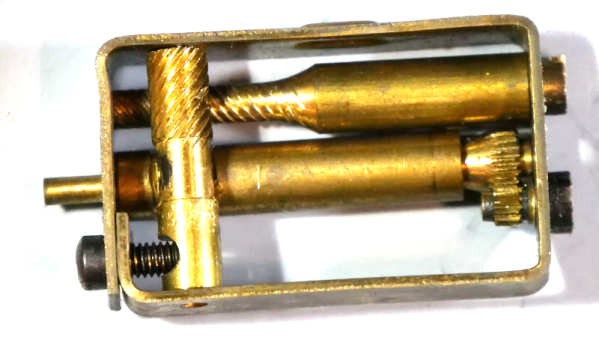
We didn’t know what a C-2400 LP was before we saw [David’s] video below, but it turned out to be pretty interesting. The device is an aircraft compass and after replacing it, he decided to take it apart for us. Turns out, that like a nautical compass, these devices need adjustment for all the metal around them. But while a ship’s compass has huge steel balls for that purpose, the tiny and lightweight aviation compass has to be a bit more parsimonious.

The little device that stands in for a binnacle’s compensators — often called Kelvin’s balls — is almost like a mechanical watch. Tiny gears and ratchets, all in brass. Apparently, the device is pretty reliable since the date on this one is 1966.

Continue reading “Aircraft Compass Teardown”

Spell Checking Your Programming From The Linux Command Line

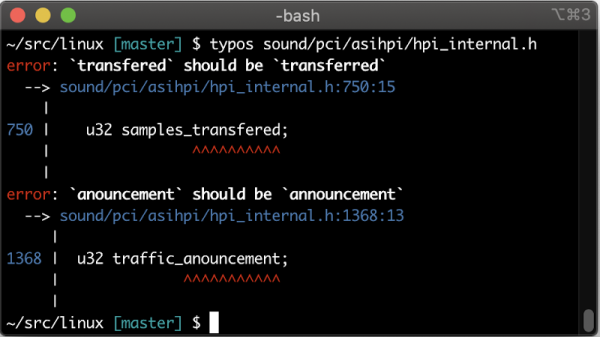
For most of us who didn’t do well in high school English class, spell checkers are a real game-changer. Sure, you can still swap a “to” and a “too,” but a spell checker will catch a lot of typos. But what about in your source code? You usually don’t spell check source code and even if you did, the rules are funny. After all, “my_proejct” is a perfectly fine variable name, but you probably meant “my_project.” That’s where a program called typos comes in. It aims to be a spell checker for source code that is fast enough and with a low enough false positive rate that you can run it against changed code and reject spelling problems.

Sure, if “my_proejct” is a one-time typo, the compiler or interpreter will probably catch it. But it won’t catch comments and it also won’t catch something you spell wrong consistently. For that you need something like typos.

Continue reading “Spell Checking Your Programming From The Linux Command Line”

Build A New ZX81

[Retro Shack’s] ZX81 died, and while he tried to figure out the fix, he decided to build a new one. Of course, building a circa-1980-something computer from new parts is a bit daunting. Unless you start with an existing design that has it all ready to put together.

The PCB looks great and we like that the silkscreen shows acknowledgments of projects that helped the designer, [Alejandro Sebastian]. The case is, of course, 3D printed. At first, the power LED didn’t work, but voltages looked correct and the board powered up.

Continue reading “Build A New ZX81”

Web Assembly, Music Synthesis, And The Beauty Of Math

The electronics hobby has changed a lot since the advent of the microprocessor. Before that — and with the lack of large-scale integrated circuits — projects in magazines tended to be either super simple or ultra complex. However, one popular type of project dealt with music synthesis. Fairly simple circuits could combine to make a complex synthesizer so it was sort of the best of both worlds. Nowadays, you are more likely to tackle a music synthesizer in software like [Tim] did when he created Abelton in Web Assembly and C++. Along the way, he learned a lot about the relationship between math and music.

[Tim] covers what he learned about the Nyquist theorem and how to keep synthesis data flowing in real time with buffers. However, there are some problems trying to do all this in a cross-browser context. The AudioWorklet class appears to have widespread support, though, and [Tim] managed to get that working.

Continue reading “Web Assembly, Music Synthesis, And The Beauty Of Math”

Finite Element Analysis Vs Real World

In advanced engineering circles, the finite element method — or, more commonly, finite element analysis — is a real staple. With the advent of more powerful home computers, though, even your home projects can benefit. The technique itself is very general, but you usually see it used for structural analysis. However, you might wonder how well it corresponds to reality. That is if analysis shows a segment of your part is weak (or strong) does that hold true when you actually build the part? [Fiveohno] wondered the same thing and decided to do some testing, which you can see in the video below.

Of course, like any simulation, the accuracy will only be as good as your data input and model. But if you work carefully, it should match up pretty well to the real world, so it is interesting to see the results of a real-world test. In fact, a video from Solidworks that shows a similar part points out — inadvertently — what not to do. For example, the force used in that analysis was too low and at a point where the part was at relatively low stress instead of at the maximum stress.

Continue reading “Finite Element Analysis Vs Real World”