3D Printed Transistor Goes Green

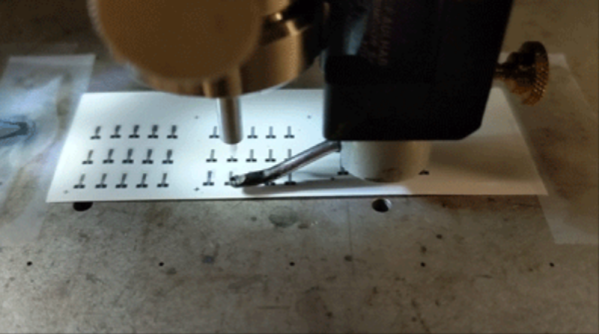
We’ll be honest, we were more excited by Duke University’s announcement that they’d used carbon-based inks to 3D print a transistor than we were by their assertion that it was recyclable. Not that recyclability is a bad thing, of course. But we would imagine that any carbon ink on a paper-like substrate will fit in the same category. In this case, the team developed an ink from wood called nanocelluose.

As a material, nanocellulose is nothing new. The breakthrough was preparing it in an ink formulation. The researchers developed a method for suspending crystals of nanocellulose that can work as an insulator in the printed transistors. Using the three inks at room temperature, an inkjet-like printer can produce transistors that were functioning six months after printing.

Continue reading “3D Printed Transistor Goes Green”

Historical Hackers: Emergency Antennas Launched By Kite

Your airplane has crashed at sea. You are perched in a lifeboat and you need to call for help. Today you might reach for a satellite phone, but in World War II you would more likely turn a crank on a special survival radio.

These radios originated in Germany but were soon copied by the British and the United States. In addition to just being a bit of history, we can learn a few lessons from these radios. The designers clearly thought about the challenges stranded personnel would face and came up with novel solutions. For example, how do you loft a 300-foot wire up to use as an antenna? Would you believe a kite or even a balloon?

Continue reading “Historical Hackers: Emergency Antennas Launched By Kite”

DIN Rails For… Everything

Cross-section of a 35mm top hat DIN rail.

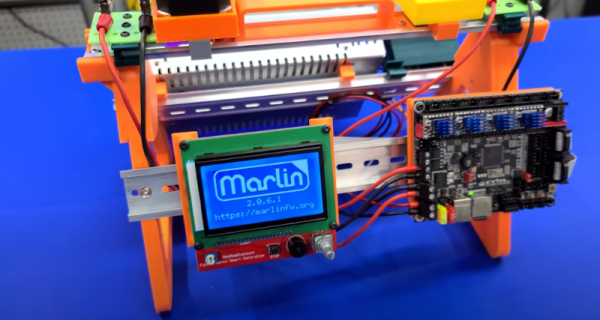
One of the great things about the Internet is it lets people find out what other people are doing even if they normally wouldn’t have much exposure to each other. For example, in some businesses DIN rails are a part of everyday life. But for a long time, they were not very common in hobby electronics. Although rails are cheap, boxes for rails aren’t always easy or cheap to obtain, but 3D printing offers a solution for that.

So while the industrial world has been using these handy rails for decades, we are starting to see hobby projects incorporate them more often and people like [Makers Mashup] are discovering them and finding ways to use them in projects and demonstrating them in this video, also embedded below.

If you haven’t encountered them yet, DIN rails are a strip of metal, bent into a particular shape with the purpose of mounting equipment like circuit breakers. A typical rail is 35 mm wide and has a hat-like cross-section which leads to the name “top hat” rail. A 25 mm channel lets you hide wiring and the surface has holes to allow you to mount the rail to a wall or a cabinet. These are sometimes called type O or type Ω rails or sections.

There are other profiles, too. A C-rail is shaped like a letter C and you can guess what a G section looks like, too. Rails do come in different heights, as well, but the 35 mm is overwhelmingly common. However, there are 15 mm rails and 75 mm rails, too.

Continue reading “DIN Rails For… Everything”

Sinclair BASIC For Today

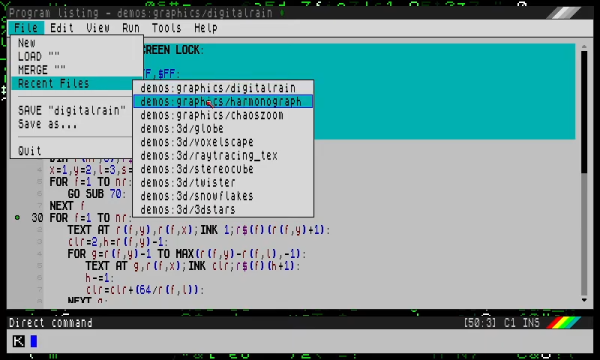
If you are of a certain age, your first exposure to computer programming was probably BASIC. For a few years, there were few cheaper ways to program in BASIC than the Sinclair ZX series of computers. If you long for those days, you might find the 1980-something variant of BASIC a little limiting. Or you could use SpecBasic from [Paul Dunn].

SpecBasic is apparently reasonably compatible with the Spectrum, but lets you use your better hardware. For example, instead of a 256×192 8-color screen, SpecBas accommodates larger screens and up to 256 colors. However, that does lead to certain incompatibilities that you can read about in the project’s README file.

Continue reading “Sinclair BASIC For Today”

The Laser Power Record Has Been Broken

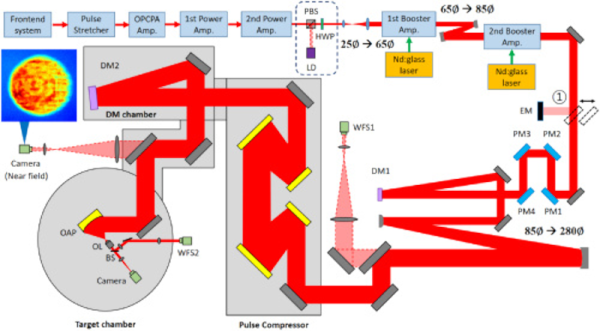
Lasers do all sorts of interesting things and — as with so many things — more is better. Korean scientists announced recently they’ve created the most powerful laser beam. 1023 watts per square centimeter, to be exact. It turns out that 1022 Watts/cm2 may not be commonplace, but has been done many times already at several facilities, including the CoReLS petawatt (PW) laser used by the researchers.

Just as improving a radio transmitter often involves antenna work instead of actual power increases, this laser setup uses an improved focus mechanism to get more energy in a 1.1 micron spot. As you might expect, doing this requires some pretty sophisticated optics.

Continue reading “The Laser Power Record Has Been Broken”

Leap Motion Controls Hands With No Glove

It isn’t uncommon to see a robot hand-controlled with a glove to mimic a user’s motion. [All Parts Combined] has a different method. Using a Leap Motion controller, he can record hand motions with no glove and then play them back to the robot hand at will. You can see the project in the video, below.

The project seems straightforward enough, but apparently, the Leap documentation isn’t the best. Since he worked it out, though, you might find the code useful.

An 8266 runs everything, although you could probably get by with less. The Leap provides more data than the hand has servos, so there was a bit of algorithm development.

We picked up a few tips about building flexible fingers using heated vinyl tubing. Never know when that’s going to come in handy — no pun intended. The cardboard construction isn’t going to be pretty, but a glove cover works well. You could probably 3D print something, too.

The Unity app will drive the hand live or can playback one of the five recorded routines. You can see how the record and playback work on the video.

This reminded us of another robot hand project, this one 3D printed. We’ve seen more traditional robot arms moving with a Leap before, too. Continue reading “Leap Motion Controls Hands With No Glove”

The Fine Structure Constant In A Blink

Electronics is really an applied branch of physics, so it isn’t surprising that if you are serious about your electronics, you probably know a little physics, too. If you’ve ever heard the term “fine structure constant” and weren’t entirely sure what it means, [Parth G] wants to explain it to you in about a minute. His video explanation appears below.

You may know that the constant, often represented by α, is approximately 1/137, but what does that mean? The answer relates to the orbit of electrons. You might remember from school that electrons orbit in shells around the nucleus.  That is, an atom might have some electrons in the innermost shell, and more electrons in an outer shell.

Continue reading “The Fine Structure Constant In A Blink”