Piddler Illustrates Aliasing And The Z-Transform

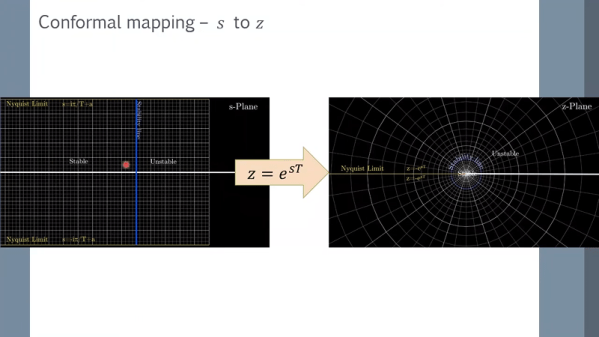
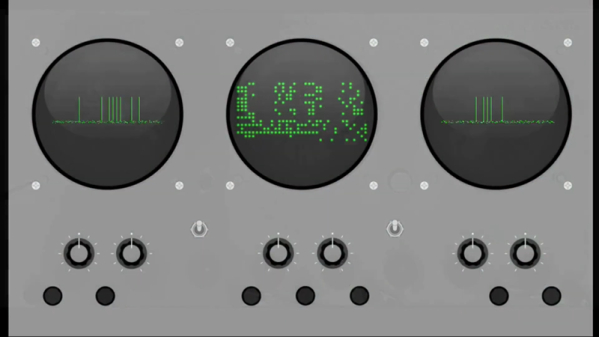
One of the problems about learning too much control system theory is that you start to realize almost everything is some sort of control system. That’s the case with [Fernando Zigunov]. After observing a Rayleigh-Plateau instability in his kitchen sink, he decided to build a little display piece that shows water apparently defying gravity that he calls The Piddler.

We’ve seen things like this before, of course. A coffee pump, a check valve, and a strobe lamp with a controller is all that it takes. What makes this project interesting is the over hour-long video lecture on the theory behind why this works and how it relates to aliasing and the z-transform. You can check out the video, below.

Continue reading “Piddler Illustrates Aliasing And The Z-Transform”

Old School Rotary Tools That Weren’t Made By Dremel

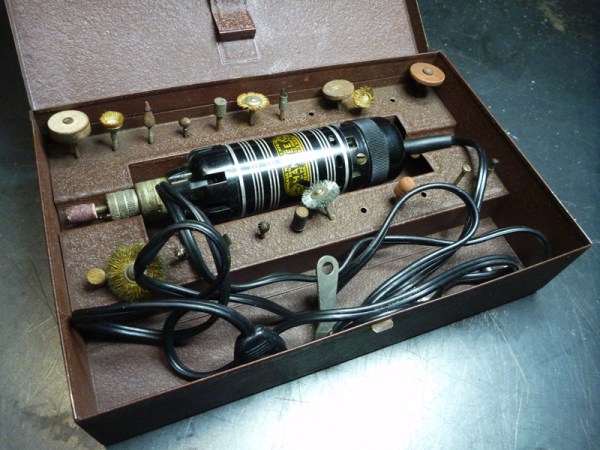
Albert Dremel developed the now famous rotary tool and started the company in 1932 to make blade sharpeners. It would be 1935 before the company produced the Moto-Tool which is mostly recognizable as an ancestor of the modern Dremel.

Dremel achieved such dominance that today the name is synonymous with rotary tools in the same way Xerox means photocopy and Crock-Pot is any slow cooker. Sure, there are knock offs you can get from the usual cheap tool outlets, but generally, people reach for a Dremel even when it isn’t really one. Today that tool might really be a Black and Decker or a Dewalt or even a cheap brand like Wen or Chicago Electric. But in the first half of the 20th century, you might have reached for a Handee.

A Whole Shop Full of Tools

The Handee was a product of the Chicago Wheel and Manufacturing Company who, in 1937, billed it as “a whole shop full of tools in one,” as you can see in this ad. While $10.75 might sound like a price for a Harbor Freight cheapie tool, adjusted for inflation that’s around $200 in 2020 money. At least for that price you got three free accessories out of the over 200 available.

I didn’t remember the Handee and I wanted to see if I could figure out what happened to it and the company who made it. After all, with the Internet at your disposal, how hard could it be? Turns out, I did learn a lot, but in the end, tracing down a company like this from the old days isn’t always as easy as you might think.

Continue reading “Old School Rotary Tools That Weren’t Made By Dremel”

Take A 3D Printed Brushless Motor Demo For A Spin

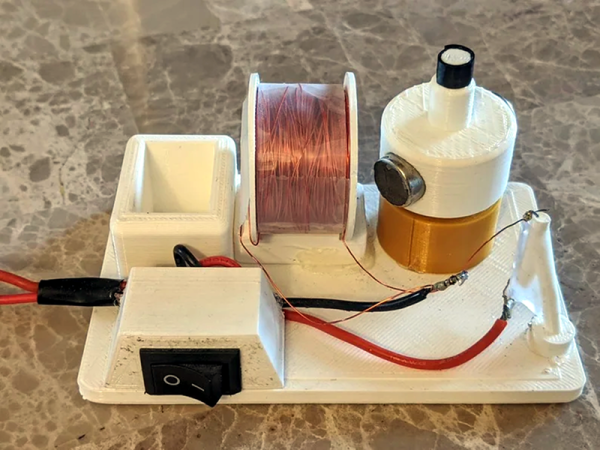
It used to be a staple of junior high physics class to build some sort of motor with paperclips or wire. A coil creates a magnetic field that makes the rotor move. In the process of moving, brushes that connect the coil to the rest of the circuit will reverse its polarity and change the magnetic field to keep the rotor turning. However, brushless motors work differently. The change in magnetic field comes from the drive controller, not from brushes. If you want to build that model, [Rishit] has you covered. You can see his 3D printed model brushless motor running in the video below.

Usually, you have a microcontroller determining how to drive the electromagnets. However, this model is simpler than that. There are two permanent magnets mounted to the shaft. One magnet closes a reed switch to energize the coil and the other magnet is in position for the coil to attract it, breaking the current. As the shaft turns, eventually the second magnet will trip the reed switch, and the coil will attract the first magnet. This process repeats over and over.

Continue reading “Take A 3D Printed Brushless Motor Demo For A Spin”

Keyboard Switch Is Really A Transformer

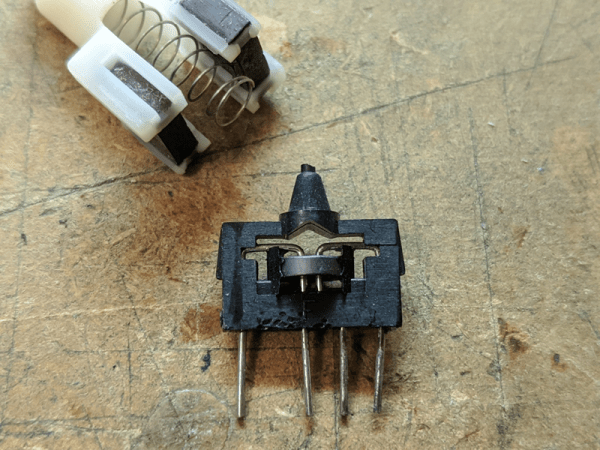
We don’t know why [TubeTime] decided to show off this oddball keyboard switch as a series of Twitter posts, but we were glad to see them somewhere. At first, the switch looks pretty conventional. But as the pictures reveal the insides, you’ll notice something unusual: a ferrite toroid! These switches operate as a transformer and are known as magnetic valve switches.

The switches have two sets of two pins — one set for the primary and one for the secondary of the transformer wound around the ferrite core. That transformer remains stationary, but a pair of permanent magnets move. When the key is up, the magnets are close to the core and cause the transformer to saturate, so there is little or no output at the secondary. When you depress the key, the magnet moves away from the core, allowing the signal to pass through the transformer. What that means is there is no mechanical contact, which is good for switch life. It is also important in environments where a small spark could cause an explosion. You can watch a video about a keyboard that used those switches, below.

Continue reading “Keyboard Switch Is Really A Transformer”

60’s Natural Gas Pipeline Computer Retires To Play Games

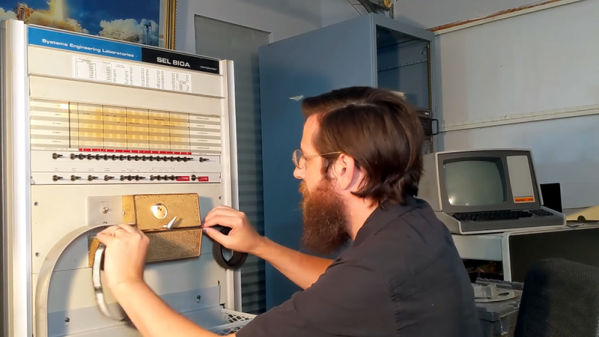
Computer gaming has come a very long way since the 1960s. While computers of that era may not run Doom or anything even close to it, many of us had our first exposure to computers playing Hunt the Wumpus, Adventure, or Star Trek over a clackety old TeleType machine. If you missed those days, or if you simply miss them, you might enjoy the video from [somecomputerguy] who fires up an old retired gas pipeline computer and loads enough paper tape into it to play Lunar Lander. (Video embedded below.)

We don’t miss the days of toggling in a bootloader so you could load the paper tape for a second bootloader before you could enter the actual program you wanted to run.

Continue reading “60’s Natural Gas Pipeline Computer Retires To Play Games”

EDSAC Lives In MiSTer

There’s a lot of argument over which was the first modern computer to be built. There’s room for debate, but EDSAC — the work of Dr. Maurice Wilkes — certainly was among the first. While we’ve seen simulators before, [hrvach’s] FPGA-based simulator for the MiSTer platform has a lot going for it. Check out the video, below.

So much of what we take for granted today was first developed on the EDSAC. For example, the “Wheeler jump” (named after graduate student David Wheeler) was the origin of the idea of a subroutine.

Continue reading “EDSAC Lives In MiSTer”

Docking With ISS Isn’t As Easy As You Might Think

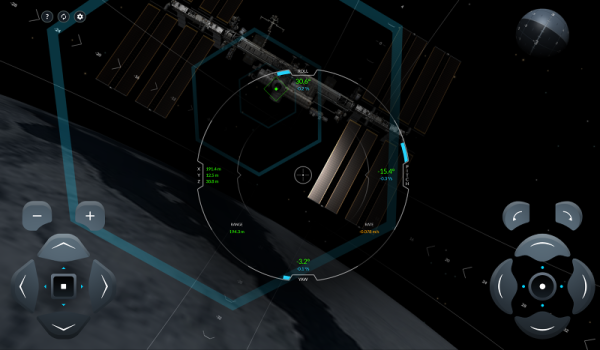
Complexity is a funny thing. In prehistoric times, a caveman might float across a lake on a log. That’s simple. But as you add a rudder, a sail, or even a motor, it gets more and more complex. But if you add enough complexity — a GPS and an autopilot, for example, it becomes simple again. The SpaceX Dragon capsule actually docks itself to the ISS. However, the crew on the station can take over manually if they need to. What would that be like? Try the simulation and find out. If you don’t make it on the first, try, [Scott Manley’s] video below might help you out.

This isn’t a flashy Star Wars-style simulator. Think more 2001. Movement is slow and it is easy to get out of control. The user interface is decidedly modern compared to the old Apollo era

Continue reading “Docking With ISS Isn’t As Easy As You Might Think”