From The MacGyver Files: Using A Stepper Motor As An Encoder

It isn’t hard to imagine a scenario where you are stuck at home all day with nothing to do and certain items are in short supply. Sure, bathroom tissue gets all the press, but try buying some flour or a freezer and see how far you get. Plus online shopping has given up on next day delivery for the duration. Not hard to imagine at all. Now suppose your latest self-quarantine project needs a rotary shaft encoder. Not having one, what do you do? If you are [Tech Build] you go all MacGyver on an old printer and pull out a stepper motor.

How does a stepper motor turn into an encoder? Well, that’s the MacGyver part. We are not big fans of the physical circuit diagrams, but it looks like [Tech Build] borrowed (with credit) from an earlier post and that one has a proper schematic.

Continue reading “From The MacGyver Files: Using A Stepper Motor As An Encoder”
Learn PDP-11 Assembly For Fun But Probably No Profit

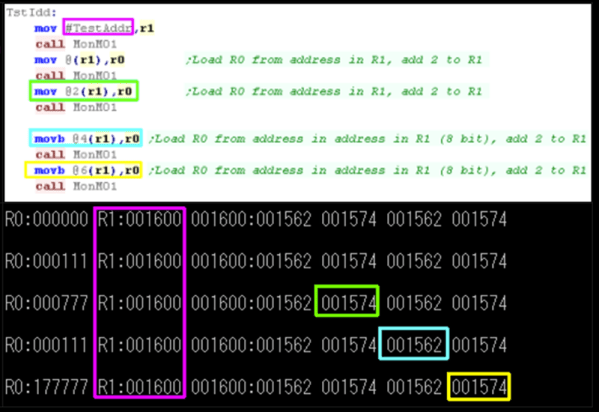
Learning a new skill is fun, especially one that could land you a new job. We don’t think you’ll find too much demand for PDP-11 assembly language programmers, but if it still interests you, check out [ChibiAkumas’s] video that starts a series on that subject for “absolute beginners.”

The PDP-11 is a venerable computer, but you can still find simulators ranging from SIMH to browser-based virtual devices with front panels. If you want real hardware, there is a PDP-11 on a chip that is still around (or you can score the real chips, sometimes) and there are some nice hardware simulations, too.

Continue reading “Learn PDP-11 Assembly For Fun But Probably No Profit”

Linux Fu: Tracing System Calls

One of the nice things about Linux and similar operating systems is that you can investigate something to any level you wish. If a program has a problem you can decompile it, debug it, trace it, and — if necessary — even dig into the source code for the kernel and most of the libraries the program is probably using. However, the tools to do this aren’t ones you use every day. One very interesting tool is strace. Using it you can see what system calls any program makes and that can sometimes give you important clues about how the program works or, probably more often, why it doesn’t work.

Let’s consider the least complex use of the command. Suppose you want to make symlink from testxmit.grc to the /tmp directory. That command is simple:

ln -sf testxmit.grc /tmp

But if you tell strace to run it, the command becomes:

strace ln -sf testxmit.grc /tmp

You might want to redirect the output to a file using the shell or the -o option, though. Some commands generate a lot and often the first page or two of output isn’t really what you care about anyway. Continue reading “Linux Fu: Tracing System Calls”

Real Engineering Behind Ventilators

Experts on cognition tell us that most people think they know more than they really do. One particular indicator for that is if someone is an expert in one field and they feel like all other fields relate to theirs (everything boils down to math or chemistry or physics, for example). This causes them to be overconfident on things they don’t actually know about. When it became clear that the current virus crisis might lead to a shortage of ventilators, many electronic experts set about to design low-cost easy to replicate ventilators. How hard is it, after all, to squeeze a bag once every few seconds? But it turns out, there are a lot of details you need to know to do it right. [Real Engineering] and [Real Science] joined to create an excellent video that covers a lot of what you need to know. You can see the video below. The video shows a few designs that — while motivated by altruism — would probably do more harm than good if used on real patients.

The video’s creator is a biomedical engineer who worked in the past for Medtronic — a maker of ventilators who, by the way, recently open-sourced one of their designs. They also had [Dr. Rohin Francis], who has a medical YouTube channel, fact check the video. and provide some on-screen background We learned a few new medical terms and found that a high-end ventilator made in one factory gets built at about 225 per week. They think they can increase to 500.

Continue reading “Real Engineering Behind Ventilators”

Compiling C To PowerPoint

If you have worked for a large company — or even a small one — it might seem that you spend more time writing PowerPoint charts than programming. [Tom Widenhain’s] video asks the question: Can we compile C into PowerPoint? Watch the video below to find out the answer. Would it surprise you to know that [Tom] wanted to simulate the x86? It surprised us, too, and we had to note the video appeared on April 1. It does look workable, though, other than it is a bit unwieldy.

Instead of a Turing machine, this builds a set of clever logic gates. Unsurprisingly, [Tom] is the guy who put together a Turing machine in Excel. Surprisingly, he isn’t the first one to attempt a C to PPT compiler. The University of Chicago had a similar idea over a year ago, based on [Tom’s] earlier work and executed program using inefficient Turing machines.

Continue reading “Compiling C To PowerPoint”

Making An Arduino Ventilator? Read This First

Thanks to the virus crisis, lots of people are designing makeshift ventilator designs in the hopes of saving people’s lives. Many of these are based around some sort of Arduino-powered CPU. [Armstrong Subero] things that’s a great idea, but cautions that making an electronic pair of dice is a different proposition than creating a machine to breathe for someone. But he isn’t just complaining. He talks about considerations when building a real-time and safety-critical system.

[Armstrong] has a lot of good points, although we aren’t sure you need the complexity of a real-time operating system just to squeeze a bag. If anything, that seems like it might make it more susceptible to unexpected operation. However, we agree with his comments that you should have closed-loop control to make sure the device is working, alarming when the device isn’t working, and watchdog timers to guard against lockup.

Continue reading “Making An Arduino Ventilator? Read This First”

NeoPixel Matrix Simulation Lets You Virtually Groove To The Lights

You are stuck at home quarantined and you want to do some Arduino projects. The problem is you don’t have all the cool devices you want to use. Sure, you can order them, but the stores are slow shipping things that aren’t essential these days. If you want to get a headstart while you are waiting for the postman, check out Wokwi’s Playground. For example, you can write code to drive a virtual NeoPixel 16×16 matrix. There’s even example code to get you started.

There are quite a few other choices in the playground including Charlieplexed LEDs, a keypad, and an LCD. There are also challenges. For example, in the traffic light challenge, you are given code that uses a task scheduler library to implement a traffic light. You have to add a turn signal to the code.

In addition to LEDs in various configurations, the site has some serial bus components, an LCD, a keypad, and a NeoPixel strip. There are also a few tools including an EasyEDA to KiCad converter and a way to share sourcecode similar to Pastebin.

Of course, simulations only get you so far, but the site is a fun way to play with some different I/O devices. It would be very nice if you could compose for the different components together, but you could work your code in sections, if necessary. You can do similar things with TinkerCad circuits. If you want to install software, there’s a simulator for you, too.