Endless Electronic Problems For Solving

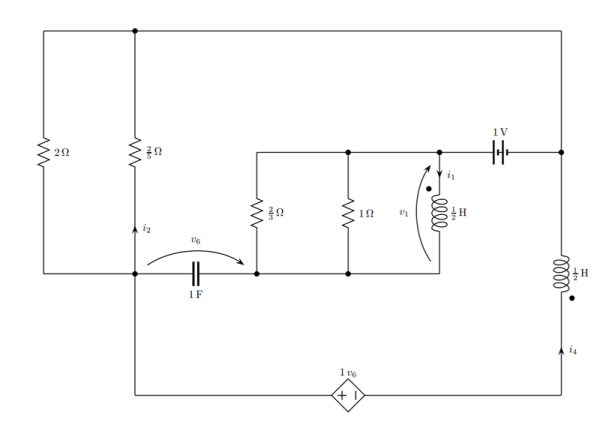
We know not everyone who likes to build circuitry wants to dive headfirst into the underlying electrical engineering that makes everything work. However, if you want to, now is a great time. Many universities have most or all of their material online and you can even take many courses for free. If you want an endless pool of solved study problems, check out autoCircuits. It can create many different kinds of electronics problems and their solutions.

You can get a totally random circuit, or choose if you want to focus on DC, AC, two-ports, or several other types of problems. You can also alter the general form of the problem. For example, for a DC analysis, you can have it assign circuit values so that the answer is a value such as 45 ohms, or you can have it just use symbols so that the answer might be i4=V1/4R. You even get to pick the difficulty level and pick certain types of problems to avoid. Just be fast. After the site generates a problem, you have 10 seconds to download it before it is gone forever.

Continue reading “Endless Electronic Problems For Solving”

Coffee Makes 3D Printing Better

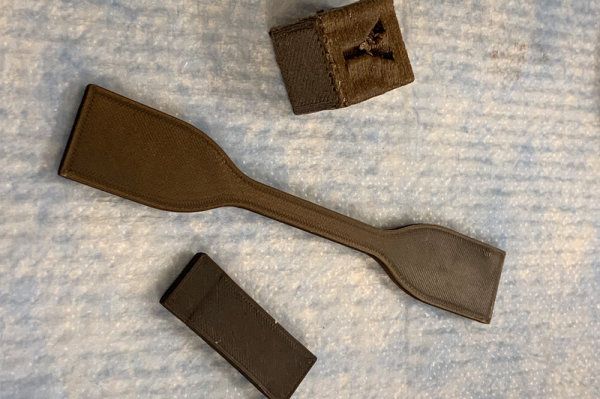
While we know some 3D printer operators who need coffee, Washington State University is showing an improved PLA material that incorporates used coffee waste. Regular PLA is not known for being especially strong, though It isn’t uncommon for vendors to add things to their PLA to change its characteristics.

The new material containing about 20% coffee waste showed an over 400% increase in toughness (25.24 MJ/m3) versus standard PLA. Why coffee waste? We aren’t sure. They didn’t add grounds, but rather a dry and odorless material left over after coffee grounds are processed for biodiesel production.

Continue reading “Coffee Makes 3D Printing Better”

Linux Fu: Python GUIs For Command Line Programs (Almost) Instantly

Not every programmer likes creating GUI code. Most hacker types don’t mind a command line interface, but very few ordinary users appreciate them. However, if you write command line programs in Python, Gooey can help. By leveraging some Python features and a common Python idiom, you can convert a command line program into a GUI with very little effort.

The idea is pretty simple. Nearly all command line Python programs use argparse to simplify picking options and arguments off the command line as well as providing some help. The Gooey decorator picks up all your options and arguments and creates a GUI for it. You can make it more complicated if you want to change specific things, but if you are happy with the defaults, there’s not much else to it.

At first, this article might seem like a Python Fu and not a Linux Fu, since — at first — we are going to focus on Python. But just stand by and you’ll see how this can do a lot of things on many operating systems, including Linux.

Continue reading “Linux Fu: Python GUIs For Command Line Programs (Almost) Instantly”

Hacking Broken Plastic Parts Without A 3D Printer

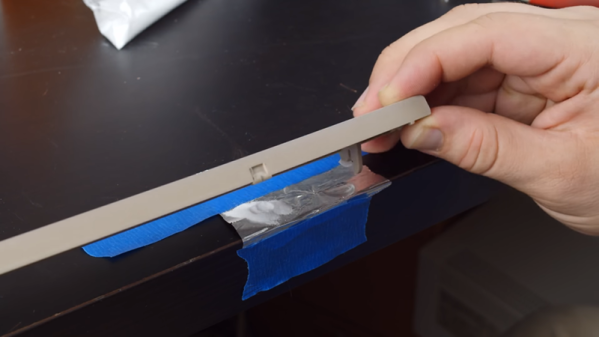
We’ve all encountered the odd plastic part that is broken and unobtainable. Sure, 3D printers can print big replacement parts, but sometimes you just need to rebuild a very specific piece. [AkBkukU] shows off a technique for doing just that using a process you could almost call manual 3D printing. We’ve seen baking soda used to cure cyanoacrylate glue before, but this technique uses it to build layers of glue that are apparently quite solid.

There’s quite a bit of nuance in the video below, but the basic idea is to put a pile of soda on one side of a piece of tin foil and a glob of glue. You dip the part in glue and then into the soda. Each time you get a little thicker layer of glue.

Afterward, you’ll have to file and otherwise shape the new part, but the fact that it can survive being filed should tell you something. We were reminded of how some people use epoxy to form repair parts and then machine them to the exact shape needed. At the very end of the video he builds up layers on a part he can’t dip. Did it work? Watch it and see.

In addition to the manual 3D printing technique, he demonstrates using baking soda to cure repairs on a knurled knob from an old clock radio. That’s a bit more conventional, but if you haven’t seen it done before, it is nearly miraculous.

Glue is amazing. We’ve seen hot glue do injection molding. There are many more types out there, too.

Continue reading “Hacking Broken Plastic Parts Without A 3D Printer”

Flying Batteries For Drones

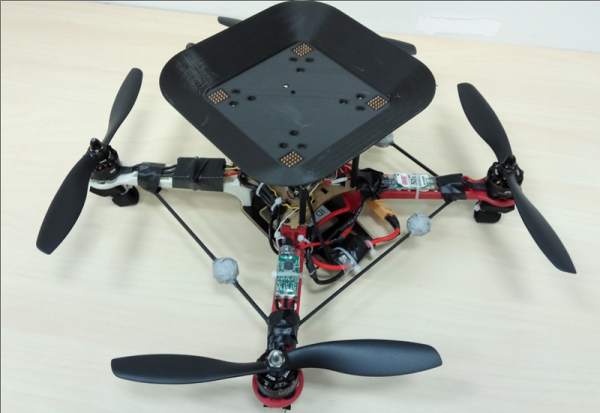
Power is the bane of drone pilots. You’d like to fly longer which means a bigger battery. But a bigger battery will weigh more which leads to less flight time. You have to strike a balance and for most consumer drones that balance is about 20 minutes of flight time, more or less. Researchers at Berkeley have a different idea: don’t use a bigger battery, but simply replace the battery in flight.

The idea isn’t completely new. After all, many planes refuel in flight — a technically sophisticated operation, but it occurs every day. The scheme here is to have a primary battery and a secondary battery. When the secondary battery is low, the drone ejects it while running on the primary battery. Another secondary battery flies to the drone and docks with it becoming the new main power source.

Continue reading “Flying Batteries For Drones”

Fast Video Covers Coax Velocity Factor

We once saw an interview test for C programmers that showed a structure with a few integer, floating point, and pointer fields. The question: How big is this structure? The correct answer was either “It depends,” or “sizeof(struct x).” The same could be said of the question “What is the speed of light?” The flip answer is 186,282 miles per second, or 299,792,458 metres per second. However, a better answer is “It depends on what it is traveling in.” [KB9VBR] discusses how different transmission lines have different velocity factors and what that means when making RF measurements. A cable with a 0.6 velocity factor sees radio signals move at 60% of that 186,282 number.

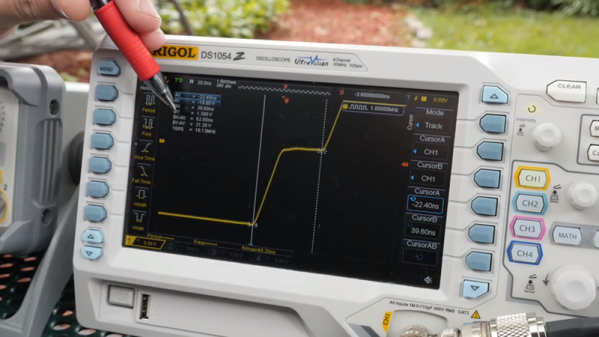
This might seem like pedantry, but the velocity factor makes a difference because it changes the actual measurements of such things as dipole legs and coax stubs. The guys make a makeshift time domain reflectometer using a signal generator and an oscilloscope.

Continue reading “Fast Video Covers Coax Velocity Factor”

CPU Showdown For Pancakes

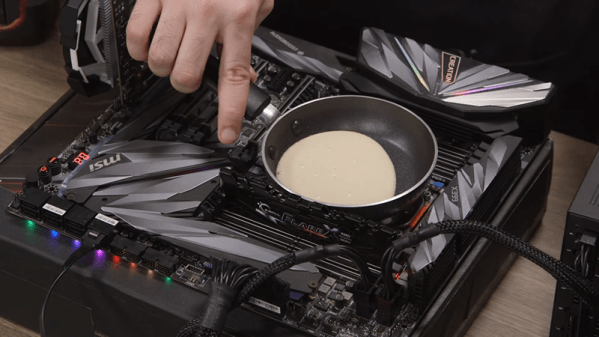
If you ask people how they rate as a driver, most of them will say they are better than average. At first, that seems improbable until you realize one thing: people judge themselves by different criteria. So Sally thinks she’s a good driver because she goes fast. Tom’s never had a wreck. Alice never gets lost. You can see the same effect with CPUs. Some are faster or have more memory bandwidth or more instruction issues per cycle. But [Andrew] and [Scharon] at Tom’s Hardware wanted to do the real test of a CPU. How well can it cook pancakes? If you want to know, see the video below.

While your CPU might be great for playing video games, it has a surprisingly small cooking surface, so the guys needed a very small pan. The pan had grooves in it, so they slathered it with thermal grease. We doubt that’s food-grade grease, either. Continue reading “CPU Showdown For Pancakes”