New Cray Will Reach 1.5 ExaFLOPS

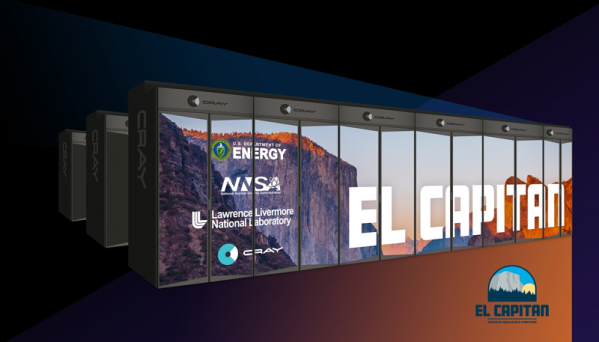
It wasn’t that long ago when hard drives that boasted a terabyte of capacity were novel. But impressive though the tera- prefix is, beyond that is peta and even further is exa — as in petabyte and exabyte. A common i7 CPU currently clocks in at about 60 gigaflops (floating point operations per second). Respectable, but today’s supercomputers routinely turn in sustained rates in the petaflop range, with some even faster. The Department of Energy announced they were turning to Cray to provide three exascale computers — that is, computers that can reach an exaflop or more. The latest of these, El Capitan, is slated to reach 1.5 exaFLOPS and will reside at Lawrence Livermore National Laboratories.

The $600 million price tag for El Capitan seems pretty reasonable for a supercomputer. After all, a Cray I could only do 160 megaflops and cost nearly $8 million in 1977, or about $33 million in today’s money. So about 20 times the cost gets them over 9,000 times the compute power.

Continue reading “New Cray Will Reach 1.5 ExaFLOPS”

Quantum Radar Hides In Plain Sight

Radar was a great invention that made air travel much safer and weather prediction more accurate, indeed it is even credited with winning the Battle of Britain. However, it carries a little problem with it during times of war. Painting a target with radar (or even sonar) is equivalent to standing up and wildly waving a red flag in front of your enemy, which is why for example submarines often run silent and only listen, or why fighter aircraft often rely on guidance from another aircraft. However, researchers in Italy, the UK, the US, and Austria have built a proof-of-concept radar that is very difficult to detect which relies upon quantum entanglement.

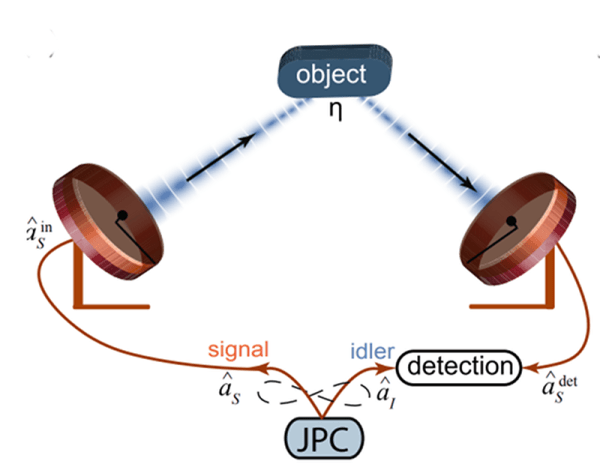
Despite quantum physics being hard to follow, the concept for the radar is pretty easy to understand. First, they generate an entangled pair of microwave photons, a task they perform with a Josephson phase converter. Then they store an “idle” photon while sending the “signal” photon out into the world. Detecting a single photon coming back is prone to noise, but in this case detecting the signal photon disturbs the idle photon and is reasonably easy to detect. It is likely that the entanglement will no longer be intact by the time of the return, but the correlation between the two photons remains detectable.

Continue reading “Quantum Radar Hides In Plain Sight”

Linux Fu: It’s A Trap!

It is easy to think that a Linux shell like Bash is just a way to enter commands at a terminal. But, in fact, it is also a powerful programming language as we’ve seen from projects ranging from web servers to simple utilities to make dangerous commands safer. Like most programming languages, though, there are multiple layers of complexity. You can spend a little time and get by or you can invest more time and learn about the language and, hopefully, write more robust programs.

Continue reading “Linux Fu: It’s A Trap!”

Qt Arrives For Small Computers

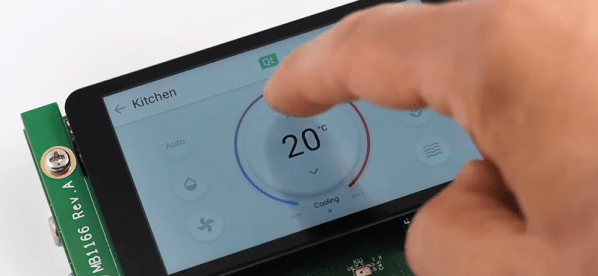
There was a time when writing embedded systems meant never having to deal with graphical user interfaces, and spending long hours trying to free up a dozen bytes of ROM to add a feature. Nowadays, an embedded system is likely to have a screen and what would have been a huge amount of memory even for a PC a scant decade ago. Qt has long been a popular choice for building software on desktop platforms, and — while not as popular — has even run on phones for a while. Now there’s Qt for MCUs which is clearly targeting the IoT market that everyone is trying to capture. You can see the glitzy video for the new product, below.

We generally like Qt, and the move recently has been towards an HTML-like markup language called QML instead of directly manipulating widgets. We guess that’s a good thing. However, Qt isn’t just for user interfaces. It provides a wide range of services in a straightforward way

Continue reading “Qt Arrives For Small Computers”

Largest Chip Ever Holds 1.2 Trillion Transistors

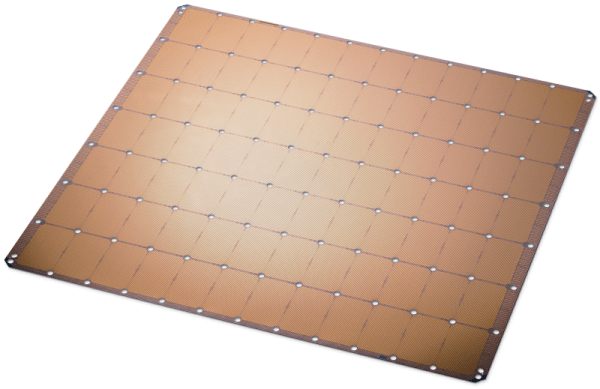
We get it, press releases are full of hyperbole. Cerebras recently announced they’ve built the largest chip ever. The chip has 400,000 cores and contains 1.2 trillion transistors on a die over 46,000 square mm in area. That’s roughly the same as a square about 8.5 inches on each side. But honestly, the WSE — Wafer Scale Engine — is just most of a wafer not cut up. Typically a wafer will have lots of copies of a device on it and it gets split into pieces.

According to the company, the WSE is 56 times larger than the largest GPU on the market. The chip boasts 18 gigabytes of storage spread around the massive die. The problem isn’t making such a beast — although a normal wafer is allowed to have a certain number of bad spots. The real problems come through things such as interconnections and thermal management.

Continue reading “Largest Chip Ever Holds 1.2 Trillion Transistors”

Russian Robot To Visit Space Station

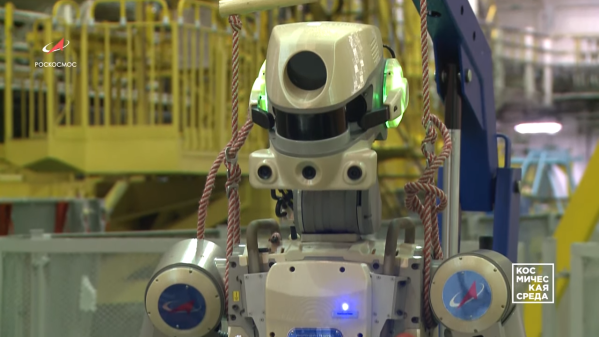
The Russians were the first to send a dog into space, the first to send a man, and the first to send a woman. However, NASA sent the first humanoid robot to the International Space Station. The Russians, though, want to send FEDOR and proclaim that while Robonaut flew as cargo, a FEDOR model — Skybot F-850 — will fly the upcoming MS-14 supply mission as crew.

Defining the term robot can be tricky, with some thinking a proper robot needs to be autonomous and others seeing robotics under human control as enough. The Russian FEDOR robot is — we think — primarily a telepresence device, but it remains an impressive technical achievement. The press release claims that it can balance itself and do other autonomous actions, but it appears that to do anything tricky probably requires an operator. You can see the robot in ground tests at about the one minute mark in the video below.

Continue reading “Russian Robot To Visit Space Station”

Sushi Roll Helps Inspect Your CPU Internals

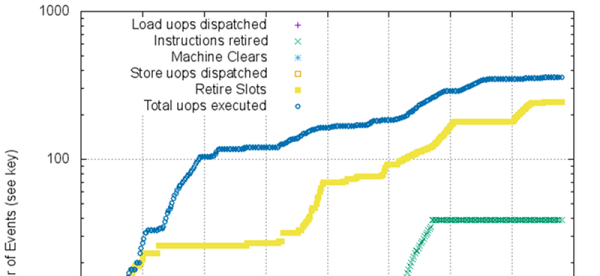
[Gamozolabs’] post about Sushi Roll — a research kernel for monitoring Intel CPU internals — is pretty long. While we were disappointed at the end that the kernel’s source is not exactly available due to “sensitive features”, we were so impressed with the description of the modern x86 architecture and some of the work done with Sushi Roll, that we just had to post it. If the post gets you wanting to actually try some of this, you can check out another [Gamozolabs] creation, Orange Slice.

While you probably know that a modern Intel CPU bears little resemblance to the old 8086 processor it emulates, it is surprising, sometimes, to realize just how far it has gone. The very first thing the CPU does is to break your instruction up into microoperations. The execution engine uses some sophisticated techniques for register renaming and scheduling that allow you to run instructions out of order and to run more than one instruction per clock cycle.

Continue reading “Sushi Roll Helps Inspect Your CPU Internals”