VGA Monitor Becomes Drawing Toy

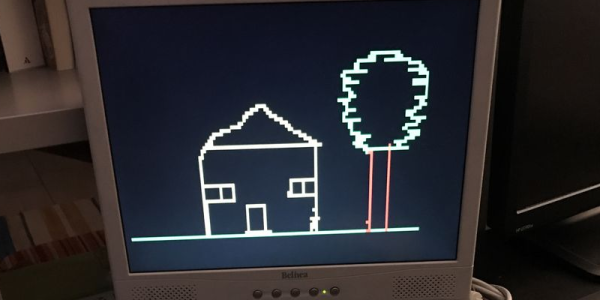
We hate to break it to [Rob Cai], but he’s built a VGA drawing toy, not an Etch-a-Sketch. How do we know? Simple, Etch-a-Sketch is a registered trademark. Regardless, his project shows how an Arduino can drive a VGA monitor using the VGAx library. Sure, you can only do four colors with a 120×60 resolution, but on the other hand, it requires almost no hardware other than the Arduino (you do need four resistors).

The hardware includes two pots and with the right firmware, it can also play pong, if you don’t want to give bent your artistic side. You can see videos of both the art toy and the pong game, below.

Continue reading “VGA Monitor Becomes Drawing Toy”

Sensing A Magnet With Local Sourcing

I had a small project going on–never mind exactly what–and I needed to detect a magnet. Normally, that wouldn’t be a big problem. I have a huge hoard of components and gear to the point that it is a running joke among my friends that we can be talking about building something and I will have all the parts we need. However, lately a lot of my stuff is in… let’s say storage (again, never mind exactly why) and I didn’t have anything handy that would do the job.

Options

If I had time, there are plenty of options for detecting a magnet. Even if you ignore exotic things like SQUID (superconducting quantum interference device) there’s plenty of ways to detect a magnet. One of the oldest and the simplest is to use a reed switch. This is just a switch made with a thin piece of ferrous material. When a magnet is nearby, the thin piece of metal moves and makes or breaks the contact.

These used to be common in alarm systems to detect an open or closed door. However, a trip to Radio Shack revealed that they no longer carry things like that as–apparently–it cuts into floorspace for the cell phones.

I started to think about robbing a sensor from an old computer fan or some other consumer item with a magnetic sensor onboard. I also thought about making some graphene and rolling my own Hall effect sensor, but decided that was too much work.

Browsing

I was about to give up on Radio Shack, but decided to skim through the two cabinets of parts they still carry just to get an idea of what I could and could not expect to find in the future. Then something caught my eye. They still carry a wide selection of relays. (Well, perhaps wide is too kind of a word, but they had a fair number.) It hit me that a relay is a magnetic device, it just generates its own electromagnetic field to open and close the contacts.

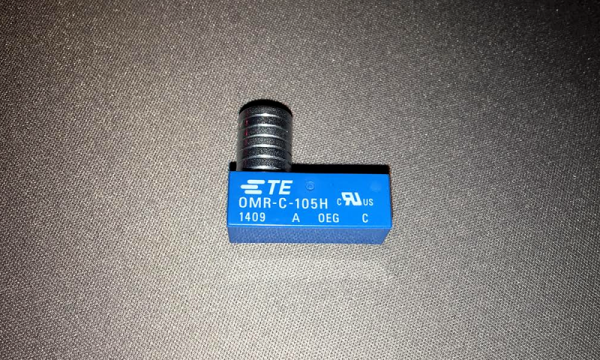
I picked up a small 5 V reed relay. They don’t show it online, but they do have several similar ones, so you can probably pick up something comparable at your local location. I didn’t want to get a very large relay because I figured it would take more external magnetic field to operate the contacts. You have to wonder why they have so many relays, unless they just bought a lot and are still selling out of some warehouse. Not that relays don’t have their use, but there’s plenty of better alternatives for almost any application you can think of.

Continue reading “Sensing A Magnet With Local Sourcing”

Absolute Power

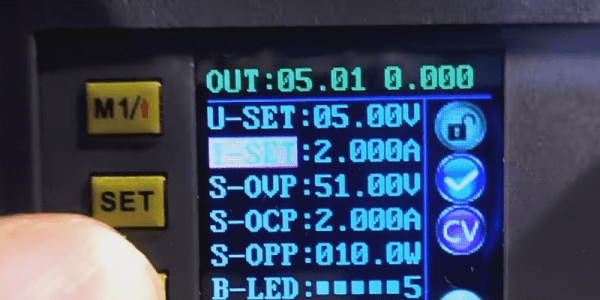
We recently noticed a very cool-looking series of power supply modules on a few of the Chinese deal web sites. Depending on the model, they provide a digitally-controlled voltage with metering. You need to provide at least a volt or so over the maximum desired output voltage. You can see a video from [iforce2d] below. The module in the video is rated for 5A at 50V maximum, but there are other sizes available. For those interested in graphs and numbers [lgyte] did a lot of characterization of these modules.

There was a time when importing goods from far away places was somewhat of an art. Finding suppliers, working out payment, shipping, and customs meant you had to know what you were doing. Today, you just surf the web, find what you want, pay with PayPal, and stuff shows up on your doorstep from all four corners of the globe.

There is one problem, though. We see a lot of cool stuff from China and some of it is excellent, especially for the price. Frankly, though, some of it is junk. It is hard to tell which is which. What’s more is even though in theory you might be able to return something, usually the freight charges make that impractical. So when you get a dud, you are likely to just eat it and chalk it up to experience. So the question is: how good (or bad) or these power supply modules?

Continue reading “Absolute Power”

USB Etch-a-Sketch-Style Mouse Is More Analog Than You’d Think

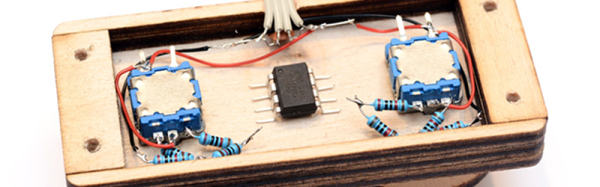
[Mitxela] wanted to build a different kind of mouse, one that worked like an Etch-a-Sketch toy with one X knob and one Y knob. Armed with some rotary encoders and a microcontroller, that shouldn’t be hard. But when you use a pin-limited ATtiny85, you are going to need some tricks.

The encoders put out a two-bit Gray code and close a button when you depress them. Plus you need some pins for the V-USB stack to handle the USB interface. [Mitxela] decided to convert the encoders  to output analog voltages using a simple resistor DAC. That would only require two analog inputs, and another anlaog input could read both switches.

One problem: there still wasn’t quite enough I/O. Of course, with AVRs you can always repurpose the reset pin as an analog pin, but you lose the ability to program the device at low voltage. And naturally, there’s a workaround for this too, allowing you to keep the reset pin and still read its analog value. You just have to make sure that value doesn’t go below about 2.5V so the device stays out of reset. Once that was in place, the rest went easy, as you can see in the video below.

Continue reading “USB Etch-a-Sketch-Style Mouse Is More Analog Than You’d Think”

Assembly Required: Subroutine Calls And The 1K Challenge

The first computer I personally owned had 256 bytes of memory. Bytes. The processor in my mouse and keyboard both have more memory than that. Lots more. Granted, 256 bytes was a bit extreme, but even the embedded systems I was building as part of my job back then generally had a small fraction of the 64K bytes of memory they could address.

Some people are probably glad they don’t have to worry about things like that anymore. Me, I kind of miss it. It was often like a puzzle trying to squeeze ten more bytes out of an EPROM to get a bug fix or a new feature put in. I though with the 1K challenge underway, I might share some of the tricks we used in those days to work around the small memory problems.

Continue reading “Assembly Required: Subroutine Calls And The 1K Challenge”

Hacking A Device That Lives Inside The Matrix

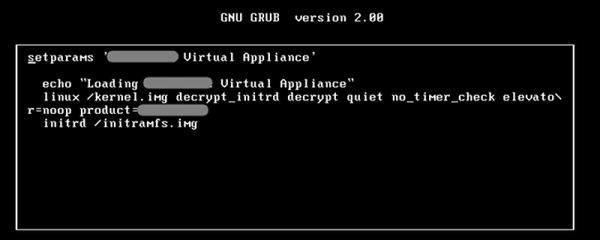
[Gerardo Iglesias Galván] decided he wanted to try his hand at bug-bounty hunting — where companies offer to pay hackers for finding vulnerabilities. Usually, this involves getting a device or accessing a device on the network, attacking it as a black box, and finding a way in. [Gerrado] realized that some vendors now supply virtual images of their appliances for testing, so instead of attacking a device on the network, he put the software in a virtual machine and attempted to gain access to the device. Understanding the steps he took can help you shore up your defenses against criminals, who might be after more than just a manufacturer’s debugging bounty.

Continue reading “Hacking A Device That Lives Inside The Matrix”

Code Like An Egyptian

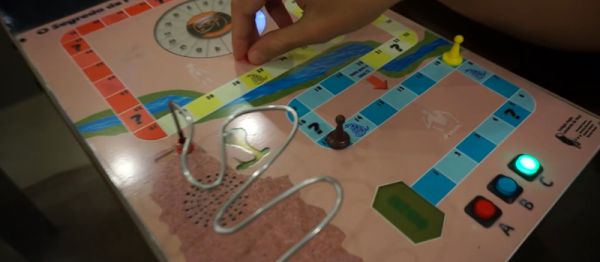
[Marcelo Maximiano’s] son had a school project. He and a team of students built “The Pyramid’s Secret“–an electronic board game using the Arduino Nano. [Marcelo] helped with the electronics, but the result is impressive and a great example of packaging an Arduino project. You can see a video of the game, below.

In addition to the processor, the game uses a WT5001M02 MP3 player (along with an audio amplifier) to produce music and voices. There’s also a rotary encoder, an LCD, a EEPROM (to hold the quiz questions and answers), and an LED driver. There’s also a bunch of LEDs, switches, and a wire maze that requires the player to navigate without bumping into the wire (think 2D Operation).

Continue reading “Code Like An Egyptian”