ESP-Micro Is A Tiny Development Board

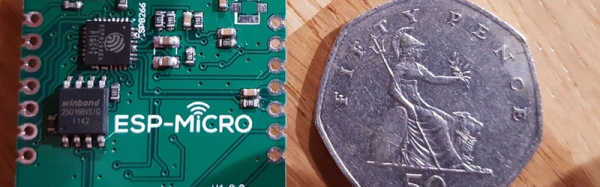
The ESP-8266 packs a lot of networking power into a small package. Some would say too small, which is why they often come on a slightly larger carrier PCB. The PCB is usually little more than a breakout with an optional 3.3V regulator. [Frazer Barnes] went one step further: he put an equally tiny USB to serial bridge, an oscillator, and some power management on an ESP-8266 breakout board.

You can program the ESP-8266 via the serial port, so having a built-in USB port is handy. Of course, you might not need it in the final product, but with the board being 25x30mm, you can probably cram it into most projects. [Frazer] posted a bit about the project on Hackaday.io, and has a GitHub project, although right now the upload of the design files is pending.

There’s no shortage of ESP-8266 projects. We saw a small Zigbee to ESP8266 board last year, and also the antidote for a tiny carrier board that includes an LCD, switches, and more. We also have tons of breakouts on Hackaday.io: here’s one with all the bells and whistles, and a similar, stripped-down version. All open-everything, and ready to go.

Kids And Hacking: Electromagnetic Eggs

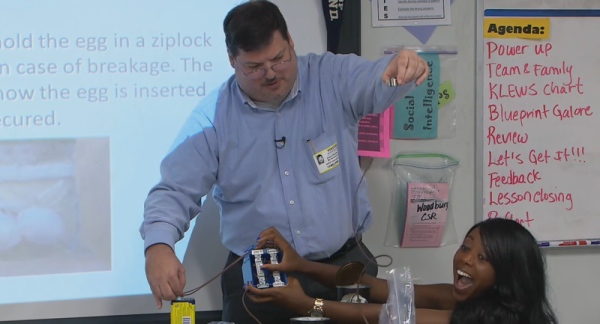
One of my favorite things to do is visit with school kids who are interested in engineering or science. However, realistically, there is a limit to what you can do in a single class that might last 30 to 90 minutes. I recently had the chance to work with a former colleague, a schoolteacher, and The Teaching Channel to create an engineering unit for classroom use that lasts two weeks.

This new unit focuses on an egg drop. That’s not an original idea, but we did add an interesting twist: the project develops a “space capsule” to protect the egg, but also an electromagnetic drop system to test the capsules. The drop system allows for a consistent test with the egg capsule releasing cleanly from a fixed height. So in addition to the classic egg drop capsule, the kids have to build an electromagnet, a safe switching circuit, and a test structure. Better still, teams of kids can do different parts and integrate them into a final product, closely mimicking how real engineering projects work.

There are a few reasons for the complexity. First, given ten class sessions, you can do a lot more than you can in a single day. Second, I always think it is good if you can find exercises that will appeal to lots of different interests. In the past, I’ve used robots and 3D printers for that reason. Some students will be interested in the electronics, others in the mechanics, and still others will be interested in the programming. Some kids will engage in 3D modeling (robot simulation or 3D objects). The point is there is something for everyone.

Continue reading “Kids And Hacking: Electromagnetic Eggs”

Robots And Crickets

If you watch science fiction movies, the robots of the future look like us. The truth is, though, many tasks go better when robots don’t look like us. Sometimes they are unique to a particular job or sometimes it is useful to draw inspiration from something other than a human being. One professor at Johns Hopkins along with some students decided to look at spider crickets as an inspiration for a new breed of jumping robots.

Continue reading “Robots And Crickets”

Solderless Breadboard Parasitics

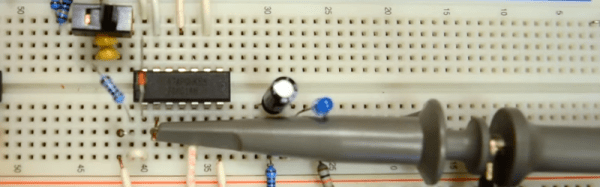
Solderless breadboards are extremely handy. You always hear, of course, that you need to be careful with them at high frequencies and that they can add unwanted capacitance and crosstalk to a circuit. That stands to reason since you have relatively long pieces of metal spaced close together — the very definition of a capacitor.

[Ryan Jensen] did more than just listen to that advice. He built a circuit and used a scope to investigate just how much coupling he could expect with a simple digital circuit. Better still, he also made a video of it (see below). The test setup shows a single gate of a hex Schmitt trigger inverter with a sine wave input. The output transitions ring and also couple back into the input.

Continue reading “Solderless Breadboard Parasitics”

Basically, Its Minecraft

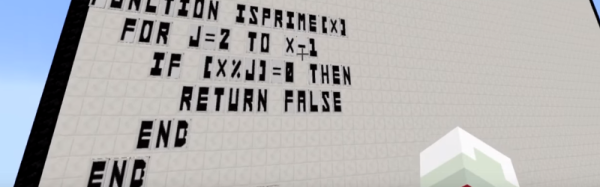
[SethBling] really likes Minecraft. How can you tell? A quick look at his YouTube channel should convince you, especially the one where he built a full-blown BASIC interpreter in Minecraft. It is not going to win any speed races, as you might expect, but it does work.

For novelty and wow factor, this is amazing. As a practical matter, it is hard to imagine the real value since there are plenty of ways a new programmer could get access to BASIC. Still, you have to admire the sheer audacity of making the attempt. One Hackaday poster (who shall remain nameless) once won a case of beer by betting someone he or she could write a BASIC compiler in BASIC, so we aren’t sticklers for practicality.

Continue reading “Basically, Its Minecraft”

Mouse Pen From Old Parts

No offense to [Douglas Engelbart] but the computer mouse has always seemed a bit of a hack to us (and not in the good sense of the word). Sure we’ve all gotten used to them, but unlike a computer keyboard, there is no pre-computer analog to a mouse. There are plenty of alternatives, of course, like touchpads and trackballs, but they never seem to catch on to the extent that the plain old mouse has.

One interesting variation is the pen mouse. These do rely on a pre-computer analog: a pen or pencil. You can buy them already made (and they are surprisingly inexpensive), but what fun is that? [MikB] wanted one and decided to build it instead of buying it.

The main parts of the pen mouse include a cheap mouse with a failing scroll wheel, a bingo pen, and the base from an old web camera. There’s also a normal-sized pen to act as the handpiece. The project is mostly mechanical rather than electrical. [MikB] took the mouse apart and cut the PCB to fit inside the base. The rest of the build is a construction project.

The result appears to work well. [MikB] includes instructions for installing the mouse correctly in Linux. The net effect is like a tablet but doesn’t’ require much space on your desk. We’ve seen plenty of mouse projects in the past, of course. We’ve even seen hacks for a head mouse if that’s your thing.

Continuing Education Via Wheel Balancing

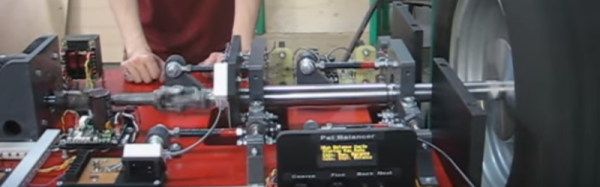
There’s an old saying that you should make things twice. Once to figure out how to build the thing, and again to build it the right way. [Pmbrunelle] must agree. His senior project in college was a machine to balance wheels. It was good enough for him to graduate, but he wanted it to be even better.

The original machine required observation of measurements on an oscilloscope and manual calculations. [Pmbrunelle] added an AVR micro, a better motor drive, and made a host of other improvements. As you can see in the video below, the machine works, but [Pmbrunelle] still wasn’t happy.

Continue reading “Continuing Education Via Wheel Balancing”