Last time, I showed you a simple PWM block and an open source UART core. This time, I’ll put these parts together to create a PC PWM output peripheral.
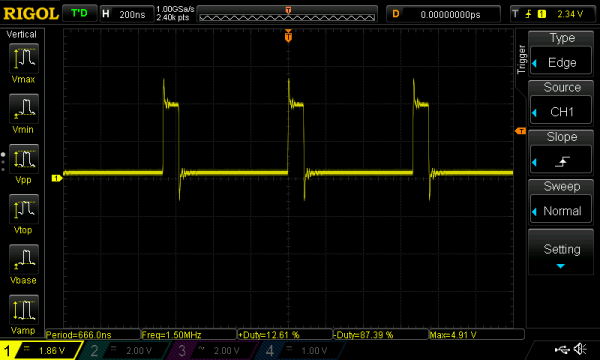
Last time, I showed you a simple PWM block and an open source UART core. This time, I’ll put these parts together to create a PC PWM output peripheral.
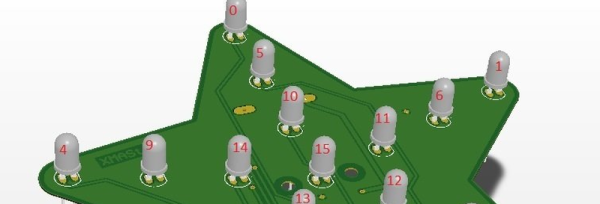
When [hkdcsf] was a teenager, he made a Christmas star with an up counter driving decoder logic and using transistors to light LEDs in festive patterns. He’s revisited this project using modern techniques including a microcontroller, a DC/DC converter, and constant current LED drivers.
The project uses two AA batteries, and that’s what makes the DC/DC converter necessary. Blue LEDs have a forward voltage of just over 3V, and the LED driver chip requires about 0.6V of overhead. Two fresh AAs will run a tad above 3V, but as they discharge, or if he’s using rechargeables, there just won’t be enough potential. To make sure the star works even with whatever LEDs are chosen, the converter takes the nominal 3V from the batteries and converts it to 3.71V.
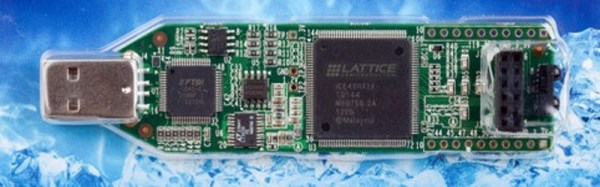
I like to think that there are four different ways people use FPGAs:
I’d bet the majority of FPGA use falls into categories one and two. Some FPGAs even have CPUs already built-in. Even without an onboard CPU, you can usually put a CPU “core” (think reusable library) into the chip. Either way, you can always add other cores to create UARTs, USB, Ethernet, PWM, or whatever other I/O you happen to need. You either connect them to a CPU on the chip, or an external one. With today’s tools, you often pick what you want from a list and then your entire project becomes a software development effort.
Continue reading “Taking The Pulse (Width Modulation) Of An FPGA”
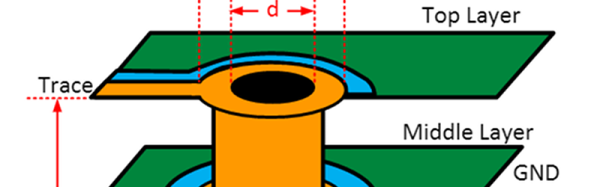
We aren’t sure that a PDF with 100 pages in it qualifies as a pocket reference, but TI’s Analog Engineer’s Pocket Reference is certainly a good read. You do have to register with TI (use a disposable address if you are too paranoid to do that), but the free download is well worth the effort. The document’s been around for awhile, but TI recently released a new 4th edition.
The first few pages might underwhelm you. You probably know the standard decimal prefixes and are more likely to ask Google to convert circular mils to square millimeters, for example. The second part, though, gets more into electronics. There’s standard values for resistors and quick reminders about the difference between X7R and Y5V ceramic in capacitors, for example.
Things get progressively more interesting, covering measurements and phase shifts, and then amplifiers. The little circuits are pithy but cover the bases including things like frequency response.
Continue reading “TI Releases New Edition Analog Engineer’s Pocket Reference”
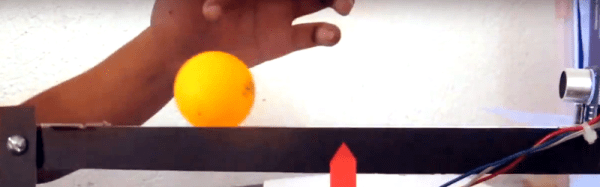
If you have a good sense of balance, you can ride a unicycle or get on TV doing tricks with ladders. We don’t know if [Hanna Yatco] has a good sense of balance or not, but we do know her Arduino does. Her build uses the ubiquitous HC-SR04 SONAR sensor and a servo.
This is a great use for a servo since a standard servo motor without modifications only moves through part of a circle, and that’s all that’s needed for this project. A PID algorithm measures the distance to the ball and raises or lowers a beam to try to get the ball to the center.
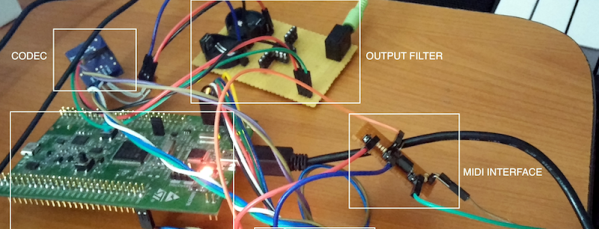
There seems to be a direct correlation between musicians and people who can program. Even programmers who don’t play an instrument often have a profound appreciation of music and so we see quite a few musical projects pop up. [Ihsan Kehribar’s] latest project is a good example. He married an STM32F031 ARM development board, an audio codec, and a simple op amp filter to make a playable MIDI instrument. Of course, it is hard to appreciate a music project from a picture, but if you want to listen to the results, there’s always Soundcloud.
He’d started the project using an 8-bit micro, but ran into some limitations. He switched to an STM32F031, which is a low-end ARM Cortex M0 chip. [Ihsan] mentions that he could have used the DSP instructions built into larger ARM chips, but he wanted to keep the project done on minimal hardware. The audio CODEC chip is from Cirrus Logic (a WM8524), and it produces two output channels at 192 kHz. As an unexpected benefit, the CODEC uses a charge pump to generate a negative voltage (much like a MAX232 does) and [Ihsan] was able to tap that voltage to provide the op-amps in the audio filter with a negative supply rail.
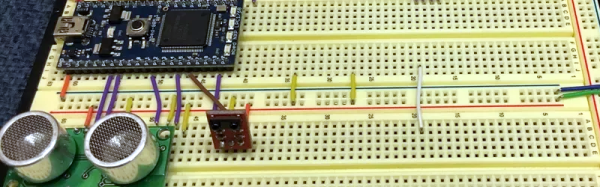
When we wave our hands at the TV, it doesn’t do anything. You can change that, though, with an ARM processor and a handful of sensors. You can see a video of the project in action below. [Samuele Jackson], [Tue Tran], and [Carden Bagwell] used a gesture sensor, a SONAR sensor, an IR LED, and an IR receiver along with an mBed-enabled ARM processor to do the job.
The receiver allows the device to load IR commands from an existing remote so that the gesture remote will work with most setups. The mBed libraries handle communication with the sensors and the universal remote function. It also provides a simple real-time operating system. That leaves just some simple logic in main.cpp, which is under 250 lines of source code.