Robot On Rails For Time Lapse Photography

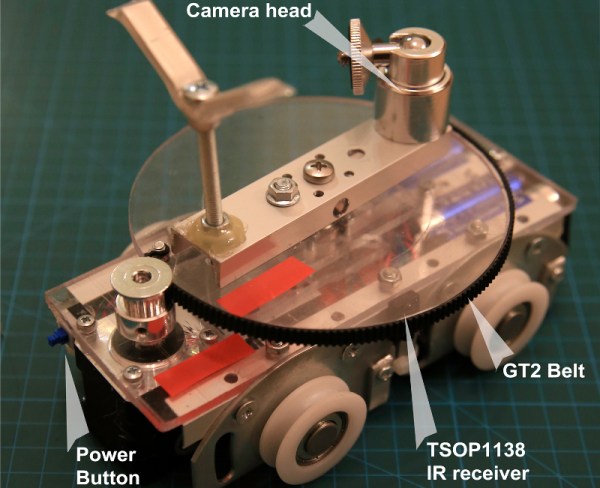
What do you get when you cross a photographer with an Arduino hacker? If the cross in question is [nukevoid], you wind up with a clever camera rail that can smoothly move with both shift and rotation capability. The impressive build uses an Arduino Pro Mini board and two stepper motors. One stepper moves the device on rails using some Delrin pulleys as wheels that roll on an extruded aluminum track. The other stepper rotates the camera platform.

The rotating platform is very cool. It’s a plastic disk with a GT2 motion belt affixed to the edge. The stepper motor has a matching pulley and can rotate the platform easily. The GT2 belt only goes around half of the disk, and presumably the software knows when to stop on either edge based on step counts. There’s even a support to steady the camera’s lens when in operation.

Continue reading “Robot On Rails For Time Lapse Photography”

Clocking (or Overclocking) An AVR

Some guys build hot rods in their garage. Some guys overclock their PCs to ridiculously high clock frequencies (ahem… we might occasionally be guilty of this). [Nerd Ralph] decided to push an ATTiny13a to over twice its rated frequency.

It didn’t seem very difficult. [Ralph] used a 44.2 MHz can oscillator and set the device to use an external clock. He tested with a bit-banged UART and it worked as long as he kept the supply voltage at 5V. He also talks about some other ways to hack out an external oscillator to get higher than stock frequencies.

We wouldn’t suggest depending on an overclock on an important or commercial project. There could be long term effects or subtle issues. Naturally, you can’t depend on every part working the same at an untested frequency, either. But we’d be really interested in hear how you would test this overclocked chip for adverse effects.

Now, if you are just doing this for sport, a little liquid nitrogen will push your Arduino to 65 MHz (see the video after the break). We’ve covered pushing a 20MHz AVR to 30MHz before, but that’s a little less ratio than [Ralph] achieved.

Continue reading “Clocking (or Overclocking) An AVR”

Building A Battery From Molten Salt

During World War II a scientist named Georg Otto Erb developed the molten salt battery for use in military applications. The war ended before Erb’s batteries found any real use, but British Intelligence wrote a report about the technology and the United States adopted the technology for artillery fuses.

Molten salt batteries have two main advantages. First, you can store them for a long time (50 years or more) with no problems. Once the salt melts (usually from a pyrotechnic charge), the battery can produce a lot of energy for a relatively short period of time thanks to the high ionic conductivity of the electrolyte (about three times that of sulfuric acid).

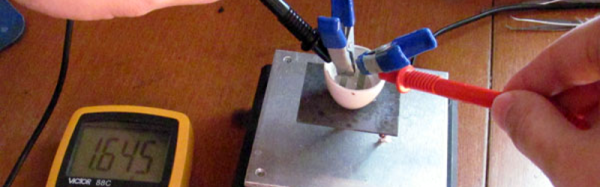
[OrbitalDesigns] couldn’t find a DIY version of a molten salt battery so he decided to make one himself. Although he didn’t get the amount of power you’d find in a commercial design, it did provide 1.6V and enough power to light an LED.

The electrolyte was a mixture of potassium chloride and lithium chloride and melts at about 350 to 400 degrees Celsius. He used nickel and magnesium for electrodes. Potassium chloride is used as a salt substitute, so it isn’t dangerous to handle (at least, no more dangerous than anything else heated to 400 degrees Celsius). The lithium compound, however, is slightly toxic (even though it was briefly sold as a salt substitute, also). If you try to replicate the battery, be sure you read the MSDS for all the materials.

Continue reading “Building A Battery From Molten Salt”

Virtual Physical Rehab With Kinect

Web sites have figured out that “gamifying” things increases participation. For example, you’ve probably boosted your postings on a forum just to get a senior contributor badge (that isn’t even really a badge, but a picture of one). Now [Yash Soni] has brought the same idea to physical therapy.

[Yash]’s father had to go through boring physical therapy to treat a slipped disk, and it prompted him into developing KinectoTherapy which aims to make therapy more like a video game. They claim it can be used to help many types of patients ranging from stroke victims to those with cerebral palsy.

Patients can see their onscreen avatar duplicate their motions and can provide audio and visual feedback when the player makes a move correctly or incorrectly. Statistical data is also available to the patient’s health care professionals.

Continue reading “Virtual Physical Rehab With Kinect”

3D Printing With 2D Inkscape Projections

If you had a formal drafting class, you probably learned about making orthographic projections–engineering drawings with multiple views (for example, top, front, and right). Even if you didn’t take the class, you’ve probably seen drawings like this where you view a 3D object as a series of 2D views from different angles.

These days, you are more likely to create a 3D model of an object, especially if you are going to 3D print it. After all, the 3D printer software is going to expect a model. When [Nightshade] wanted a laptop stand for his workbench, he started trying to do a 3D model. His final product though, was made by creating two views in Inkscape. They aren’t exactly orthographic projections of the final product, but the idea is similar.

Inkscape is a vector graphics program and generally creates SVG files, although it can also save EPS files. [Nightshade] used pstoedit to convert the EPS output to DXF format. DXF files are still two dimensional, but OpenSCAD can extrude DXF files into 3D shapes.

Just having a 3D shape of one view isn’t sufficient, though. The OpenSCAD script rotates the objects to the correct orientation and intersects them to form the final object. This is different from the usual cases of using Inkscape to trace a scan or generate simple text.

Continue reading “3D Printing With 2D Inkscape Projections”

Homemade High Voltage Caps

Do you happen to have any 15,000 volt capacitors sitting around? [Ludic Science] didn’t so he did the next best thing. He built some.

If you understand the physics behind a capacitor (two parallel conductors separated by a dielectric) you won’t find the build process very surprising. [Ludic] uses transparency film as an insulator and aluminum foil for the conductive plates. Then he wraps them into a tube. He did throw in a few interesting tips about keeping the sheets smooth and how to attach the wires to the foil. The brown paper wrapper reminded us of old caps you might find in an antique radio.

The best part by far, though, was the demonstration of drawing an arc from a high voltage power supply with and without the capacitor in the circuit. As you might expect, playing with a few thousand volts charged into a capacitor requires a certain amount of caution, so be careful!

[Ludic] measured the capacitance value with a standard meter, but it wasn’t clear where the 15,000 volt rating came from. Maybe it was the power supply he used in the video and the capacitor could actually go higher.

Continue reading “Homemade High Voltage Caps”

I Am A Battery: Harvesting Heat Energy

If you get tired of charging batteries, you might be interested in [Hackarobot’s] energy harvesting demo. He uses a peltier device (although he’s really using it as a thermocouple which it is). A 1 farad super capacitor stores energy and an LTC3108 ultra low voltage converter with a 1:100 ratio transformer handles the conversion to a useful voltage.

The truth is, the amount of energy harvested is probably pretty small–he didn’t really characterize it other than to light an LED. In addition, we wondered if a proper thermocouple would work better (some old Russian radios used thermocouples either in fireplaces or kerosene lamps to avoid requiring batteries). Although a Peltier device and a thermocouple both use the Seebeck effect, they are optimized for different purposes. Thermocouples generate voltage from a temperature differential and Peltier modules generate temperature differentials from voltage.

However, as [Hackarobot] points out, the same technique might be useful with other alternate power sources like solar cells or other small generators. The module used has selectable output voltages ranging from 2.35V to 5V.

Continue reading “I Am A Battery: Harvesting Heat Energy”