Building Reaction Wheels With Python And LEGO

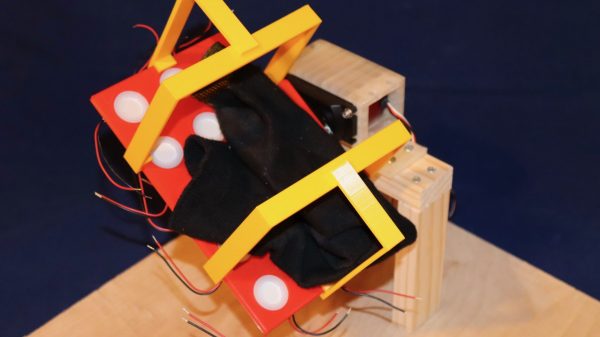
Reaction wheels are useful things, typically used by satellites to keep themselves oriented the right way up in space. Turning the reaction wheel creates an equal and opposite torque in the spacecraft, allowing it to point and rotate itself accurately. The same technique also works here on Earth, and [Brick Experiment Channel] decided to build one out of LEGO to control an inverted pendulum.

The initial design using a small LEGO wheel on an inverted pendulum was only able to work reliably over a 4-degree angle from the vertical. Upgrading the wheel to a larger, heavier one enabled the wheel to instead work over a 28-degree range instead.

A MPU9250 inertial measurement unit was pressed into service for control of the reaction wheel, fitted to the base of the pendulum and read by a Raspberry Pi. The Pi takes accelerometer and gyroscope readings, and then controls the motor on the pendulum with a PID controller to keep the inverted pendulum upright.

The video goes into a great deal of detail on what it takes to make the pendulum run smoothly. From changes to the control coefficients to measuring the motor’s back EMF, [Brick Experiment Channel] demonstrates everything required to make the pendulum robust to outside perturbances.

The inverted pendulum is a great way to learn about control theory, as we’ve seen time and again.

Continue reading “Building Reaction Wheels With Python And LEGO”

Simple Photo Enlarger Makes Great Addition To Any Darkroom

Chemical-based photography can seem like a dark art at times, but it needn’t be so. [Dan K] developed the Simple Enlarger to help spread the idea that classical photographic darkroom tools are fundamentally quite easy to understand and build.

The assembled enlarger.

A photographic enlarger illuminates a negative with light, and focuses this light on a sheet of photographic paper which can then be developed. [Dan’s] enlarger design is intended to be built using materials readily available from any dollar store or stationer’s shop, and can be built in just a few short hours. It’s built to work with a single film format and with a fixed size of photographic paper for simplicity’s sake.

A simple M-mount camera lens is pressed into service for the main optic, with the ex-Soviet part chosen for its easy focusing and cheap price. A small plywood box makes a decent body, and a white phosphor LED provides  the light source. The final rig is designed to print 35mm negatives on to standard 8×10 paper.

If you want to get into developing your own negatives and don’t want to buy a commercial enlarger, [Dan]’s build could be just the way to go. We’ve seen some other similar builds before, too. Meanwhile, if you’ve got your own nifty darkroom hacks, be sure to drop us a line!

2022 Sci-Fi Contest: Multi-Sensor Measurement System

Many sci-fi movies and TV shows feature hand-held devices capable of sensing all manner of wonderful things. The µ Spec Mk II from [j] is built very much in that vein, packing plenty of functionality into a handy palm-sized form factor. 

An ESP32 serves as the brains of the device, hooked up to a 480×320 resolution touchscreen display. On board is a thermal camera, with 32×24 pixel resolution from an MLX90640 sensor. There’s also a 8×8 LIDAR sensor, too, and a spectral sensor that can capture all manner of interesting information about incoming light sources. This can also be used to determine the transmission coefficient or reflection coefficient of materials, if that’s something you desire. A MEMS microphone is also onboard for capturing auditory data. As a bonus, it can draw a Mandelbrot set too, just for the fun of it.

Future plans involve adding an SD card so that data captured can be stored in CSV format, as well as expanding the sensor package onboard. It’s a project that reminds us of some of the tricorder builds we’ve seen over the years. Video after the break.

Continue reading “2022 Sci-Fi Contest: Multi-Sensor Measurement System”

Modern Wildfires And Their Effect On The Ozone Layer

The ozone layer is a precious thing, helping protect the Earth from the harshest of the sun’s radiative output. If anything were to damage this layer, we’d all feel the results in a very short order indeed.

In the past, humanity has worked to limit damage to the ozone layer from our own intentional actions. However, it’s not just aerosol cans and damaged air conditioning systems that are putting it at risk these days. The fierce wildfires we’ve seen so much of in recent years are also having a negative effect. Let’s take a look at why the ozone layer matters, and how it’s being affected by these wildfires.

Continue reading “Modern Wildfires And Their Effect On The Ozone Layer”

Hand-Built Metal Mouse Is Beautifully Engraved

Computer mice, like computers themselves, used to be built almost solely in hideous beige designs. These days, things are a bit more stylish, but they’re still largely following a simple plastic formula. [Uri Tuchman] decided to build a fancy metal engraved computer mouse for a little more style on the desktop.

The build starts by gutting a simple three-button scroll mouse, as there’s really no sense in reinventing the wheel where the electronics is concerned. The PCB inside is pulled out and assembled on a brass baseplate, along with standoffs and supports for the mouse wheel as needed. It’s paired with a hefty brass enclosure with a nice gentle slope to sit well in the hand. Or, as well as it can, given the square  metal edges of the finished product.

The build is full of fun details, like [Uri] trying to form a hex shaft by hand, and the work that goes into the engraving is similarly impressive. In any case, it’s a build that would pair wonderfully with a proper steampunk keyboard. Alternatively, if you hate the idea of having to do all that engraving by hand, think about building your own CNC machine. Video after the break.

Continue reading “Hand-Built Metal Mouse Is Beautifully Engraved”

Lofipi Keeps The Chill Beats Coming

These days, many people love having some lo-fi beats on when they chill and study. This has led to a cottage industry dedicated to producing said beats, and the format continues to grow in popularity. [Nicholas Sherlock] decided to build a custom audio device solely for the delivery of these comfortable tunes.

As seen on Reddit, the build relies on a Raspberry Pi 3B, paired with an X400 audio amplifier board and hooked up to a nicely-sized mid-range speaker. The hardware is assembled inside a case printed out of wood-effect PLA filament, giving it a nice old-school home audio aesthetic. As a bonus, the layer lines line up in such a way as to boost the woodgrain effect. Plug it in, and you will be immediately rewarded with lo-fi beats from boot.

Originally, the system ran a port of the code from lofigenerator.com, which algorithmically creates lo-fi beats from scratch. However, [Nicholas] could not in good conscience share the ported code, and has retooled the system to stream YouTube playlists using command line media player mpv instead. It’s set to stream typical lo-fi playlists, though could be repurposed to target anything on the platform.

It’s a nice build that really suits the lo-fi beats ideal. When you’re trying to study or focus, you don’t want to be mucking around with a YouTube tab open serving as a distraction. Instead, you can simply flick on the Lofipi, and vibe out.

The Raspberry Pi’s cheap price and great internet and media capabilities make it very popular for builds like these. They go some way to recreating the idea of receiving a broadcast, rather than forcing us into choice as per today’s modern on-demand media paradigm. If you’ve got thoughts on this, drop them in the comments, and if you’ve got your own great projects, do drop us a line.

3D Printed Turbo Pump Hopes To Propel Rockets To The Sky

There are plenty of rocket experimenters toying with various liquid-fueled contraptions at the moment, and [Sciencish] is one of them. He grew tired of using air-pressurized fuel delivery systems in his experiments due to safety reasons, and decided to create something approximating more grown up rocket designs. The result was a 3D-printed turbopump for fuel delivery.

The design is not dissimilar from a turbocharger in a car. On one side, a turbine wheel is turned by compressed air supplied from a tank or compressor. This turbine wheel is affixed to the same axle as an impeller which draws up fuel and pumps it out, ideally into a rocket’s combustion chamber. It’s all made out of resin-printed parts, which made creating the fine geometry of the turbine and impeller a cinch.

Running on compressed air at 80 psi, the turbopump is able to deliver 1.36L of water or rubbing alcohol fuel a minute. However, unfortunately, this first pass design can only deliver 20 psi of fuel pressure, which [Sciencish] suspects will not be enough to counteract combustion chamber pressures in his rocket design. More work is required to up this figure. Paired with a nozzle and ignition source, though, and it does make for some great flames.

Overall though, the safety benefit of this turbopump comes from the fact that the fuel is kept separate from the oxidizer until it reaches the combustion chamber. This comes with far less chance of fire or explosion versus a system that stores fuel pressurized by air.

While the design isn’t yet up to scratch for rocket use, it nonetheless works, and we suspect with some improvement to tolerances and fin design that the project should move along at a quick pace.

If solid rockets are more your thing though, we’ve featured plenty of those too. Video after the break.

Continue reading “3D Printed Turbo Pump Hopes To Propel Rockets To The Sky”