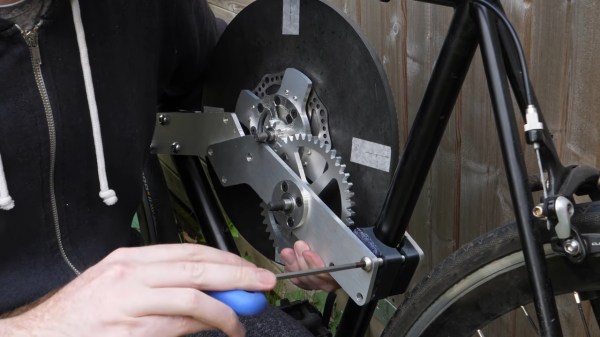
Kinetic energy recovery systems have often been proposed as a useful way to improve the efficiency of on-road vehicles, and even used to great effect in motorsports for added performance. [Tom Stanton] decided to build one of his own, outfitting a simple bicycle with a flywheel system for harvesting energy. (Video, embedded below.)
The system consists of a 300 mm steel flywheel mounted in the center of the bike’s frame. It’s connected to the rear wheel via a chain and a clutch which [Tom] assembled himself using bicycle disc brake components. The clutch is controlled by a handlebar lever, allowing the rider to slow the bike by charging the flywheel, or to charge the flywheel to maximum speed by pedalling hard with the clutch engaged.
The actual utility of the flywheel is minimal; [Tom] notes that even at its peak speed of 2200 RPM, the flywheel stores a small fraction of the energy content of a AA battery. Practical demonstration shows the flywheel is only able to deliver a small push to [Tom] when riding the bike, too.
Despite the lack of performance, it’s nonetheless an interesting project and one that demonstrates the basic principles of flywheel energy storage. The underwhelming results perhaps serve as a solid indication of why it’s not something we use particularly often, on bicycles at least. We’ve seen [Tom]’s bike experiments before, too. Video after the break.
Continue reading “Bicycle Flywheel Stores A Bit Of Energy, Not Much”