Casting Gears At Home

Automatic doors and gates are great, except when they fail, which seems to be about every three days in our experience. [MAD WHEEL] had just such a failure, with a plastic gear being the culprit. Rather than buy a new drive unit, they set about casting a replacement in metal.

The video is light on instructions and heavy on progressive rock, and may be a little difficult to follow for beginners. The process begins by gluing the original plastic part back together, and filling in the gaps with epoxy putty. A mould is then created by setting the gear in a gelatine/glycerine mixture. This mould is then filled with wax to create a wax copy of the original part. The wax gear is fitted with cylindrical stems to act as runners for molten metal, and then a plaster mould is made around the wax positive. Two plaster moulds are made, which are placed in an oven to melt out the wax.

The aim was to cast a replacement part in aluminium. The first attempt failed, with the aluminium cooling too rapidly. This meant fine details like the gear teeth simply didn’t cast properly, creating a useless metal blob. On the second attempt, the plaster mould was heated first, and this kept things hot enough to allow the aluminium to fill in the finer details. With that done, it was a simple matter of some post-processing to remove the runners, clean up the gear teeth and refine the shape of the gear on the lathe.

The resulting part does its job well, meshing properly with the other gears in the drivetrain and moving the gate effectively. Many in the comments have stated that the original gear being plastic was likely as a safety measure, to strip out in the event the gate is jammed. While this may be true, it’s a far more robust design practice to instead use a breakable plastic key rather than breaking an entire gear in the event of a problem.

Casting is quite accessible to the dedicated home maker. It’s a great way to make custom metal parts once you’ve learned the fundamentals! Video after the break.

Continue reading “Casting Gears At Home” →

Vintage Bike Gets Briggs And Stratton Power

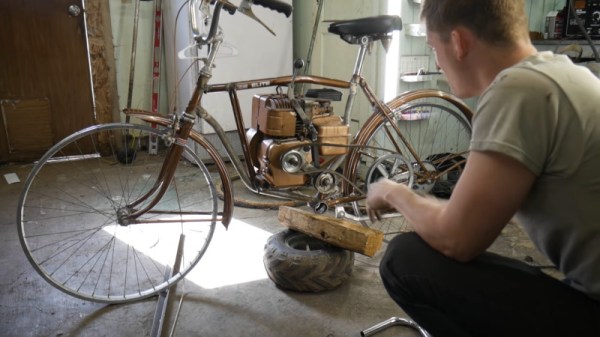
eBay made the process of motorizing a bicycle popular, with cheap engines from China combined with a handful of parts to lace everything together. If your tastes are a little more vintage however, [Oliver]’s build might be more your speed.

Starting with a real Briggs and Stratton liberated from an old rotary tiller, this engine has legitimate vintage credentials. Looking resplendent in brown, it’s paired with a bike in a similar shade from yesteryear. Drive from the engine is transferred by belt to a jackshaft, which then sends power through a chain to the rear wheel. The belt tensioner serves as a rudimentary clutch, allowing the engine to be disconnected from the drivetrain when disengaged.

The retro components, combined with an appropriate color scheme, make this a wonderful cruiser that oozes style. While it’s probably not suited for downtown commuting due to its lack of a real clutch and noise, it would make a great ride for taking in some country roads on a sunny day. We’ve seen similarly styled e-bikes, too. Video after the break.

Continue reading “Vintage Bike Gets Briggs And Stratton Power” →

Brussels Looks Towards Banning Fossil Fuel Transportation As Soon As 2035

Many cities around the world routinely struggle with smog. Apart from being unsightly, heavy air pollution has serious negative health effects, both in the short term and with regards to long-term life expectancy. Over the years, governments have tried to tackle the problem with varied tactics around the world.

When talking about smog, Brussels is not one of the cities that comes first to mind. Regardless, the local government has developed its new climate plan that seeks to abolish fossil fuel vehicles from its streets by 2035. The scheme has a variety of measures that will be staggered over the coming years. It’s part of a broadening trend in transportation, and something we’ll likely see more of around the world in coming years.

What’s The Go?

Brussels is in the process of reducing congestion by converting former roads into pedestrian-only spaces. REUTERS/Eric Vidal

Under the new plan, diesel vehicles will be banned from the city’s Low Emission Zone, or LEZ, by 2030. This will further extend to gasoline vehicles in 2035. Furthermore, special categories of higher polluting vehicles will have bans enforced even earlier. Motorcycles had previously been exempt from the LEZ, but moving forward, the most polluting models will be locked out of the city centre as soon as 2022. The aim is to reduce emissions, with a goal of cutting CO2 output by 40 percent by 2030, and becoming carbon neutral by 2050. The city is also exploring the concept of a Zero Emission Zone, or ZEZ, expanding upon earlier efforts which transformed the Boulevard Anspach from a heavily-trafficked road into a pedestrian-only plaza. Continue reading “Brussels Looks Towards Banning Fossil Fuel Transportation As Soon As 2035” →

Starlink Satellites Posing Issues For Astronomers

Spotting satellites from the ground is a popular pastime among amateur astronomers. Typically, the ISS and Iridium satellites have been common sightings, with their orbits and design causing them to appear sufficiently bright in the sky. More recently, SpaceX’s mass launches of Starlink satellites have been drawing attention for the wrong reasons.

A capture from the Cerro Telolo observatory, showing the many Starlink satellite tracks spoiling the exposure.

Starlink is a project run by SpaceX to provide internet via satellite, using a variety of techniques to keep latency down and bandwidth high. There’s talk of inter-satellite laser communications, autonomous obstacle avoidance, and special designs to limit the amount of space junk created. We’ve covered the technology in a comprehensive post earlier this year.

The Starlink craft have long worried astronomers, who rely on a dark and unobstructed view of the sky to carry out their work. There are now large numbers of the satellites in relatively low orbits, and the craft have a high albedo, meaning they reflect a significant amount of the sunlight that hits them. With the craft also launching in a closely-packed train formation, there have already been impacts on research operations.

There is some hope that as the craft move to higher orbits when they enter service, this problem will be reduced. SpaceX are also reportedly considering modifications to the design to reduce albedo, helping to keep the astronomy community onside. Regardless, with plans on the table to launch anywhere from 12,000 to 42,000 satellites, it’s likely this isn’t the last we’ll hear about the issue.

Advanced Techniques For Realistic Baking Animations

Computer graphics have come a long way since the days of Dire Straits and their first computer animated music video in 1985. To move the state of the art forward has taken the labor of countless artists, developers and technicians. Working in just that field, a group from UCLA have developed an advanced system for simulating baking in computer graphics, and the results look absolutely delicious.

We propose a porous thermo-viscoelastoplastic mixture model.

The work is being presented at SIGGRPAH Asia, and being an academic paper, is dense in arcane terminology. To properly simulate baking, the team had to consider a multitude of interdependent processes. There’s heat transfer to consider, the release of carbon dioxide from leavening agents, the browning of dough due to evaporation of water, and all manner of other complicated chemical and physical interactions.

With a model that takes all of these factors into account, the results are amazingly realistic. The team have shown off renders of cookies in the oven, freshly baked loaves of bread being torn apart, and even muffins full of melted chocolate chips.

We imagine it would have been difficult not to work up an appetite during the research process. We’ve seen impressive work from SIGGRAPH before, like this method for printing photorealistic images on 3D surfaces. Video after the break.

Continue reading “Advanced Techniques For Realistic Baking Animations” →

DIY CNC Router Uses Chains The Right Way

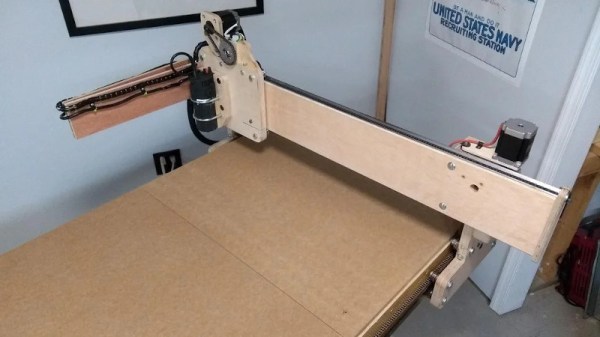
There are a million and one ways to build your own CNC router, depending on your tastes, budget, and application, your design choices will differ accordingly. [Steve Tyng] was well aware of this when undertaking his project, and built the machine that made sense for him.

[Steve’s] build has a strong focus on keeping costs down, and that’s reflected in the hardware used. Wanting a large work area of 30″ x 60″, off-the-shelf linear rails in 6 foot lengths were prohibitively expensive. Instead, 1″ angle iron was sourced from the local garden centre, and used in conjunction with steel v-bearings. It’s a lot cheaper, and good enough for the application at hand, so why not? Other smart choices abound, such as using an IKEA cabinet as the base, and a fanless computer to run the show to avoid death by dust.

When it came time to build the axes, there was plenty of roller chain on hand. Chain is usually passed up for options such as timing belts or ballscrews in the CNC community, as it tends to stretch over time and offers poor accuracy. However, [Steve] took stock of the drawbacks of the method, and made efforts to overcome these weak points in the design. The Y and X axes were specially designed to keep the chain supported along its length. This helped avoid the problem of long drooping chains and poor tension.

While it’s not an industrial-strength build with world-beating accuracy, it’s a solid CNC machine that can carve out large workpieces without issue. Over the years, we’ve seen plenty of DIY CNCs, built with everything from PVC pipe to welded steel. Video after the break.

Continue reading “DIY CNC Router Uses Chains The Right Way” →

A Foolproof Raspberry Pi Media Player

The media landscape in the home has changed precipitously over the years. Back in the days when torrents were king, DVD players and TVs started to sprout USB ports and various methods of playing digital videos, while hackers repurposed office machines and consoles into dedicated media boxes. [Roiy Zysman] is a fan of a clean, no-fuss approach, so built his PiVidBox along those lines.

The build, unsurprisingly, starts with a Raspberry Pi. Cheap, capable of playing most common codecs, and fitted with an HDMI port as standard, it’s a perfect platform for the job. Rather than fiddle with complex interfaces or media apps, instead, the PiVidBox uses a simple script. The Pi is configured to continually scan the /media folder for mounted devices, and play any videos it comes across. Simply pop in an SD card or USB drive, and the content starts rolling. No buttons, remotes, or keyboards needed!

It’s a interface without much flexibility, but it makes up for that in barebones simplicity. We can imagine it would come in handy for a conference room or other situation where users grow tired of messing around with configurations to get screens to work. The Raspberry Pi makes a rather excellent basis for a media player build, and we’ve seen some stunning examples in the past!