A Doom-esque Port To The ATmega328

Doom holds a special place as one of the biggest games of the 1990s, as well as being one of the foundational blocks of the FPS genre. Long before 3D accelerators hit the market, iD Software’s hit was being played on computers worldwide, and later spread to all manner of other platforms. [David Ruiz] decided to build a cutdown version for everyone’s favourite, the ATmega328.

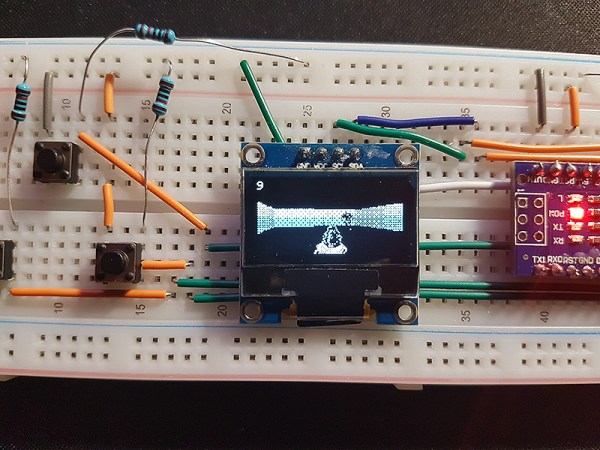
Due to the limited resources available, it’s not a direct port of Doom. [David] instead took some sprites and map data from the original game, and built a raycasting engine similar to that of Wolfenstein 3D. Despite the limited memory and CPU cycles, the basic game can run at between 8-11 FPS. There are fancy dithering tricks to help improve the sense of depth, a simplified enemy AI, and even a custom text library for generating the UI.

It’s a great example of what can be done with a seemingly underpowered part. We’ve seen similar work before, with Star Fox replicated on the Arduboy. A hacker’s ingenuity truly knows no bounds.


 

Electronic Candle Charges Inductively

Humans like things that look like other things. A great example are faux LED tea light candles, with a plastic “flame” and flickering orange LED to recreate the effect of their waxy brethren. [gzumwalt] wanted to take the concept a little further, however, and got down to work.

The design harvests the orange LED and flame lens from an existing LED candle, but the rest is all original. [gzumwalt] printed a full-size candle, and fitted it with inductive charging hardware and a lithium-polymer battery. A corresponding charging base is used to supply power to the candle when it’s not in use. This is all handled automatically, with neodymium magnets used to activate reed switches to turn the charger on and the LED off.

It’s a tidy build that can be easily replicated with a 3D printer and some off-the-shelf parts. It’s also less wasteful than using disposable batteries, and safer than using real candles – so if you find yourself routinely shooting candle scenes in your budget film studio, it might be worth printing up a set of these.

LED candles range from the basic to the extreme – we’ve seen builds so realistic, you can light them with a match.

A Super Tidy School Bus RV Conversion

Many of us have seen an old bus for sale for a tantalizingly low price, and begun thinking about the possibilities. [EpiclyEpicEthan1] is someone who took the next step, bought the bus, and got to work converting it to an RV, with impressive results.

The bus in question is a 2002 International RE3000, which in its former life had helped move school children and barrels of pool chemicals to and fro. The project began, as many do, with a full teardown of the interior. With this done, the floor was treated to remove rust and repainted. Insulation and new plywood boards were then installed, and the fit-out began.

The amount of work involved in the build is immense. There’s a master bedroom, auxiliary bedroom, bathroom, and kitchen area. It’s a fully featured RV in every sense of the word, and yes, there is hot water. There was also significant work done to improve the driving experience, with switches relocated, lights added, and a reversing camera installed for easier parking.

Overall, it’s an impressive project that should serve as great inspiration to anyone wanting to attempt something similar. Then again, if your means are a little more limited, you could always go for a Corolla build.

Building A Foam Machine From A Leaf Blower And A Water Pump

Imagine a tub overflowing with bubble bath, except it’s a club dancefloor and music is pumping all night. This is what is known as a “foam party” — a wild and exciting concept that nonetheless many are yet to experience. The concept exploded in popularity in Ibiza in the 1990s, and foam parties are regularly held at nightclubs and festivals the world over.

Foam is generated with the obviously-named foam machine, and these can be readily purchased or hired for anyone wishing to host such an event. However, that’s not the hacker way. If you’re a little ingenious and take heed of the safety precautions, here’s how you can do it yourself.

Continue reading “Building A Foam Machine From A Leaf Blower And A Water Pump” →

Testing Brushless Motors With A Little Help From The ESC

These days, brushless motors are the go-to for applications requiring high power in a compact package. It’s possible to buy motors in all manner of different configurations off the shelf, and the range available is only getting better. However, sometimes getting something truly optimal requires a bit of customization. With motors, this can involve swapping magnets or hand-winding coils. In these cases, it can be useful to test the modified motor to determine its performance. [JyeSmith]’s ESC tester is capable of just that.

Fundamentally, the ESC tester is a simple piece of hardware. It uses a microcontroller to speak the Dshot protocol. This protocol is typically used to communicate between multi-rotor flight controllers and ESCs. In this case, the Dshot telemetry is instead displayed on a small OLED screen. This enables the user to read off KV values, as well as other useful data such as current draw and RPM. This can help quantify the effects of any modifications made to a motor, as well as prove useful for learning about parts of spurious origins.

It’s a device that should prove useful to those trying to eke out every last drop of performance from their multi-rotor builds. We expect to see more similar projects emerge as drone racing continues to increase in popularity. If you’re still trying to learn the theory behind the technology, you can always build your own brushless motor. Video after the break.

[Thanks to Keegan for the tip!]

Continue reading “Testing Brushless Motors With A Little Help From The ESC” →

LED Matrix Becomes Fun Tetris Clock

Sometimes a project is borne simply out of the fact that some interesting parts have been left sitting around too long. Of course, this is as good a reason to build as any other, and can often lead to some interesting results. [Jorj Bauer]’s Tetris Display is one such project.

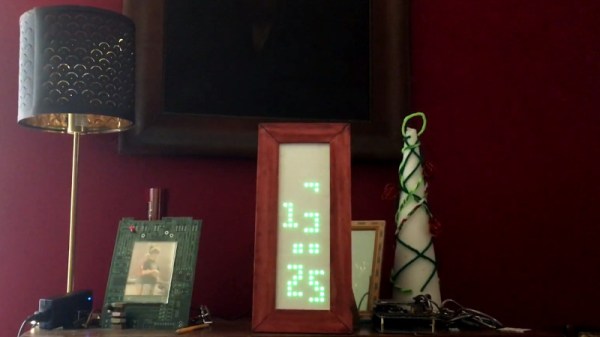
The project started because [Jorj] had an 8 x 32 WS2812 LED array laying about, and it was high time it got turned into something cool. The resulting display has several features, making it a welcome piece around the home. It can act as a clock, with automatic compensation for daylight savings and brightness control depending on the time of day. It can also serve as a text scroller, and of course, the party piece – it can play Tetris. It all runs on an ESP-01, with a second device acting as a remote to control the game.

Rather than simply being another LED matrix project, [Jorj] put a little flair into things. A font was developed that allowed the time to be displayed in a pixel font composed entirely of Tetris pieces (or tetrominos). This allows the time to be displayed by pieces dropping from the top of the display. The Tetris implementation is solid, too – implementing the proper Super Rotation System that professionals would expect.

[Jorj] reports that this build was inspired by an earlier Tetris Clock featured in these very pages. It’s a tidy piece that we’re sure is a great addition to the mantlepiece. Video after the break. Continue reading “LED Matrix Becomes Fun Tetris Clock” →

PackProbe Reports Laptop Battery Health

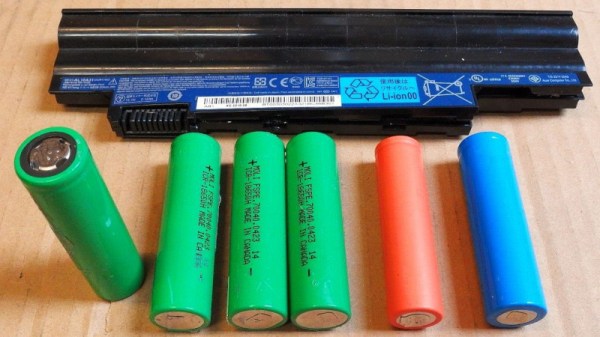
The 18650 cell has become a ubiquitous standard in the lithium battery world. From power drills to early Tesla vehicles, these compact cells power all manner of portable devices. A particularly common use is in laptop batteries, where they’re often built into a pack using the Smart Battery System. This creates a smart battery that can communicate and report on its own status. PackProbe is a software tool built to communicate with these batteries, and you might just find it comes in handy.

The code runs on the WiFi-enabled Arduino Yún by default, but can be easily modified to suit other Arduino platforms. Communicating over SMBus using the Arduino’s I2C hardware, it’s capable of working with the vast majority of laptop batteries out there which comply with the Smart Battery System. With that standard being minted in 1994, it’s spread far and wide these days.

It’s a great way to harvest not only the specifications and manufacturing details of your laptop battery pack, but also to check on the health of the battery. This can give a clear idea over whether the battery is still usable, as well as whether the cells are worth harvesting for those in the recycling business.

You’re not limited to just the Arduino, though. There’s a similar tool available for the ESP8266, too.