Anodizing Aluminium In The Land Of The Queen

Aluminium is a useful material, both for its light weight and resistance to corrosion. This resistance can be improved further with various treatments, one of the more popular being anodizing. This is the process behind the fancy colored metal bling on your cousin’s BMX bike. It’s possible to perform this in the home lab, when taking the appropriate precautions.

[The Recreational Machinist] has been experimenting with anodizing on and off for the last few years, and decided to share their process – as a “what did”, rather than a “how to”. The video is from the perspective of performing this task in the United Kingdom, as the availability of chemicals varies around the world and can affect the viability of various processes involved.

All the relevant techniques are covered, from cathode design to the hardware chosen to give the best results. There’s even discussion of the use of magnetic stirrers to prevent bubble marks, as well as proper cleaning processes to avoid unsightly blemishes from fingerprints or other contaminants. Perhaps the most useful tip provided is that using specific anodizing dyes does give the best results, though it is possible to get by with various types of clothing dye. As always, your mileage may vary.

There’s a big difference between reading theory and seeing the specifics of an actual working process, and [The Recreational Machinist] does a great job of showing off the realities of achieving this at home. We’ve seen it done before, with different chemicals too. Video after the break. Continue reading “Anodizing Aluminium In The Land Of The Queen” →

Building A Vibration Tumbler On The Cheap

There are few tasks quite as laborious as sanding and polishing. Any job that takes a lot of time and elbow grease is a prime candidate for mechanical help, and this one is no exception. At the suggestion of friends, [VegOilGuy] decided it was time to invest in a vibration tumbler. Naturally, building it rather than buying it was the order of the day.

If you’ve ever used an electric sander, you’ll know they’re an excellent source of vibration. Initially, the intention was to build a tumbler with the sander being removable and still usable for its original purpose. A clamping base was constructed with cable ties, wood, and Bondo, but sadly to no avail. The Velcro connection to the plastic tumbler bowl was simply not robust enough to hold up to repeated use.

Instead, the sander was permanently bolted to the tumbler bowl, yielding more positive results. A funnel was then also added to the bowl, to improve media circulation and reduce the amount required. Initial tests were positive, with the tumbler successfully polishing some cast brass parts using crushed walnut shells. [VegOilGuy] is still looking for a more abrasive media to use for initial patina removal, however.

Sometimes the best tools are the ones you build yourself. In this case, it’s a cheap and easy way to get a vibration tumbler and the results are great. If sanders aren’t your speed, why not check out this fan based build instead? Video after the break.

Continue reading “Building A Vibration Tumbler On The Cheap” →

We Were Really Overdue For Laser Jackets

Depending on who you talk to, everything is either fine, or we’re living in an oppressive cyberpunk dystopia in which we forgot to drench everything in colored neon lighting. There’s little to be done about the digital surveillance panopticon that stalks our every move, but as far as the aesthetic goes, [abetusk] is bringing the goods. The latest is a laser jacket, to give you that 2087 look in 2019.

The build starts with a leather jacket, which is festooned with 128 individual red laser diodes. These are ganged up in groups of 4, and controlled with 32 individual PWM channels using two PCA9685 controllers. An Arduino Nano acts as the brains of the operation, receiving input from a joystick and a microphone. This allows the user to control lighting effects and set the jacket to respond to sounds and music.

[abetusk] does a great job of conveying the tricks needed to successfully pull this off. The instructions should allow any curious maker to replicate the build at home, and code is available on Github to help run the show. There’s lots of detail on proper enclosures, connectors, and cabling techniques to avoid the wearer inadvertently pulling everything to bits when wearing the garment to the club. Remember, there’s nothing more punk than educating your friends.

It’s an eye-catching build that would be an excellent addition to any Neo-Chicago street gang wardrobe. It’s not the first time [abetusk] has graced these pages, either – there are electroluminescent looks, too. Video after the break.

Continue reading “We Were Really Overdue For Laser Jackets” →

Fizzle Loop Synth Does It With 555 Timers

For every project that uses an Arduino to make soup or an ESP8266 to hash bitcoin, there’s always someone out there uttering the same old refrain. I could have done it with a 555. More often than not, this is true, even if it is tangential to the discussion being had. In this case however, such a statement is moot. [lonesoulsurfer] has built the Fizzle Loop Synth, featuring not one, but three triple-nickel timers.

It’s a build that delights in both presentation and performance. The hardware is elegantly slotted into a vintage metal flashlight case, which is absolutely covered in controls. It’s an aesthetic that gives us an irresistible urge to start twiddling knobs and flicking switches. Inside, two 555s are set up as basic flasher circuits, each feeding a vactrol – essentially a resistive optoisolater. Inside is an LED, which is optically coupled to a light-dependent resistor. The LEDs are flashed by the 555s, and this creates a varying resistance which is used to feed a third 555 which generates the tones.

The final result is a fun little noisebox that’s capable of generating quite the variety of bleeps, bloops and blops. There’s an onboard speaker for noodling on the go, as well as a line-out if you need to record your work on external hardware. It would be great fun to hear this circuit hooked up to a modular synth, too.

For a history lesson on the venerable 555, we’ve got you covered. Video after the break.

Continue reading “Fizzle Loop Synth Does It With 555 Timers” →

A Zelda Compilation Album On A Cartridge

The Zelda series of games are known for their exciting gameplay, compelling story, but also their soundtracks. From fast-paced boss battles, to scenes of emotional turmoil, these tunes have been pumped out millions of Nintendo consoles over the years. [Tyler Barnes] has been a fan for a long time, and decided to produce a compilation of some of these tracks – delivering it on cartridge, of course.

The music was created using the Music Macro Language, and encoded into the NSF format ready to play on the Nintendo Entertainment System. [Tyler] has coded a menu system that allows the user to pick which tracks they wish to listen to. There’s some pretty parallax animations as well, along with an easter egg for those who know the games well enough to unlock it.

[Tyler] hopes to burn a few EEPROMs and send out some custom carts, either using donor carts or fresh builds. If you’re a fan of NES music but need your C64 fix as well, there’s a solution for that too. Video after the break.

Continue reading “A Zelda Compilation Album On A Cartridge” →

Hiding Messages In Magnets

Magnets have always been fun, particularly since the super-powerful neodymium type became readily available. You can stack them up, pull them apart, or, if you really want, use them for something practical. Now [Adric] has shown us a new use for them entirely – by writing hidden messages on them.

It’s a remarkably simple hack, but ingenious all the same. [Adric] was pretty sure that the Quelab hackerspace laser wasn’t powerful enough to cut or etch a nickel-plated neodymium magnet. However, they suspected it would have just enough power to heat localised parts of the magnet above the Curie temperature, where the magnetic properties of the material break down.

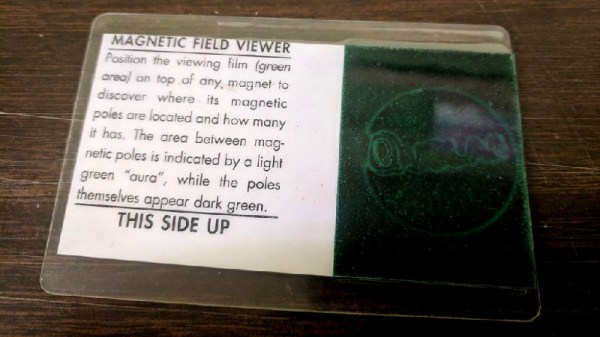
Thus, the laser cutter was set up to run a few passes over some neodymium magnets. By placing a magnetic viewing film over the magnet, it’s possible to make the etched pattern visible. There was also some incidental visible marking of the magnet surface, which [Adric] thinks is due to the tape applied to the magnet before the laser processing.

For those of you operating spy rings in deep cover, you’ve now got a new way to send them secret messages. Just be sure to check in with the local postal service as to their policies regarding giant magnets in the post. Then you can contemplate whether you have the ability to sense magnetic fields.

Arduino Shield Makes Driving Nixies Easy

Nixie tubes are adored by hackers across the world for their warm glow that recalls an age of bitter nuclear standoffs and endless proxy wars. However, they’re not the easiest thing to drive, requiring high voltages that can scare microcontrollers senseless. Thankfully, it’s possible to score an Arduino shield that does the heavy lifting for you.

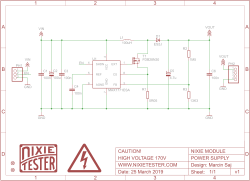
The HV supply is the heart of any Nixie driver.

The shield uses HV5812 drivers to handle the high-voltage side of things, a part more typically used to drive vacuum fluorescent displays. There’s also a DHT22 for temperature and humidity measurements, and a DS3231 real time clock. It’s designed to work with IN-12 and IN-15 tubes, with the part selection depending on whether you’re going for a clock build or a combined thermometer/hygrometer. There’s also an enclosure option available, consisting of two-tone laser etched parts that snap together to give a rather sleek finished look.

For those looking to spin up their own, code is available on Github and schematics are also available. You’ll have to create your own PCB of course, but there are guides that can help you along that path. If you’re looking to whip up a quick Nixie project to get your feet wet, this might just be what you need to get started. Of course, you can always go straight to hard mode, and attempt a functional Nixie watch. Video after the break.

Continue reading “Arduino Shield Makes Driving Nixies Easy” →